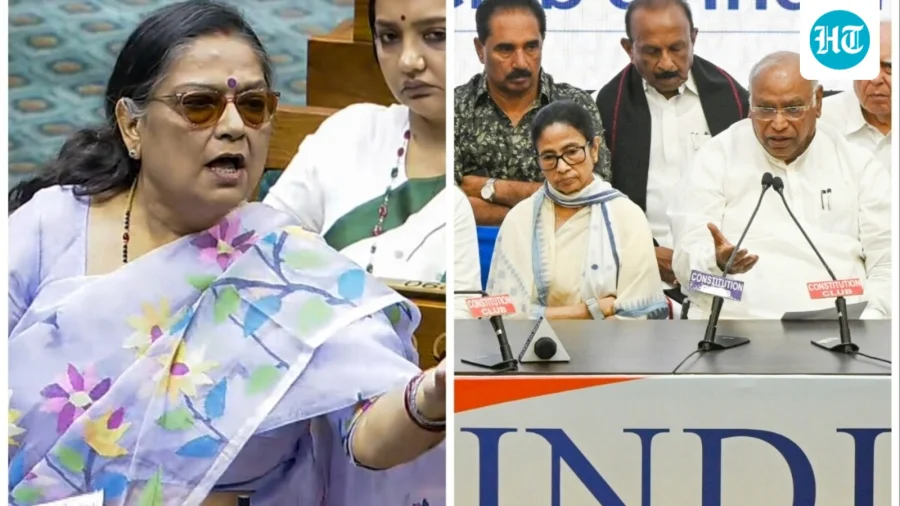
In a stunning blow to Mamata Banerjee’s leadership, TMC MP Kakoli Ghosh Dastidar has declared she will not bow down, even if it costs her everything. “Mera sar katega lekin jhukega nahi,” she said on Monday, as she revealed that she and 19 other rebel MPs have formally requested the Lok Sabha Speaker to recognise them as a separate group backing the NDA.
20 TMC MPs break ranks — what Kakoli Ghosh said
Speaking to reporters, Kakoli Ghosh Dastidar confirmed that a faction of 20 MPs has written to the Lok Sabha Speaker seeking recognition as a distinct bloc that will support the ruling NDA. She cited “lawlessness and unemployment” in West Bengal as the driving reasons behind the move, signalling deep dissatisfaction within the party over governance issues in the state.
Why this revolt matters for Mamata Banerjee
This is not just another rebellion. Twenty MPs walking out of the TMC fold represents the largest internal revolt since the party’s poor showing in the 2024 Lok Sabha elections. For Mamata Banerjee, who has long projected herself as the undisputed leader of Bengal and a key opposition figure nationally, this defection undermines both her parliamentary strength and her political narrative of unity.
Timeline of the internal crisis
The cracks in TMC’s unity have been widening since the 2024 general elections, where the party failed to meet expectations in several key constituencies. Over the past months, multiple MPs have expressed dissatisfaction with the party’s direction, but Monday’s coordinated move by 20 MPs marks a decisive escalation. Kakoli Ghosh, a two-time MP from the Basirhat constituency, has now emerged as the face of the rebellion.
Who is affected — and what it means for Bengal voters
For ordinary Bengalis, this revolt raises questions about the stability of the state government and the future of TMC’s governance model. If the defections continue, Mamata Banerjee could face a crisis of confidence within her own party, potentially impacting policy decisions and the party’s ability to counter the BJP in the state. Voters in constituencies represented by rebel MPs are now watching closely to see whether their representatives will switch sides formally.
TMC leadership’s response — silence so far
As of Monday evening, the TMC high command had not issued an official statement on the development. Party insiders suggest that Mamata Banerjee is assessing the scale of the revolt before deciding on a response. The lack of immediate reaction has only fuelled speculation about the extent of internal dissent within the party.
What is driving the rebellion — analysis
Political analysts point to a combination of factors: dissatisfaction with the party’s electoral strategy, perceived lack of internal democracy, and growing frustration over governance issues in Bengal. Kakoli Ghosh’s reference to “lawlessness and unemployment” echoes criticisms that have been levelled by opposition parties for years. The move also suggests that some TMC MPs see the NDA as a more stable political platform for their own political survival.
Confirmed facts vs what remains unclear
What is confirmed: Kakoli Ghosh Dastidar has publicly stated that 20 MPs have written to the Lok Sabha Speaker seeking recognition as a group supporting the NDA. She has used the phrase “Mera sar katega lekin jhukega nahi” to signal her defiance. What remains unclear: whether all 20 MPs have formally signed the letter, whether the Speaker will accept the request, and whether more TMC MPs are considering similar moves. The TMC leadership has not confirmed or denied the development.
Risks and balanced view
While the rebel faction claims strength, defections in Indian politics are often fluid. Some MPs may reconsider if the TMC leadership offers concessions or if the Speaker’s ruling does not go their way. There is also the risk of legal challenges under the anti-defection law, which could disqualify MPs if the party leadership moves against them. Critics of the rebellion argue that it weakens the opposition’s voice in Parliament and consolidates the NDA’s dominance.
Wider trend — opposition parties facing internal fractures
The TMC revolt is part of a broader pattern where opposition parties across India are grappling with internal dissent after electoral setbacks. From the Congress to regional parties like the DMK and AAP, several parties have seen leaders jump ship to the ruling coalition. This trend reflects the growing pull of the NDA’s political machinery and the challenges faced by opposition parties in retaining their cadre.
What should readers and voters do now
For voters in constituencies represented by rebel TMC MPs, it is important to track official announcements from the Lok Sabha Speaker and the Election Commission. If the defection is formalised, by-elections could be triggered in some seats. Citizens should also watch for the TMC leadership’s response — whether it moves to disqualify the rebels or attempts to negotiate a truce.
What happens next — the political road ahead
The Lok Sabha Speaker’s decision on the rebel group’s recognition will be the next major milestone. If recognised, the 20 MPs will formally sit with the NDA, boosting the ruling coalition’s numbers. The TMC leadership may also approach the Supreme Court to challenge the move under the anti-defection law. Meanwhile, Mamata Banerjee faces the difficult task of reasserting her authority within the party and preventing further defections.
Our Take
This rebellion is more than a numbers game — it is a signal that Mamata Banerjee’s grip on her party is weakening at a critical juncture. The fact that a senior MP like Kakoli Ghosh is willing to publicly defy her leader and align with the NDA suggests deep-rooted discontent that cannot be papered over. For the NDA, this is a strategic win; for the opposition, it is a reminder that internal unity is the first casualty of electoral defeat. The coming weeks will reveal whether this is an isolated revolt or the beginning of a larger exodus.
Frequently Asked Questions
Who is Kakoli Ghosh Dastidar?
Kakoli Ghosh Dastidar is a two-time Trinamool Congress MP from the Basirhat constituency in West Bengal. She has now emerged as the leader of a rebel faction of 20 TMC MPs who have expressed support for the NDA.
What does “Mera sar katega lekin jhukega nahi” mean?
It is a Hindi phrase meaning “My head may be cut off, but I will not bow down.” Kakoli Ghosh used this statement to signal her defiance against political pressure and her determination to stand by her decision to support the NDA.
How many TMC MPs are rebelling?
Kakoli Ghosh has claimed that 20 TMC MPs, including herself, have written to the Lok Sabha Speaker seeking recognition as a separate group that will support the NDA. The exact list of MPs has not been officially released.
What happens next for the rebel MPs?
The Lok Sabha Speaker will decide whether to recognise the group. If recognised, the MPs can formally sit with the NDA. However, the TMC leadership may challenge this under the anti-defection law, which could lead to disqualification proceedings.