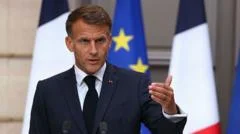
French President Emmanuel Macron has issued a direct warning: Russian hybrid attacks against Europe are not slowing down — they are intensifying. And France, he says, is now treating the threat as serious enough to demand state-level protection of its most sensitive sites.
Macron said he has tasked his government with protecting critical infrastructure and defence industry sites across the country. The statement, brief but pointed, places France squarely on the front line of what European officials increasingly describe as a shadow war being waged below the threshold of open military conflict.
What Macron Actually Said — And What It Signals
According to the French president, the intensification of Russian hybrid attacks against Europe is now a clear and present concern. His response was operational, not rhetorical: he directed the government to safeguard critical infrastructure and defence industry locations.
That instruction matters. It suggests French intelligence and security agencies are tracking specific, credible threats — not abstract risks. Critical infrastructure typically includes power grids, water systems, transport networks and telecommunications. Defence industry sites cover factories and facilities involved in military production.
Why This Warning Lands Differently in 2025
Hybrid warfare is deliberately ambiguous. It blends cyberattacks, sabotage, disinformation, espionage and physical disruption — often designed to stay just below the threshold that would trigger a NATO Article 5 response.
For ordinary Europeans, the consequences are not abstract. A sabotaged rail signal, a hacked energy grid or a fire at a defence plant can disrupt daily life, raise prices and erode public confidence. Macron's warning speaks directly to that fear.
How Europe Arrived at This Point
Since Russia's full-scale invasion of Ukraine, European governments have repeatedly accused Moscow of conducting hybrid operations across the continent. These have ranged from cyber intrusions and disinformation campaigns to suspected acts of sabotage.
France has not been immune. French officials have previously flagged foreign interference attempts, and Macron's latest statement suggests Paris now views the threat as sustained and evolving rather than episodic.
Who Is Affected — And Why It Matters to Real People
The immediate focus is on infrastructure and defence sites. But the ripple effects reach further. Workers at these facilities, communities nearby, and the broader public all depend on the systems being protected.
If hybrid attacks succeed, the damage is rarely confined to one target. A disrupted power supply or a compromised communications network can affect hospitals, businesses and households within hours.
France's Official Position
Macron's directive is the clearest public signal yet that France is shifting from monitoring hybrid threats to actively defending against them. The government has been formally tasked with protection — a move that carries political and budgetary implications.
Specific measures, timelines or named sites have not been detailed in the original statement. That silence is itself telling: governments often avoid disclosing exactly what they are protecting, precisely because that information is valuable to adversaries.
Reading Between the Lines
Macron's language — "intensifying" — is significant. It implies a trend line, not a single incident. That framing aligns with warnings from other European capitals and NATO officials who have described a sustained campaign of hostile activity.
It also reflects a broader strategic reality: hybrid attacks are cheap, deniable and effective. They allow a state to apply pressure without crossing the line into conventional war.
Confirmed Facts vs What Remains Unclear
Confirmed: Macron has said Russian hybrid attacks against Europe are intensifying. He has tasked his government with protecting critical infrastructure and defence industry sites.
Unclear: Which specific sites are being prioritised. What new measures will be introduced. Whether additional funding or legislation will follow. And what intelligence prompted the statement at this particular moment.
Any claims beyond these points should be treated as speculation until officially confirmed.
Risks and the Balanced View
Warnings about hybrid warfare can serve multiple purposes. They can mobilise public support, justify increased defence spending, and signal resolve to adversaries. Critics sometimes argue that such warnings can also be used to expand government powers or shift political narratives.
At the same time, the threat is not hypothetical. European governments have documented real incidents, and dismissing the risk outright would be equally unwise. The honest position is that the threat is credible, the scale is debated, and the response is still taking shape.
A Wider Pattern Across Europe
France is not alone. Across Europe, governments have hardened defences around energy, transport and military infrastructure. The trend points to a continent preparing for a form of conflict that has no clear front line.
Macron's statement fits into that pattern — and may push other countries to follow with similar public commitments.
What Readers Should Take Away
For the general public, the practical message is simple: expect to hear more about infrastructure security, cyber resilience and defence readiness in the months ahead. For businesses tied to critical sectors, this is a signal to review their own security posture.
For investors and analysts, defence and cybersecurity spending across Europe is likely to remain a growth area — though policy decisions, not headlines, will drive the real numbers.
What Could Happen Next
France may announce specific protective measures, increased surveillance or new coordination with NATO and EU partners. Other European governments could issue similar warnings. And the underlying threat — whatever its exact scale — is unlikely to disappear soon.
What remains to be seen is whether Europe's response stays defensive or escalates into a more assertive posture.
Our Take
Macron's warning is not a dramatic escalation in itself — it is a confirmation of something European security officials have been saying for months. What makes it notable is the operational instruction attached to it: protect the sites that matter most.
That shift, from warning to action, is the real story. It signals that France now treats hybrid attacks not as a possibility to prepare for, but as a threat already underway.
Frequently Asked Questions
What are Russian hybrid attacks against Europe?
Hybrid attacks combine cyber operations, sabotage, disinformation, espionage and other tactics designed to destabilise a country without triggering open military conflict. They are often deniable and hard to attribute definitively.
What did Macron say exactly?
Macron said Russian hybrid attacks against Europe are intensifying and that he has tasked his government with protecting critical infrastructure and defence industry sites.
Why is France protecting critical infrastructure now?
The French president's directive reflects growing concern that hybrid threats are escalating and could target essential systems such as energy, transport and defence facilities.
Does this mean Europe is at war with Russia?
No. Hybrid attacks operate below the threshold of conventional war. Macron's statement is a security warning and a protective directive, not a declaration of military conflict.