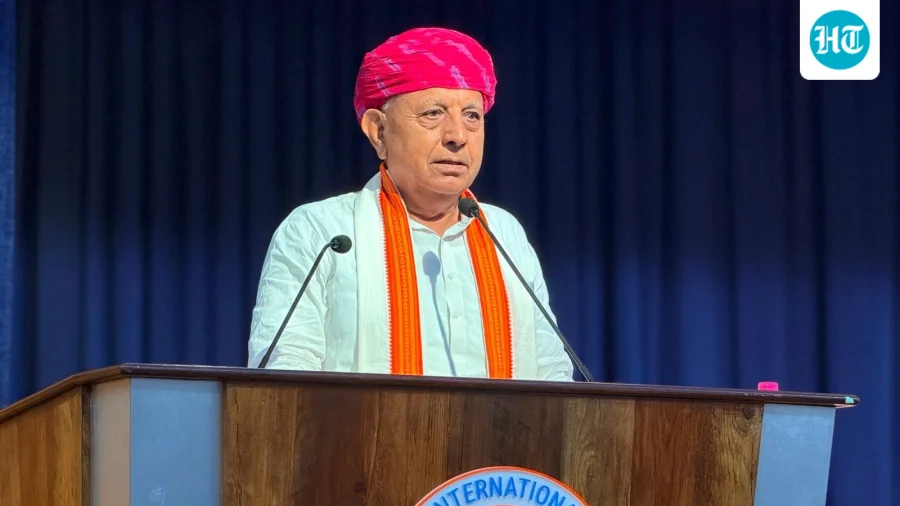
Union Minister of State for Agriculture Bhagirath Choudhary is at the centre of a political storm after reports emerged that he received a subsidy of ₹99.03 lakh from the National Horticulture Board (NHB) — a body under the very ministry he now serves — for a commercial cucumber farming project in Rajasthan. The opposition has cried foul, accusing the BJP of a blatant conflict of interest. But Choudhary, a farmer-turned-politician, has hit back, insisting the application was made years before he became a minister and that “nothing is hidden.”
The subsidy that sparked the row
According to reports, the subsidy was granted under the NHB’s scheme for commercial horticulture projects. The amount — ₹99.03 lakh — was approved for a cucumber farming venture in Choudhary’s home district of Nagaur, Rajasthan. The project was reportedly set up on land owned by the minister’s family. The revelation has raised questions about whether a sitting minister can benefit from a scheme run by his own department, even if the application predates his appointment.
Why this matters: Conflict of interest and public trust
At the heart of the controversy is the principle of conflict of interest. Critics argue that even if the application was filed in 2018, the approval and disbursal of funds occurred while Choudhary was a minister in the same ministry. This, they say, creates a perception — if not proof — of undue influence. For ordinary farmers who struggle to access government schemes, the idea of a minister getting a near-Rs 1 crore subsidy from his own department feels deeply unfair. The row also threatens to erode public trust in the impartiality of government schemes.
How the controversy unfolded
The story first broke via social media posts and news reports, which alleged that Choudhary had received the subsidy after becoming a minister. The opposition Congress and other parties quickly seized on the issue, demanding a thorough investigation. Choudhary, a first-time minister from the BJP, responded by releasing a statement clarifying the timeline. He said he had applied for the subsidy in 2018, long before he was inducted into the Union Council of Ministers in 2024. He also claimed that the project was evaluated and approved by the NHB on its merits, without any interference from him.
Who is affected: Farmers, taxpayers, and the political class
For the average Indian farmer, this controversy is a reminder of the vast gap between policy and practice. While the government promotes horticulture subsidies to boost income, the perception that a minister can fast-track his own application undermines the scheme’s credibility. Taxpayers, too, have a stake: ₹99 lakh of public money was used to support a commercial venture owned by a public servant. Politically, the BJP faces a tricky situation — defending a minister while also maintaining its anti-corruption image. The opposition, meanwhile, sees an opportunity to paint the government as hypocritical.
Choudhary’s defence: ‘I applied before becoming minister’
In his response, Bhagirath Choudhary said, “I applied for this subsidy in 2018, like thousands of other farmers. The process was transparent. I have nothing hidden.” He emphasised that he was a farmer first and that his application was processed by the NHB based on standard criteria. He also pointed out that he had not used his position to influence the decision. However, critics note that the final approval and disbursal happened after he became a minister, raising questions about whether the NHB officials felt any pressure — implicit or explicit — to clear the file.
What the rules say: Can a minister get a subsidy from his own ministry?
There is no specific law that bars a minister from availing a government scheme, as long as the application is genuine and processed without favouritism. However, the Code of Conduct for Union Ministers, issued by the Department of Personnel and Training, advises ministers to avoid any situation that could lead to a conflict of interest. It states that ministers should not use their official position to influence decisions that benefit themselves or their family members. Whether Choudhary’s case violates this code is a matter of interpretation — and likely, legal scrutiny.
Confirmed facts vs what remains unclear
What is confirmed: Choudhary applied for a ₹99.03 lakh subsidy under the NHB scheme in 2018. The subsidy was approved and disbursed. Choudhary became a Union Minister of State for Agriculture in 2024. What remains unclear: Whether the approval process was influenced by his political position. Whether the NHB followed all due diligence. Whether any rules were technically violated. The opposition’s allegations of a “scam” remain unproven, but the perception of impropriety is hard to dismiss.
Risks and balanced view
Supporters of Choudhary argue that he is being targeted simply because he is a BJP minister, and that thousands of farmers get similar subsidies every year. They point out that the application was made before his ministerial tenure, and that he has not been accused of any procedural violation. Critics, however, counter that the very fact of a minister benefiting from his own ministry’s scheme is problematic, regardless of the timeline. They argue that even the appearance of a conflict of interest is damaging to public trust. The truth likely lies somewhere in between: the subsidy may be technically legal, but it is politically and ethically questionable.
Wider pattern: Politicians and government schemes
This is not the first time a politician has been accused of misusing government schemes. In recent years, several MPs and MLAs have faced questions over availing farm loans, subsidies, or housing benefits meant for the poor. The issue highlights a systemic gap: while schemes are designed for the general public, there are often no clear rules to prevent elected representatives from benefiting. This case could prompt a broader debate on whether politicians should be barred from availing schemes administered by their own departments.
What should farmers and citizens do now?
For farmers, the controversy should not discourage them from applying for legitimate subsidies. The NHB scheme remains a valuable tool for horticulture development. However, citizens should demand greater transparency in how subsidies are approved, especially when the applicant is a public servant. If you are a farmer, ensure your application is complete and track its status online. If you suspect misuse, you can file a complaint under the Right to Information Act or approach the relevant ombudsman.
What happens next
The opposition is likely to raise the issue in the upcoming Parliament session, demanding a joint parliamentary committee or a CBI probe. The government may respond by asking the NHB to submit a detailed report. Choudhary’s political future may depend on whether any procedural lapses are found. If the matter escalates, it could become a major embarrassment for the BJP, especially given its strong anti-corruption rhetoric. For now, the minister has dug in his heels, insisting that he has done nothing wrong.
Our Take
This controversy is less about a specific subsidy amount and more about the principle of accountability. Bhagirath Choudhary may well have followed every rule, but the optics of a minister getting nearly a crore from his own department are damaging. In a democracy, perception matters as much as legality. The government would do well to institute clear guidelines on whether ministers can avail schemes from their own ministries. Until then, such rows will keep recurring — and public trust will keep eroding.
Frequently Asked Questions
What is the controversy about Bhagirath Choudhary?
Union Minister Bhagirath Choudhary is accused of receiving a ₹99.03 lakh subsidy from the National Horticulture Board, a body under the agriculture ministry he serves in, for a cucumber farming project. He says he applied in 2018, before becoming a minister.
Did Bhagirath Choudhary break any rules?
There is no confirmed violation of law, but the Code of Conduct for Union Ministers advises against situations that create a conflict of interest. Whether his case violates this code is under debate.
What is the National Horticulture Board subsidy scheme?
The NHB provides financial assistance for commercial horticulture projects, including subsidies for infrastructure, technology, and cultivation. The scheme is open to all farmers, subject to eligibility and project viability.
What has the opposition said about this?
The opposition Congress and other parties have accused the BJP of a “conflict of interest” and demanded a probe. They have raised questions about the timing of the approval and the minister’s role.