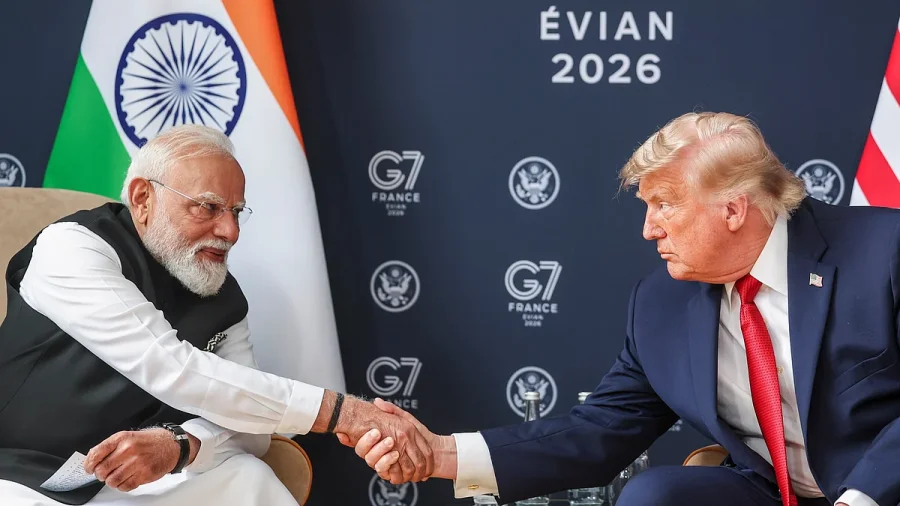
The Congress party on Saturday launched a blistering attack on Prime Minister Narendra Modi, accusing him of failing to directly raise the killing of three Indian seafarers in an American military strike during his meeting with US President Donald Trump at the G7 summit in France. The opposition party alleged that the government's guiding principle has become "PR first" rather than "nation first".
Congress accuses Modi of diplomatic failure over seafarers' deaths
Addressing a press conference, Congress media and publicity department head Pawan Khera criticised Modi's interaction with Trump on the sidelines of the G7 summit. "He sat huddled on the sofa, addressing Trump as 'excel...' — this is not how a prime minister should represent the nation's interests," Khera said. The Congress leader argued that the deaths of three Indian nationals in a US military strike demanded a direct and forceful response from the prime minister.
Why the seafarers' deaths matter for India-US ties
The killing of Indian seafarers in a US military operation has sparked outrage in India, with families demanding accountability. For the Congress, this is not just a diplomatic failure but a question of national honour. The opposition party is tapping into public sentiment that the government has been too deferential to Washington, especially under Trump's "America First" policy. The incident risks straining public perception of the India-US relationship, which has been a cornerstone of Modi's foreign policy.
Congress invokes Manmohan Singh and Indira Gandhi's US diplomacy
Khera invoked the responses of former prime ministers Manmohan Singh and Indira Gandhi during past diplomatic disputes with the United States. "When Manmohan Singh faced a similar situation, he did not hesitate to raise the issue directly with the US president. Indira Gandhi, too, stood firm on national interest," Khera said. The Congress is drawing a sharp contrast between Modi's approach and that of previous Congress governments, which it claims prioritised national interests over optics.
Who are the affected families and what they want
The families of the three deceased seafarers have been demanding a clear explanation from both the Indian and US governments. They want compensation, a formal apology, and assurances that such incidents will not recur. For them, the prime minister's silence during the G7 meeting is a deep betrayal. "Our sons died serving on a ship, and the PM couldn't even mention their names to Trump?" a family member told reporters, speaking on condition of anonymity.
Pawan Khera's press conference: Key accusations
During the press conference, Khera detailed the Congress's grievances. He said Modi's body language with Trump — described as "huddled on the sofa" — reflected a lack of assertiveness. The Congress also questioned why the government had not released a readout of the Modi-Trump meeting that specifically addressed the seafarers' deaths. "The government is more interested in photo-ops than in protecting Indian lives," Khera charged.
What the Modi-Trump meeting actually covered
Official readouts from the G7 summit have not confirmed whether the seafarers' deaths were discussed. The Ministry of External Affairs has not issued a detailed statement on the bilateral meeting. This lack of transparency has fuelled the Congress's allegations. The opposition is demanding that the government release the full transcript or at least a detailed account of what was discussed.
Confirmed facts vs what remains unclear
Confirmed: Three Indian seafarers were killed in a US military strike. PM Modi met President Trump at the G7 summit in France. The Congress has publicly criticised Modi for not raising the issue. Unclear: Whether Modi actually raised the issue privately. The exact content of the Modi-Trump conversation. The US government's official response to India's concerns. The Congress's claims are based on the absence of any public mention of the seafarers in summit readouts.
Why India's diplomatic approach to the US is under scrutiny
India's relationship with the US has deepened under Modi, with cooperation on defence, trade, and technology. However, incidents like the seafarers' deaths test the limits of this partnership. Critics argue that India has become too reliant on US goodwill, often avoiding direct confrontation on sensitive issues. The Congress is exploiting this vulnerability, positioning itself as the defender of national sovereignty.
Risks and balanced view: Is the Congress's criticism fair?
Supporters of the government argue that diplomacy often requires discretion, and that raising sensitive issues publicly can backfire. They point out that Modi has previously raised Indian concerns with US leaders on other matters. However, the Congress's criticism resonates with a public that expects its leaders to be vocal about Indian lives lost abroad. The opposition's invocation of past Congress leaders also carries weight, as Manmohan Singh and Indira Gandhi were known for their firm handling of US relations during crises.
Wider trend: India's growing assertiveness vs deference in foreign policy
This incident is part of a broader debate about India's foreign policy posture. While Modi has projected strength on the global stage — from border disputes with China to energy deals with Russia — critics say his government has been less assertive with the US. The seafarers' deaths have become a flashpoint for this tension, with the Congress demanding a more muscular approach.
What readers should know about the seafarers' deaths and diplomatic protocol
For ordinary Indians, this story underscores the importance of diplomatic accountability. If you or your family members work in international shipping or are affected by such incidents, it is crucial to know that the Indian government has a responsibility to raise your concerns with foreign governments. Citizens can contact the Ministry of External Affairs or their local MP to demand action. The Congress's criticism, while political, highlights a legitimate question: should a prime minister always raise such issues directly, or is behind-the-scenes diplomacy more effective?
Future outlook: What could happen next
The Congress is likely to continue its attack in Parliament and in public rallies. The government may be forced to issue a detailed statement or release a readout of the Modi-Trump meeting. The US administration may also face pressure to address India's concerns directly. If the issue is not resolved, it could become a recurring theme in India's domestic politics, especially ahead of elections.
Our Take
This is more than a political slugfest. The Congress's criticism touches on a fundamental question of diplomatic accountability. While it is true that not every issue can be raised publicly in a bilateral meeting, the absence of any public mention of the seafarers' deaths is troubling. The government owes it to the families and the nation to clarify what was discussed. At the same time, the Congress must be careful not to undermine India's strategic interests for short-term political gain. The truth likely lies somewhere in between — but transparency is the only way to restore trust.
Frequently Asked Questions
Did PM Modi actually raise the seafarers' deaths with Trump?
It is not confirmed. The government has not released a detailed readout of the Modi-Trump meeting that specifically mentions the seafarers. The Congress alleges it was not raised, based on the absence of any public confirmation.
Why is the Congress invoking Manmohan Singh and Indira Gandhi?
The Congress is drawing a historical contrast, arguing that previous Congress governments were more assertive in raising Indian concerns with the US during diplomatic disputes. This is a political strategy to criticise Modi's foreign policy approach.
What happened to the three Indian seafarers?
Three Indian seafarers were killed in a US military strike. The exact circumstances of the strike and the identities of the seafarers have not been fully disclosed by either government.
What should the Indian government do now?
The government should release a detailed statement on the Modi-Trump meeting, confirm whether the issue was raised, and take concrete steps to seek accountability and compensation from the US for the families of the deceased.