On the 51st anniversary of one of India’s most contentious political periods, the National Council of Educational Research and Training (NCERT) placed the Emergency squarely in the hands of 14-year-olds. The new Class IX Social Science textbook — released on June 25, 2026 — includes, for the first time, a dedicated section on the 1975-77 Emergency under a chapter titled ‘Challenges to Democratic Practices in India’. The move has ignited a fierce debate: is this a long-overdue reckoning with history, or a calculated political intervention in the classroom?
A textbook release on a politically charged date
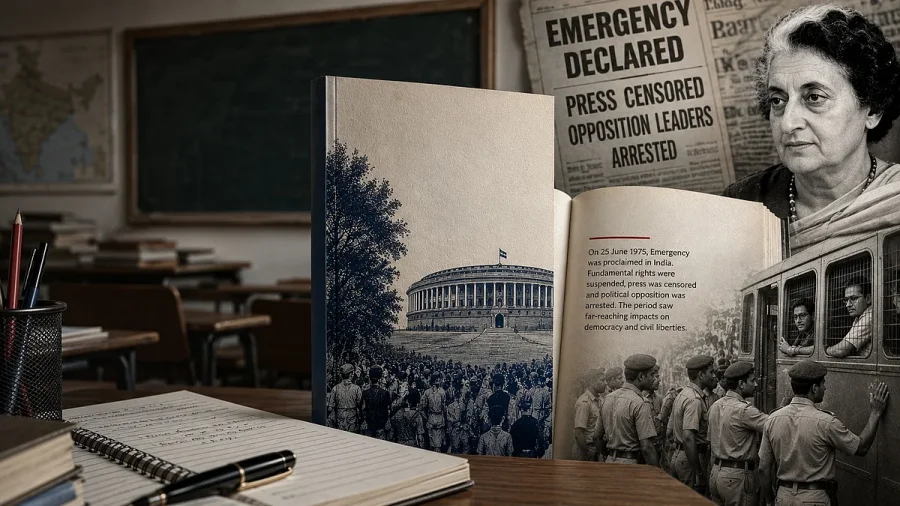
The choice of date was not accidental. June 25 marks the day in 1975 when Prime Minister Indira Gandhi imposed a national Emergency, suspending civil liberties, censoring the press, and arresting political opponents. By releasing the textbook on this exact date, NCERT signalled that the chapter is not just academic — it is a statement. Union Education Minister Dharmendra Pradhan defended the timing and content, saying future generations must learn about the ‘dark deeds’ of the Emergency so that such events are never repeated. “We cannot hide from our history,” he told reporters.
What the new NCERT chapter actually says
The section appears within the broader chapter on ‘Democracy’ in the textbook ‘Understanding Society, India and Beyond: Part 1’. It frames the Emergency as a period when democratic institutions were undermined, fundamental rights suspended, and dissent crushed. The language is direct: it describes the Emergency as a ‘dark chapter’ in India’s democratic journey. For the first time, Class 9 students will study specific events — the arrest of opposition leaders, press censorship, forced sterilisation campaigns, and the concentration of power in the Prime Minister’s Office. The textbook does not name Indira Gandhi directly in the section heading, but the historical context makes the reference unmistakable.
Why the timing raises questions about political intent
Critics argue that the release on the anniversary — and the minister’s framing of ‘dark deeds’ — turns pedagogy into political messaging. “Teaching the Emergency is necessary. But doing it on the anniversary with a minister calling it ‘dark deeds’ suggests the government wants to use the classroom to settle political scores,” said a former NCERT advisor who spoke on condition of anonymity. The concern is that students are not just learning history — they are being taught a specific political interpretation of it, one that aligns with the current government’s narrative about the Congress party’s authoritarian past.
How the Emergency has been taught in Indian schools before
Until now, the Emergency was not part of the Class 9 curriculum. It appeared only in higher secondary political science textbooks, and even then, it was treated briefly — often as a footnote in the story of Indian democracy. The decision to introduce it at the Class 9 level — when students are 14 to 15 years old — marks a significant shift. Education experts point out that younger students are less equipped to critically analyse complex historical events, making them more susceptible to a single narrative. “At Class 9, students are still developing their ability to question sources and understand multiple perspectives. A strongly worded chapter can shape their worldview permanently,” said Dr. Meera Chandrasekhar, a professor of education policy at Jawaharlal Nehru University.
Who is affected — students, teachers, and parents
The immediate impact is on approximately 2.5 crore students enrolled in Class 9 across CBSE-affiliated schools. Teachers now face the challenge of presenting the Emergency in a balanced way while adhering to the textbook’s framing. Parents, too, are divided. Some welcome the move, arguing that young Indians must know about the darkest period in the country’s democratic history. Others worry that the chapter could be used to demonise a particular political party, turning the classroom into a battleground for contemporary politics. “My daughter came home and asked if Indira Gandhi was a dictator. How do I answer that without getting into a political argument?” said a parent from Delhi.
Education Minister Dharmendra Pradhan’s full defence
In a series of statements, Pradhan has been unequivocal. “The Emergency was a blot on India’s democracy. It is our duty to ensure that children know the truth so that no government ever dares to repeat it,” he said. He dismissed allegations of political bias, arguing that the chapter is based on historical facts and not on any party’s ideology. “We are not teaching politics. We are teaching history. If the truth hurts some people, that is not our problem,” he added. The Ministry of Education has also pointed out that the textbook was reviewed by a committee of historians and educationists before publication.
The deeper debate: can history ever be taught without bias?
The controversy over the NCERT Emergency chapter is part of a larger global debate about how nations teach their own difficult histories. In the United States, battles over Critical Race Theory in schools mirror India’s struggle over how to teach the Emergency, the anti-Sikh riots of 1984, the Gujarat riots of 2002, and other contentious events. Historians argue that no textbook is ever completely neutral — every choice of what to include, what to omit, and how to frame events reflects a political judgment. The question is not whether bias exists, but whether the bias is transparent and open to debate. “The problem is not that the chapter has a point of view. The problem is that it presents that point of view as the only truth,” said historian Dr. Ramachandra Guha in a recent interview.
Confirmed facts vs what remains unclear
What is confirmed: NCERT released the textbook on June 25, 2026; the chapter includes a dedicated section on the Emergency; Education Minister Pradhan defended the move; the textbook was reviewed by a committee. What remains unclear: whether the committee included historians with diverse political views; whether the chapter mentions the justifications given by the Indira Gandhi government for imposing the Emergency (such as internal disturbance and economic crisis); and whether students will be encouraged to examine primary sources or only the textbook narrative. NCERT has not yet released the full list of committee members or the detailed chapter content for independent review.
Risks of partisan pedagogy in the classroom
Educationists warn that when a government uses the curriculum to promote its political narrative, it undermines the very purpose of education — to develop critical thinking. “If students are taught that one party is always good and another is always bad, they stop questioning. That is dangerous for democracy,” said Prof. Apoorvanand, a Delhi University academic. There is also the risk of backlash: students from families that support the Congress party may feel alienated or targeted, while those from BJP-supporting families may develop a simplistic, one-sided view of history. The classroom, instead of being a space for inquiry, becomes a site of political indoctrination.
Broader pattern: curriculum changes under the current government
The Emergency chapter is not an isolated move. Since 2014, the NCERT has revised multiple textbooks — removing chapters on the anti-Sikh riots, the Mughal Empire, and the theory of evolution, while adding content on yoga, Ayurveda, and Hindu kings. Critics see a pattern: the curriculum is being reshaped to align with a Hindutva-centric, nationalist view of Indian history. Supporters argue that earlier textbooks were biased towards a leftist, Congress-centric narrative and that the current changes merely correct the balance. The Emergency chapter fits into this larger realignment — a deliberate effort to ensure that the Congress party’s authoritarian past is not forgotten.
What students, parents, and teachers should do now
For students: read the chapter critically. Ask your teacher about different perspectives on the Emergency. Look up primary sources — newspaper articles from 1975-77, speeches by Indira Gandhi, and accounts from opposition leaders. For parents: discuss the chapter with your children. Encourage them to ask questions and think for themselves. For teachers: supplement the textbook with additional readings. Present multiple viewpoints and let students form their own conclusions. The goal should be understanding, not indoctrination.
What happens next — political and academic fallout
The debate is expected to intensify. Opposition parties, particularly the Congress, are likely to raise the issue in Parliament, accusing the government of using the curriculum for political vendetta. Academic bodies may demand an independent review of the textbook. NCERT has indicated that it will release supplementary teacher training materials to help educators handle the chapter sensitively. Meanwhile, the textbook is already in schools, and students across India will begin studying the Emergency this academic year. How teachers handle it — and how students respond — will determine whether this becomes a genuine educational exercise or a political flashpoint.
Our Take
Teaching the Emergency to 14-year-olds is not inherently wrong. In fact, it is necessary. A democracy that does not teach its own failures is a democracy that has not learned from them. But the timing, the framing, and the political context of this textbook release raise legitimate concerns. When a government chooses the anniversary of a traumatic event to release a chapter that calls it ‘dark deeds’, and when the education minister uses language that echoes political campaign rhetoric, the line between education and propaganda blurs. The real test will be in the classroom. If teachers are empowered to present multiple perspectives, if students are encouraged to question and debate, then this chapter could be a valuable lesson in democratic vigilance. If not, it risks becoming just another tool in India’s increasingly polarised political landscape.
Frequently Asked Questions
Which class will study the Emergency chapter in NCERT textbooks?
The dedicated section on the Emergency appears in the Class IX Social Science textbook ‘Understanding Society, India and Beyond: Part 1’, released in June 2026.
Why is the NCERT Emergency chapter controversial?
Critics argue that releasing the chapter on the 51st anniversary of the Emergency, and the Education Minister’s framing of ‘dark deeds’, suggests a political motive rather than a purely educational one. There are concerns about partisan pedagogy and lack of multiple perspectives.
What does the new NCERT chapter say about the Emergency?
The chapter describes the Emergency as a ‘dark chapter’ in India’s democratic history, covering the suspension of fundamental rights, press censorship, arrest of opposition leaders, and forced sterilisation campaigns. It is part of a broader chapter on ‘Challenges to Democratic Practices in India’.
Has the Emergency been taught in Indian schools before?
Yes, but only in higher secondary political science textbooks, and usually as a brief reference. This is the first time a dedicated section appears in the Class 9 curriculum, making it accessible to younger students.