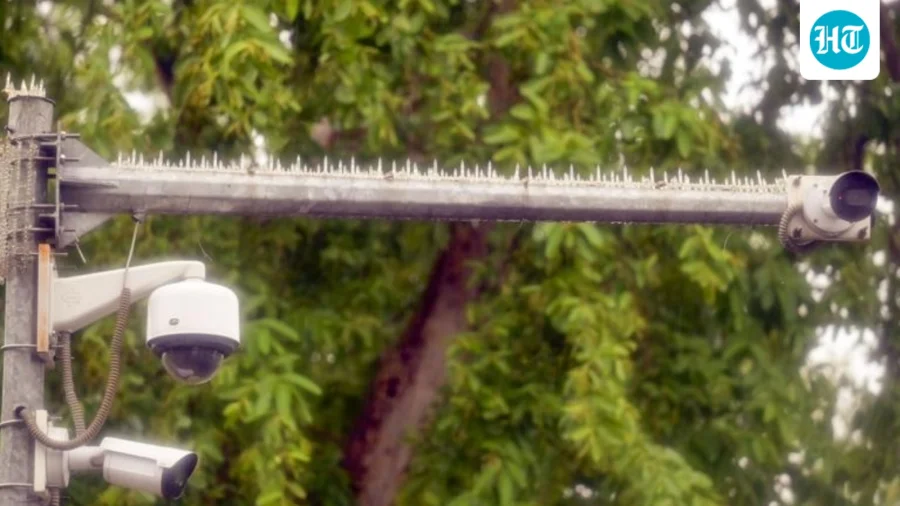
In a city where pigeons are as much a part of the landscape as auto-rickshaws and chai stalls, Delhi Police has found itself fighting an unexpected adversary: birds. The force has begun installing "anti-bird spikes" on CCTV cameras across high-security zones after pigeons repeatedly perched on the devices, blocking the lens and creating blind spots in surveillance coverage.
Why pigeons became a security problem for Delhi Police
It started as a minor nuisance — pigeons sitting on CCTV cameras, leaving droppings, occasionally pecking at the casing. But over time, the problem escalated. In several high-security areas, including zones near government buildings and key installations, pigeons were perching directly in front of camera lenses, obscuring the view for minutes or even hours at a time. For a surveillance network designed to monitor activity 24/7, even a few minutes of blocked footage can be critical.
How anti-bird spikes work and why they were chosen
The solution is deceptively simple: stainless steel or plastic spikes installed on top of the camera housing, creating an uneven surface that makes it uncomfortable for birds to land. Unlike nets or chemical deterrents, spikes are non-lethal, low-maintenance, and cost-effective. They do not harm the birds — they simply discourage them from perching. Delhi Police opted for this method after evaluating alternatives like ultrasonic devices and gel repellents, which were either too expensive or ineffective in outdoor conditions.
Where the spikes are being installed first
The installation is currently focused on high-security zones — areas around Parliament, the President’s Estate, key government ministries, and police headquarters. These locations have the highest density of CCTV cameras and the most stringent surveillance requirements. The spikes are being fitted on both fixed and PTZ (pan-tilt-zoom) cameras, with careful attention to not obstruct the camera’s movement or field of view.
What this means for Delhi’s surveillance network
Delhi has one of the most extensive CCTV networks in India, with thousands of cameras monitoring streets, intersections, and public spaces. The pigeon problem, while seemingly trivial, highlights a broader challenge: urban surveillance infrastructure must contend with environmental factors — weather, dust, vandalism, and yes, wildlife. The anti-bird spike initiative is a reminder that even the most sophisticated security systems can be disrupted by the simplest of obstacles.
Delhi Police’s response and public reaction
Delhi Police officials confirmed the measure, describing it as a practical response to an operational issue. "We noticed that pigeons were frequently sitting on cameras, especially in quieter hours, and the footage was being compromised," an officer said. "The spikes are a simple, humane solution." Public reaction has been mixed — some residents find the situation amusing, while others appreciate the police’s attention to detail. On social media, the move has sparked lighthearted commentary about the city’s bird population outsmarting security systems.
Why this matters beyond the pigeon problem
The incident underscores a larger truth about urban security: it is not just about high-tech solutions like facial recognition or AI analytics. Sometimes, the most effective interventions are low-tech, low-cost, and deeply practical. It also raises questions about how cities adapt their infrastructure to coexist with urban wildlife — a growing concern as urbanization expands and human-animal interactions increase.
Confirmed facts vs what remains unclear
Confirmed: Delhi Police is installing anti-bird spikes on CCTV cameras in high-security zones. The measure is non-lethal and aimed at preventing pigeons from blocking camera lenses. Unclear: The exact number of cameras being fitted, the total cost of the initiative, and whether the measure will be extended to other parts of the city. There is no official data on how many incidents of blocked footage were recorded before the spikes were introduced.
Risks and balanced view
While anti-bird spikes are generally considered humane, some animal welfare groups argue that spikes can still cause injury if birds attempt to land forcefully. Others point out that pigeons may simply relocate to other perches, potentially shifting the problem rather than solving it. There is also the question of maintenance — spikes can accumulate debris or become loose over time, requiring periodic checks. Delhi Police has not disclosed a maintenance schedule.
Wider trend: Urban wildlife meets city infrastructure
This is not an isolated case. Cities around the world have faced similar challenges — from seagulls blocking traffic cameras in coastal towns to monkeys disrupting power lines in Indian cities. The pigeon-CCTV problem is part of a broader pattern where urban infrastructure must be designed with wildlife in mind. As cities grow smarter, they must also become more adaptable to the unpredictable behaviour of the creatures that share their space.
Practical guidance for residents and building managers
For those managing private CCTV systems in areas with heavy bird activity, the same principle applies. Anti-bird spikes are widely available and easy to install on camera housings, light fixtures, and ledges. They are a cost-effective way to maintain clear footage without harming birds. Residents should ensure spikes are installed by professionals to avoid damaging the camera or voiding warranties.
Future outlook
If the anti-bird spike initiative proves successful in high-security zones, Delhi Police may expand it to other areas, including traffic junctions, metro stations, and public parks. The move could also set a precedent for other Indian cities grappling with similar bird-related surveillance issues. Meanwhile, the pigeons of Delhi will likely find new perches — but for now, the cameras will stay clear.
Our Take
This story is a delightful reminder that security challenges are not always about cyber threats or sophisticated breaches. Sometimes, the biggest obstacle is a pigeon with a preference for a warm camera lens. Delhi Police’s response is pragmatic, humane, and refreshingly low-tech. It also highlights the importance of thinking about infrastructure in context — not just what works in a lab, but what works on a Delhi street, where birds, dust, and weather are part of daily reality. The real takeaway? Good security is about attention to detail, even when that detail has feathers.
Frequently Asked Questions
Why is Delhi Police installing anti-bird spikes on CCTV cameras?
Pigeons were perching on CCTV cameras in high-security zones, blocking the lens and creating blind spots in surveillance footage. The spikes prevent birds from landing, ensuring cameras remain functional.
Are anti-bird spikes harmful to pigeons?
No. The spikes are designed to make landing uncomfortable, not to injure birds. They are considered a humane deterrent and are widely used in urban settings to keep birds away from ledges, signs, and cameras.
Which areas in Delhi are getting these spikes first?
The installation is focused on high-security zones, including areas around Parliament, the President’s Estate, key government ministries, and police headquarters.
Will this solution be used in other Indian cities?
There is no official plan yet, but if the measure proves effective in Delhi, it could serve as a model for other cities facing similar bird-related surveillance issues.