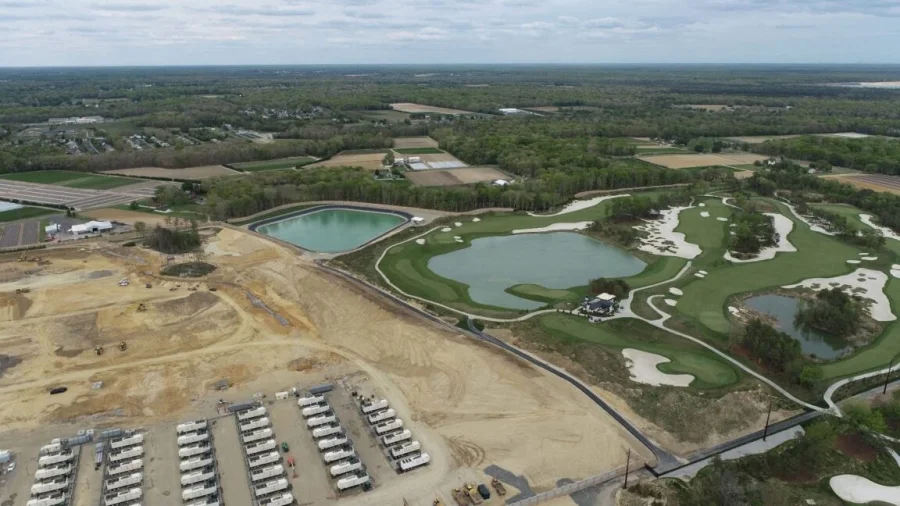
Sixty-two gas generators. Not one of them permitted. That's the finding that turned a quiet data center build-out in New Jersey into a $1.1 million state penalty — and a warning shot for an industry racing to power artificial intelligence.
The state ordered DataOne, the operator behind one of the East Coast's largest planned data centers, to pay the fine for violating New Jersey's Air Pollution Control Act, according to the original report. The generators had been installed and run without the permits the state requires.
What the drone footage actually showed
The violation didn't surface through a routine inspection. It came into view through thermal drone imagery gathered by The Guardian and Floodlight News in August, which showed 45 of the 62 generators actively operating.
Thermal cameras detect heat signatures, which is why they can reveal generators running behind fences, at night, or in areas the public rarely sees. In this case, the footage gave regulators a visual record that paperwork alone would not have provided.
Why 1,982 kilowatts is the number that matters
New Jersey requires permits for generators with a capacity of 37 kilowatts or higher. The DataOne units were running at 1,982 kilowatts — more than 50 times that threshold.
That gap is not a technicality. States track generators at this scale because they emit carbon dioxide, nitrogen oxides, carbon monoxide, and other combustion-related pollutants, according to New Jersey's Department of Environmental Protection. At 1,982 kW, each unit falls firmly into the category regulators want visibility into.
The emissions question data centers don't like answering
Data centers are electricity-hungry by design. The AI boom has pushed that demand sharply higher, and grid connections in many regions now take years to secure. Gas generators have become a stopgap — a way to keep servers running when the grid can't deliver.
But backup power at this scale stops being "backup." When dozens of units run simultaneously, the emissions profile starts to resemble a small power plant rather than a resilience measure.
Why this fine lands harder than the dollar figure suggests
$1.1 million is not a crippling sum for a large data center operator. The significance lies elsewhere: it establishes that state regulators are willing to act on evidence gathered outside their own inspection process.
It also puts other operators on notice. If drone footage can document unpermitted generation at one site, it can do so at others.
Confirmed Facts vs What Remains Unclear
Confirmed: The $1.1 million fine, the 62 generators, the 45 observed operating, the 1,982-kW capacity, and the 37-kW permitting threshold all come from the original report and state findings.
Unclear: Whether DataOne will appeal, whether additional penalties or remediation requirements will follow, and whether other facilities face similar scrutiny. Those details have not been confirmed.
The bigger pattern: AI's power problem meets environmental oversight
This case sits at the intersection of two trends moving in opposite directions. Data center capacity is expanding fast to meet AI demand. Environmental permitting moves slowly, on purpose.
When those timelines collide, operators face a choice: wait for grid capacity and permits, or install generation quietly and hope no one looks. The drone footage suggests someone was looking.
What this means for communities near data centers
Residents near large data center sites have increasingly raised concerns about noise, air quality, and transparency. Unpermitted generators are difficult to monitor precisely because they aren't disclosed.
This case gives those communities a template: independent documentation, followed by regulatory action.
Practical guidance for operators and investors
For data center operators, the lesson is straightforward — permitting thresholds are low, and thermal imaging makes concealment difficult. For investors, it's a reminder that power procurement carries regulatory risk that doesn't always appear in a project timeline.
For residents, it's a signal that state environmental agencies can act on third-party evidence.
Future Outlook
Expect closer scrutiny of generator installations at data center sites across the region. Whether this becomes a broader enforcement pattern — or remains an isolated penalty — will depend on how other states respond to similar findings.
Our Take
The fine itself is modest. The precedent is not. New Jersey has effectively told the data center industry that the fastest path to power cannot be the quietest one. As AI demand keeps climbing, that message will be tested again.
Frequently Asked Questions
Why was DataOne fined $1.1 million?
New Jersey found that DataOne installed and operated 62 gas generators without the permits required under the state's Air Pollution Control Act.
How were the unpermitted generators discovered?
Thermal drone footage gathered by The Guardian and Floodlight News in August showed 45 of the 62 generators operating, prompting a state investigation.
Why does New Jersey require permits for gas generators?
Generators at or above 37 kilowatts emit pollutants including carbon dioxide, nitrogen oxides, and carbon monoxide, so the state tracks them for air quality oversight.
What happens next for DataOne?
The company has been ordered to pay the fine. Whether it appeals or faces further requirements has not been confirmed.