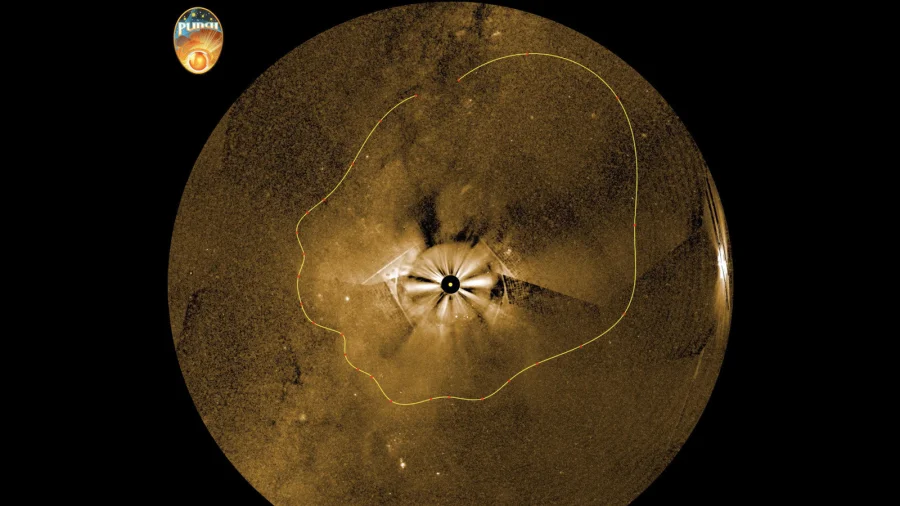
The Sun is waking up, and its temper tantrums could soon be far less surprising. NASA's PUNCH mission has reportedly achieved a major leap in predicting when solar storms will strike Earth, a development that could fundamentally change how we prepare for space weather.
A New Era in Space Weather Forecasting
NASA's PUNCH mission — short for Polarimeter to Unify the Corona and Heliosphere — is now providing data that significantly sharpens solar storm predictions. The mission's advanced imaging allows scientists to track coronal mass ejections (CMEs) with greater precision, offering a clearer picture of when these massive bursts of solar wind and magnetic fields will reach our planet.
Why Solar Storm Predictions Matter for Daily Life
Solar storms are not just a scientific curiosity. When a CME hits Earth, it can disrupt satellite communications, interfere with GPS navigation, and even cause voltage fluctuations in power grids. For airlines flying polar routes, for farmers relying on GPS-guided equipment, and for anyone using a smartphone, accurate solar storm warnings translate into fewer disruptions and better preparedness.
How the PUNCH Mission Improves on Previous Methods
Earlier prediction methods relied on observing the Sun's surface and estimating the speed and direction of ejections. The PUNCH mission adds a crucial layer by observing the solar wind in the region between the Sun and Earth. This "in-transit" view helps scientists refine their models, reducing the uncertainty that has long plagued space weather forecasts.
Who Stands to Benefit Most from Earlier Warnings
Satellite operators are among the primary beneficiaries. With more accurate predictions, they can place satellites in safe mode or adjust orbits to protect sensitive electronics. Power grid operators can also take preventive measures to avoid transformer damage. Even astronauts aboard the International Space Station gain from better warnings about radiation exposure.
NASA's Perspective on the Mission's Progress
NASA has confirmed that the PUNCH mission has greatly advanced the prediction of solar storms. The agency views this as a critical step in its broader space weather research program, which aims to protect both technology and human life from the Sun's unpredictable behavior.
What This Advancement Means for Future Research
The improved prediction capability is not just about today's storms. The data gathered by PUNCH will feed into long-term models, helping scientists understand the Sun's 11-year activity cycle and its impact on Earth's magnetosphere. This research could eventually lead to even more precise forecasts, potentially giving days of warning instead of hours.
Confirmed Facts vs What Remains Unclear
What is confirmed is that NASA's PUNCH mission has made significant strides in solar storm prediction. What remains less clear is the exact margin of improvement and how quickly these enhanced predictions will translate into operational warnings for industries. NASA has not yet released detailed performance metrics comparing PUNCH-based forecasts to previous methods.
Risks and Balanced View
While the advancement is promising, space weather prediction remains inherently challenging. The Sun's behavior is complex, and even the best models carry uncertainty. Some experts caution that while PUNCH improves our understanding, it does not eliminate the risk of sudden, unpredictable solar events. The mission is a tool for better forecasting, not a guarantee of perfect prediction.
The Broader Pattern of Solar Activity
This development comes as the Sun approaches the peak of its current solar cycle, a period marked by increased sunspot activity and more frequent CMEs. The timing makes PUNCH's improved predictions particularly valuable, as the likelihood of significant solar storms affecting Earth is higher now than in recent years.
Practical Guidance for Those Affected by Solar Storms
For industries that depend on satellite technology, the message is to stay informed about space weather forecasts and maintain contingency plans. For the general public, the impact is mostly indirect — but understanding that solar storms can affect everyday technology helps contextualize occasional GPS glitches or communication hiccups. Monitoring NOAA's Space Weather Prediction Center remains the best way to stay updated.
Future Outlook for Solar Storm Prediction
As the PUNCH mission continues to collect data, prediction models are expected to improve further. The integration of PUNCH data with other space weather observatories could create a more comprehensive warning system. The ultimate goal is to provide reliable forecasts that give industries and governments enough lead time to protect critical infrastructure.
Our Take
The PUNCH mission's progress represents a quiet but significant victory for space science. While it may not make headlines like a rocket launch, the ability to predict solar storms more accurately has tangible benefits for a world increasingly dependent on space-based technology. This is science working quietly in the background to keep our modern lives running smoothly.
Frequently Asked Questions
What is NASA's PUNCH mission?
PUNCH is a NASA mission designed to study the Sun's outer atmosphere and the solar wind. It uses advanced imaging to track solar storms as they travel toward Earth, improving space weather predictions.
How does the PUNCH mission predict solar storms?
PUNCH observes coronal mass ejections in the region between the Sun and Earth, providing real-time data on their speed and direction. This helps scientists forecast when a solar storm will reach our planet.
Why is accurate solar storm prediction important?
Solar storms can disrupt satellites, GPS, power grids, and communications. Accurate predictions allow operators to take protective measures, reducing the risk of damage and service interruptions.
When will PUNCH-based predictions be fully operational?
NASA has confirmed significant progress, but a specific timeline for fully operational use has not been announced. The mission continues to collect data to refine its prediction models.