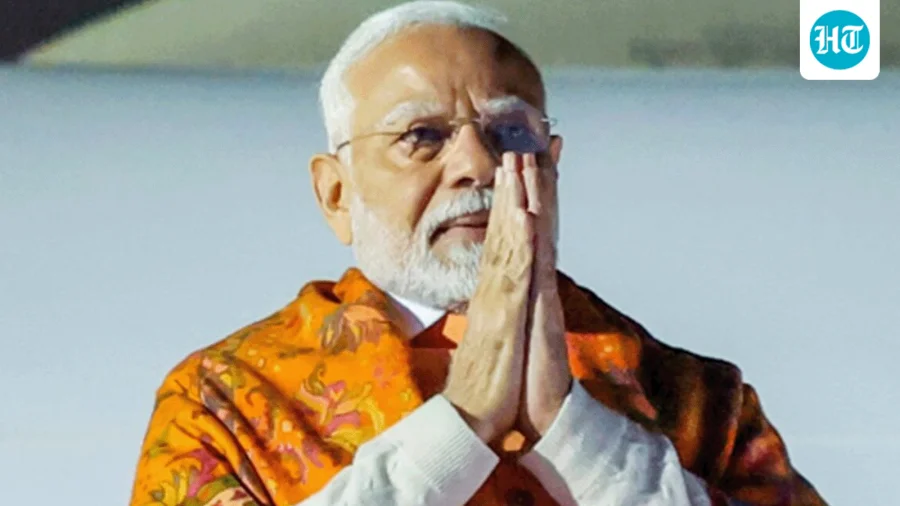
Prime Minister Narendra Modi marked 13 years in office on Monday with a pointed attack on the Congress party, asserting that India's economic growth rate only began to accelerate after the National Democratic Alliance (NDA) came to power. "The nation’s destiny changed in 2014," he said, drawing a sharp contrast between the Congress-led United Progressive Alliance (UPA) era and his own government's tenure.
Modi's 'Congress growth rate' jibe: What he said
Speaking at an event, PM Modi argued that India's growth trajectory was stagnant under Congress rule. "The country's growth rate picked up pace only when the NDA government, first under Atal Bihari Vajpayee ji and then under our government, came into power," he said. The remark was a direct jab at the Congress party's economic record, which he characterized as a period of missed opportunities and slow progress.
Why this attack matters now
The timing of the jibe is significant. With general elections approaching, the BJP is aggressively framing its tenure as a turning point for India's economy. The Congress, meanwhile, has been trying to reclaim its legacy as the party that liberalized the economy in 1991. Modi's statement is designed to undercut that narrative by focusing on the post-2014 period as the true era of transformation.
The Vajpayee-Modi continuity argument
By linking his government's performance to that of former Prime Minister Atal Bihari Vajpayee, Modi is reinforcing the idea of a continuous NDA legacy of good governance. This is a strategic move to consolidate the BJP's base and appeal to voters who remember the Vajpayee era as a time of stability and development. It also serves to distance the NDA from the Congress's record, which the BJP often portrays as corrupt and inefficient.
Human impact: What this means for ordinary Indians
For the average Indian voter, the debate over growth rates translates into questions about jobs, prices, and living standards. The Modi government points to infrastructure projects, digital payments, and welfare schemes as evidence of progress. Critics, however, highlight persistent unemployment and inflation. The PM's speech is an attempt to convince voters that the economic trajectory under the NDA is fundamentally better than what came before.
Congress response and political fallout
The Congress party is expected to counter the PM's claims by citing its own achievements, such as the 1991 economic reforms, the National Rural Employment Guarantee Act (NREGA), and the Right to Information Act. Party leaders may also question the Modi government's handling of the economy, pointing to the slowdown before the pandemic and the uneven recovery. The exchange is likely to intensify as the election campaign heats up.
Decoding the 'destiny changed' narrative
Modi's phrase "nation’s destiny changed in 2014" is a powerful political slogan. It suggests a clean break from the past and positions his government as a transformative force. This narrative resonates with voters who feel that the previous Congress-led governments were mired in scandal and policy paralysis. However, it also invites scrutiny of the Modi government's own record, including its handling of the economy, social tensions, and democratic institutions.
Confirmed facts vs what remains unclear
Confirmed: PM Modi made the statement about growth rates and the NDA's role in accelerating India's economic progress. The NDA government under Vajpayee (1998-2004) and Modi (2014-present) are the two periods he referenced. Unclear: The exact data or metrics the PM used to support his claim are not specified in his speech. Independent economic data shows India's growth rate has fluctuated under both Congress and NDA governments, with periods of high growth under both. The long-term impact of the Modi government's policies on job creation and income inequality remains a subject of debate among economists.
Why the BJP's economic message is central to its campaign
The BJP's political strategy heavily relies on the narrative of economic transformation. The party's moat lies in its ability to project itself as a decisive, development-oriented alternative to the Congress. This is reinforced by flagship schemes like Make in India, Digital India, and the Goods and Services Tax (GST). The PM's speech is a reminder to voters that the BJP sees the 2014 election as a watershed moment, not just politically but economically.
Risks and balanced view
While the PM's attack is politically effective, it carries risks. Over-reliance on the "before and after 2014" narrative can backfire if voters feel that the promises of 2014 have not fully materialized. Critics argue that India's growth has been uneven, with benefits concentrated among the wealthy. Additionally, the Congress can point to its own record of high growth during the early 2000s, before the global financial crisis. A balanced view requires acknowledging that both Congress and NDA governments have overseen periods of growth and stagnation.
The wider trend: Economic nationalism in Indian politics
Modi's jibe is part of a broader trend of economic nationalism in Indian politics. Both major parties now compete to claim credit for India's economic rise. The BJP's strategy is to frame the Congress as a party of the past, while positioning itself as the architect of a new, confident India. This narrative is particularly potent among first-time voters and the aspirational middle class.
What voters should watch for next
As the election campaign intensifies, voters should look for concrete data from both sides. The Congress is likely to release its own economic white paper, while the BJP will continue to highlight infrastructure and welfare achievements. For those trying to make sense of the claims, independent economic reports from the RBI, World Bank, and IMF can provide a more nuanced picture. The key is to compare not just growth rates but also indicators like employment, poverty reduction, and income equality.
Future outlook: What could happen next
The political battle over economic legacy is likely to dominate the next few months. The BJP will double down on its "New India" narrative, while the Congress will try to reclaim its reformist credentials. The outcome of this debate could influence swing voters in key states. If the economy continues to grow, the BJP's message will gain traction. If growth slows or inequality worsens, the Congress may find more receptive ears.
Our Take
PM Modi's 'Congress growth rate' jibe is a classic political move — it simplifies a complex economic history into a clear, emotionally resonant narrative. For the BJP, the story is simple: before 2014, India was stuck; after 2014, India soared. For the Congress, the challenge is to remind voters that economic progress is not linear and that their own record includes landmark reforms. The truth, as always, lies somewhere in between. What matters most for voters is not just who claims credit for past growth, but who has a credible plan for future prosperity.
Frequently Asked Questions
What did PM Modi say about the Congress growth rate?
PM Modi said that India's growth rate picked up only when the NDA government, first under Atal Bihari Vajpayee and then under his own leadership, came to power. He contrasted this with the Congress-led UPA era, which he characterized as a period of slow growth.
Why did PM Modi make this remark now?
The remark was made as PM Modi marked 13 years in office. It is part of a broader political strategy to frame the BJP's tenure as a transformative period for India's economy, especially with elections approaching.
How did the Congress party respond?
The Congress party is expected to counter the PM's claims by highlighting its own economic achievements, such as the 1991 reforms and social welfare programs. Party leaders may also criticize the Modi government's record on jobs and inflation.
Is India's growth rate actually higher under the NDA?
Economic data shows that India's growth rate has fluctuated under both Congress and NDA governments. The NDA period saw high growth in the early 2000s and again after 2014, but the Congress era also had strong growth years. The debate often depends on which specific time periods and metrics are compared.