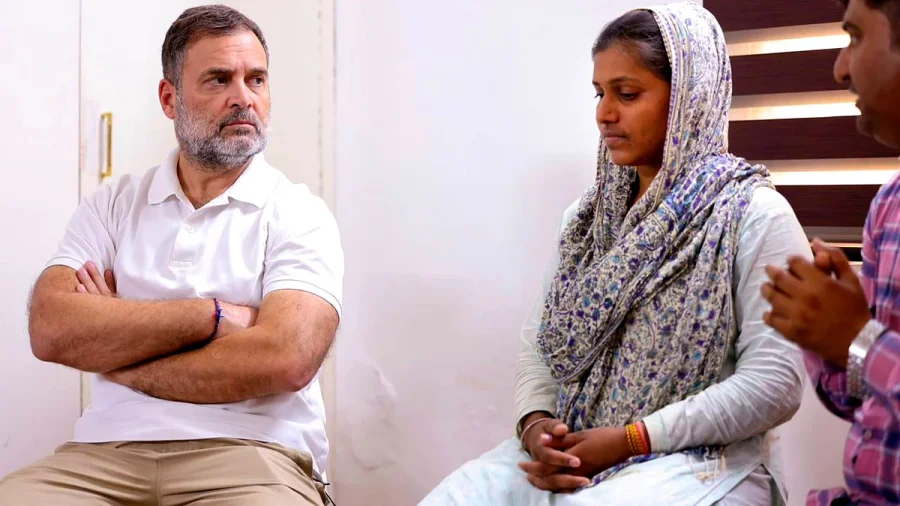
The grief of a family in Sikar, Rajasthan, has become a national symbol of a crisis that refuses to fade. When Congress leader Rahul Gandhi sat down with the parents of Pradeep Meghwal, a NEET aspirant who died by suicide, he didn’t just offer condolences. He pointed a finger directly at the top of the government, holding Prime Minister Narendra Modi and Home Minister Amit Shah accountable for what he called a “broken, corrupt system.” This meeting, held at the NSUI office in Jaipur, has reignited a painful debate about the state of India’s examination system and the human cost of its failures.
Rahul Gandhi meets NEET aspirant’s family, blames paper leak for tragedy
Rahul Gandhi, the Leader of Opposition in the Lok Sabha, met the family of Pradeep Meghwal on Wednesday. Pradeep, a bright student who had appeared for the NEET-UG 2026 examination, died by suicide in Sikar. The exam was later cancelled amid widespread allegations of a paper leak. Gandhi’s visit was not a quiet, private affair. It was a public statement of political accountability. In a post on X in Hindi, he described the family’s pain as “beyond words” and directly linked the tragedy to the handling of the NEET exam.
Why This Matters Right Now
This is not just a story about one politician meeting one grieving family. It is a story about the trust of millions of students and parents across India. The NEET paper leak has shaken the foundation of a system that millions rely on for their future. When a student as promising as Pradeep Meghwal feels driven to such an extreme, it raises urgent questions about the pressure, the fairness, and the accountability of those in power. This meeting brings the human cost of a systemic failure into sharp focus, forcing a national conversation about who is responsible when the system breaks.
How the Tragedy Unfolded
Pradeep Meghwal, a resident of Sikar, was a dedicated NEET aspirant. He had appeared for the NEET-UG 2026 examination, a high-stakes test that determines admission to medical colleges across India. The exam was marred by allegations of a massive paper leak, leading to its cancellation. The news of the leak, and the subsequent uncertainty, reportedly devastated Pradeep. He died by suicide, leaving behind a family shattered by grief and a community demanding answers. The incident quickly became a flashpoint in the ongoing political debate over the integrity of the examination system.
Who Is Affected and What Rahul Gandhi Said
The immediate victims are Pradeep’s parents, who have lost their son. But the impact ripples out to every student who has ever felt the crushing weight of a system they believe is rigged. Rahul Gandhi’s message was clear. “Pradeep’s death was not suicide — it was the result of a broken, corrupt system,” he said. He held the “Modi-Shah duo” directly accountable, arguing that the Prime Minister and Home Minister cannot escape responsibility for the failures of the examination system. His words were a direct challenge to the government’s narrative that the paper leak was an isolated incident.
What We Know So Far — and What Remains Unclear
What we know: Pradeep Meghwal died by suicide. The NEET-UG 2026 exam was cancelled due to a paper leak. Rahul Gandhi met the family and blamed the Modi-Shah duo. The government has acknowledged the leak and initiated an investigation.
What remains unclear: The full extent of the paper leak network. The specific actions that will be taken against those responsible. Whether the government will implement systemic reforms to prevent future leaks. The exact timeline of events leading to Pradeep’s death. The political fallout of Gandhi’s direct accusation.
Risks, Concerns, and the Balanced View
The central concern is the erosion of trust in a system that determines the future of millions. Critics argue that the government’s response has been reactive rather than preventive. Supporters of the government point to the cancellation of the exam and the ongoing investigation as evidence of action. However, the human cost of the failure is undeniable. The risk is that without fundamental reform, such tragedies will repeat. The political risk for the government is that this incident becomes a symbol of systemic incompetence, while for the opposition, it is a powerful tool to question the government’s credibility.
Why Similar Concerns Are Growing Across India
The NEET paper leak is not an isolated event. In recent years, there have been multiple reports of leaks and irregularities in major competitive exams, including UGC-NET and CUET. This pattern has created a climate of anxiety and distrust among students. The pressure to succeed in these exams is immense, and when the system is perceived as unfair, the psychological toll can be devastating. The growing frequency of such incidents suggests a deeper, systemic problem that requires more than just a one-time investigation.
- The NEET-UG 2026 exam was cancelled after a paper leak was reported.
- Pradeep Meghwal’s death has become a symbol of student distress.
- Rahul Gandhi’s meeting has intensified political pressure on the government.
“Today, I met the family of the brilliant student Pradeep Meghwal, who was so devastated by the NEET paper leak that he took his own life. Their pain cannot be contained in words. A mother and father have lost their son, and they were guilty of nothing.” — Rahul Gandhi, via X
What Students and Parents Should Know Now
For students and parents, the immediate takeaway is to be aware of the ongoing investigations and the status of the cancelled exam. The government has promised a re-examination, but the dates and details remain unclear. It is crucial to stay updated through official channels. More importantly, this incident highlights the need for mental health support for students under immense academic pressure. Families should be vigilant about signs of distress and seek professional help when needed. The broader lesson is that the fight for a fair system is a collective one, and voices demanding accountability must be heard.
What Could Happen Next
The political fallout is likely to intensify. The opposition will continue to use this incident to attack the government. The government will likely face increased pressure to not only punish those responsible for the leak but also to implement robust reforms to prevent future incidents. The re-examination will be a critical test of the system’s credibility. If it is conducted smoothly and fairly, it may help restore some trust. If not, the crisis could deepen. The case of Pradeep Meghwal will remain a painful reminder of what is at stake.
Our Take: Why This Story Matters Beyond One Incident
This story is a stark reminder that behind every statistic, every exam, and every political debate, there are real people with real dreams. Pradeep Meghwal’s death is a tragedy that should never have happened. It is a symptom of a system that has become too high-stakes, too opaque, and too vulnerable to corruption. Rahul Gandhi’s visit, while political, has served a crucial purpose: it has put a human face on a systemic failure. The question now is whether this tragedy will lead to meaningful change, or whether it will be forgotten in the next news cycle. The answer will define the future of millions of students.
FAQs
Why did Rahul Gandhi meet the family of the NEET aspirant?
Rahul Gandhi met the family of Pradeep Meghwal to express his condolences and to hold the Modi-Shah duo accountable for the NEET paper leak, which he described as a result of a “broken, corrupt system.” He aimed to highlight the human cost of the examination system’s failure.
What was the NEET paper leak and how did it affect students?
The NEET-UG 2026 examination was cancelled after widespread allegations of a paper leak. This caused immense distress among students, many of whom had prepared for years. The leak eroded trust in the fairness of the exam, leading to anxiety and, in the tragic case of Pradeep Meghwal, a fatal outcome.
Who is being held accountable for the NEET paper leak?
Rahul Gandhi has directly held Prime Minister Narendra Modi and Home Minister Amit Shah accountable, arguing that as the heads of the government, they are responsible for the systemic failures that allowed the leak to happen. The government has initiated an investigation to find those directly responsible for the leak.
What is the government’s response to the NEET paper leak and the student’s death?
The government has acknowledged the paper leak, cancelled the exam, and promised a re-examination. An investigation is underway to identify and punish those responsible. However, critics argue that the response has been reactive and that more systemic reforms are needed to prevent future incidents and restore student trust.