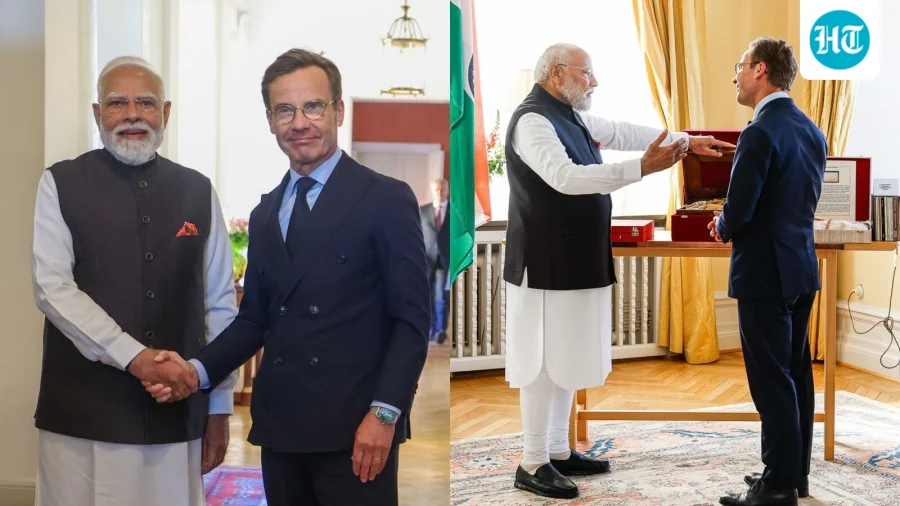
In a significant diplomatic move that signals a deepening of ties between New Delhi and Stockholm, Prime Minister Narendra Modi and Swedish Prime Minister Ulf Kristersson agreed to elevate India-Sweden relations to a full-fledged Strategic Partnership. The announcement, made after delegation-level talks in Gothenburg, came with five concrete outcomes and a deeply symbolic cultural gesture — a gift of Rabindranath Tagore’s poems from Kristersson to Modi.
The development is not just a routine diplomatic update. It represents a recalibration of one of Europe’s most promising partnerships with India, touching on trade, defence, innovation, and green technology. For millions watching India’s global positioning, this is a moment that matters.
India-Sweden Strategic Partnership: Five Key Outcomes from the Modi-Kristersson Talks
The talks between PM Modi and Swedish PM Kristersson yielded five major outcomes, each designed to deepen cooperation across critical sectors. While the full text of the joint statement is awaited, officials confirmed that the Strategic Partnership framework will now guide bilateral engagement. The outcomes are expected to cover enhanced collaboration in trade and investment, innovation and technology, defence and security, green transition and sustainable development, and cultural and people-to-people ties. These areas reflect a shared ambition to move beyond traditional diplomacy into concrete, results-oriented cooperation.
Why This Matters Right Now
This elevation of ties comes at a time when global supply chains are being reshaped, and Europe is looking for reliable partners beyond its immediate neighbourhood. For India, Sweden offers cutting-edge technology in green energy, defence manufacturing, and innovation. For Sweden, India represents a massive market and a stable democratic partner in the Indo-Pacific. The timing of the Strategic Partnership signals that both nations see each other as essential to their long-term economic and strategic goals. For Indian readers, this means potential new opportunities in trade, technology transfer, and even job creation in sectors like renewable energy and defence.
How the Talks Unfolded in Gothenburg
The delegation-level talks took place in Gothenburg, Sweden’s second-largest city and a hub for innovation and trade. PM Modi and PM Kristersson led their respective teams in discussions that spanned several hours. The atmosphere was described as warm and productive, with both leaders expressing a shared vision for the future. The presence of Crown Princess Victoria of Sweden added a ceremonial weight to the proceedings, underscoring the importance Sweden places on this relationship. The talks were preceded by a series of preparatory meetings between officials from both sides, indicating that the Strategic Partnership was a carefully negotiated outcome.
Who Is Affected and What Officials Are Saying
The immediate beneficiaries of this partnership are businesses and investors in both countries. Indian companies in the IT, pharmaceuticals, and renewable energy sectors are likely to find new avenues in Sweden. Swedish firms in defence, telecom, and green technology will gain easier access to the Indian market. Officials from both sides have expressed optimism. PM Modi, ahead of the talks, said he looked forward to advancing the India-Sweden friendship in trade, investments, innovation, defence, and sustainability. PM Kristersson echoed this sentiment, highlighting the shared values of democracy, rule of law, and innovation that bind the two nations.
What We Know So Far — and What Remains Unclear
What is confirmed: India and Sweden have agreed to a Strategic Partnership. Five outcomes were announced, covering trade, innovation, defence, green transition, and cultural ties. PM Kristersson gifted PM Modi a collection of Rabindranath Tagore’s poems, a gesture that resonated deeply given Tagore’s historic visit to Sweden in 1921. What remains unclear: the specific timelines for implementing these outcomes, the exact investment targets, and whether any defence deals were signed. Officials have not yet released the full text of the joint statement, leaving room for more details to emerge in the coming days.
Risks, Concerns, and the Balanced View
While the Strategic Partnership is a positive step, it is not without challenges. Trade negotiations between India and the European Union have historically been slow, and bilateral agreements with individual EU members can sometimes face bureaucratic hurdles. There is also the question of execution — past partnerships have sometimes struggled to translate into tangible outcomes. Critics may argue that such agreements often remain at the level of intent without measurable progress. However, the specificity of the five outcomes and the presence of Crown Princess Victoria suggest a higher level of commitment from the Swedish side. The partnership’s success will ultimately depend on follow-through and regular review mechanisms.
Why Similar Diplomatic Moves Are Growing in Importance
This is not an isolated event. India has been actively pursuing strategic partnerships with several European nations, including France, Germany, and the UK. The trend reflects a broader shift in global geopolitics, where middle powers are seeking diversified alliances to reduce dependency on any single bloc. For Sweden, which recently joined NATO, deepening ties with India also aligns with its security interests in the Indo-Pacific. The Tagore gift is a reminder of the cultural and historical connections that underpin these modern diplomatic moves. Tagore’s visit to Sweden in 1921 left a lasting impression, and this gesture revives that legacy.
- India and Sweden have a history of cooperation in innovation, with the two countries launching a joint innovation partnership in 2018.
- Sweden is home to global companies like Ericsson, Volvo, and IKEA, all of which have significant operations in India.
- The Strategic Partnership is expected to boost collaboration in green hydrogen, electric mobility, and defence manufacturing.
"PM Modi will meet PM Kristersson to advance the India-Sweden friendship in trade, investments, innovation, defence and sustainability." — PM Modi, ahead of the talks
What Readers, Investors, and Businesses Should Know Now
For Indian businesses, this is a signal to explore opportunities in Sweden’s innovation ecosystem. Sectors like clean energy, digital health, and defence are likely to see increased bilateral activity. Investors should watch for announcements on joint ventures and technology transfer agreements. For students and researchers, the partnership could open up new exchange programmes and collaborative projects. The cultural dimension, highlighted by the Tagore gift, also suggests a push for greater people-to-people ties, which could lead to easier visa regimes and tourism promotion.
What Could Happen Next
In the coming months, we can expect a series of follow-up meetings between ministers and officials from both sides to flesh out the details of the Strategic Partnership. A joint action plan may be released, outlining specific targets and timelines. There could also be announcements of new bilateral investment treaties or defence cooperation agreements. The Tagore gift may lead to cultural events and exhibitions celebrating the shared literary heritage. The long-term trajectory points towards a deeper, more resilient partnership that could serve as a model for India’s engagement with other Nordic nations.
Our Take: Why This Story Matters Beyond One Diplomatic Meeting
This is not just about a handshake and a gift. The Modi-Kristersson talks represent a strategic realignment in a world where trust and reliability are becoming scarce commodities. India and Sweden are both democracies that believe in rules-based order, innovation-driven growth, and sustainable development. The Strategic Partnership is a recognition that they can achieve more together than alone. The Tagore poems gift is a reminder that diplomacy is not just about trade and defence — it is also about shared humanity and cultural respect. For readers, this story is a window into how nations build bridges in a fractured world.
FAQs
What is the India-Sweden Strategic Partnership announced by PM Modi and PM Kristersson?
The Strategic Partnership is a framework to elevate bilateral relations between India and Sweden. It covers five key areas: trade and investment, innovation and technology, defence and security, green transition and sustainable development, and cultural ties. The agreement was reached during PM Modi’s talks with Swedish PM Ulf Kristersson in Gothenburg.
What were the five outcomes of the Modi-Kristersson talks?
The five outcomes include enhanced cooperation in trade and investment, innovation and technology, defence and security, green transition and sustainable development, and cultural and people-to-people ties. These outcomes are designed to deepen the bilateral relationship and create concrete opportunities for both nations.
Why did Swedish PM Kristersson gift Tagore poems to PM Modi?
The gift of Rabindranath Tagore’s poems was a symbolic gesture highlighting the deep cultural and historical ties between India and Sweden. Tagore visited Sweden in 1921 and left a lasting impression. The gift underscores the importance of cultural diplomacy in the broader strategic partnership.
How will the India-Sweden Strategic Partnership affect Indian businesses and investors?
Indian businesses can expect new opportunities in sectors like clean energy, digital health, defence manufacturing, and innovation. The partnership is likely to lead to joint ventures, technology transfer agreements, and easier market access. Investors should watch for specific announcements on bilateral investment treaties and trade facilitation measures.