Imagine walking into your office, and your ID badge doesn’t just let you through the door. It also reminds you of your first meeting, drafts a quick email to your team, and even suggests the best time to grab coffee based on your schedule. That future might be closer than you think.
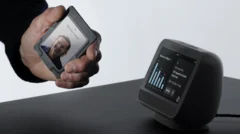
Microsoft is quietly testing a new kind of wearable AI gadget with its own employees. It’s not a smartwatch or a pair of glasses. It’s something far more subtle: a wearable access badge, paired with a desktop device, designed to bring artificial intelligence directly into the daily flow of office work.
What Microsoft’s Wearable AI Badge Actually Does
According to reports, the device is being tested internally by Microsoft staff. The core concept is simple but powerful. The wearable badge, likely equipped with sensors and microphones, can understand context. It knows when you’re in a meeting, when you’re at your desk, and when you’re on the move.
Paired with a desktop device, the system can then offer proactive assistance. Think of it as a personal AI assistant that is always with you, but without the need to pull out your phone or speak to a smart speaker. It could:
- Automatically log your activities for timesheets.
- Summarize a meeting you just walked out of.
- Remind you of action items based on conversations.
- Help you find a colleague’s location in the office.
The goal is to make AI an invisible, seamless part of the workday, reducing friction and boosting productivity.
Why This Matters Right Now
This isn’t just another gadget. It’s a signal of where Microsoft—and the entire tech industry—sees the future of work. After the remote work revolution, companies are desperate to make the office experience more valuable than working from home. A wearable AI that anticipates your needs could be the killer feature that makes the office feel smarter, not just a place to sit.
For employees, it raises a big question: would you wear a device that tracks your work patterns? For employers, the promise of data-driven productivity is tempting. But for everyone, it signals a world where the boundary between human intuition and machine assistance becomes even thinner.
How the Testing Is Unfolding Inside Microsoft
Microsoft is known for testing new hardware and software concepts internally before a public launch. The company has not officially confirmed the details of this specific wearable AI project, but sources indicate that the testing is active and focused on real-world office scenarios.
The “wearable access badge” is a clever form factor. It’s something employees already wear. By embedding AI into an existing object, Microsoft avoids the stigma of a new, bulky device. The desktop device likely acts as a hub, processing data and connecting to the cloud.
This approach is classic Microsoft: leverage existing infrastructure (badges, desks, Office 365) and add a layer of intelligent software.
Who Is Affected and What Officials Are Saying
Right now, the primary testers are Microsoft employees. But the implications are massive for anyone who works in an office. If the test is successful, this technology could be rolled out to Microsoft’s enterprise customers, potentially affecting millions of knowledge workers worldwide.
Microsoft has not issued a public statement about this specific device. However, the company’s broader strategy, as outlined in its Work Trend Index, emphasizes “human agency” and the need for AI to empower people, not replace them. This wearable badge fits that narrative perfectly—it’s designed to augment, not automate.
What We Know So Far — and What Remains Unclear
What we know:
- Microsoft is testing a wearable AI gadget.
- The form factor is an access badge.
- It is paired with a desktop device.
- Testing is internal with Microsoft employees.
What remains unclear:
- The exact AI capabilities and features.
- How the device handles privacy and data security.
- Whether it will ever be released to the public.
- The timeline for a potential launch.
- How it integrates with existing Microsoft products like Teams and Copilot.
Risks, Concerns, and the Balanced View
Any wearable device that listens and tracks activity raises serious privacy concerns. Employees might feel like they are being constantly monitored. The data collected—conversations, movement patterns, work habits—is incredibly sensitive.
Microsoft will need to address these concerns head-on. The company has a history of prioritizing enterprise security, but the perception of a “Big Brother” badge could be a major hurdle. Critics will argue that this is a step too far in workplace surveillance, even if the intent is productivity.
On the other hand, proponents will say that the data is anonymized and used to make work easier. The key will be transparency and control. If employees can opt out or control what the device tracks, adoption will be smoother.
Why Similar Trends in Wearable AI Are Growing
Microsoft is not alone. The entire tech industry is racing to make AI wearable. From Meta’s smart glasses to Apple’s rumored smart ring, the goal is the same: make AI an always-on, ambient assistant. The office is the perfect testing ground because it’s a controlled environment with clear productivity goals.
This trend is also driven by the limitations of smartphones. Pulling out a phone to ask an AI assistant is disruptive. A wearable badge that whispers a reminder or updates your calendar automatically is far more seamless. The future of AI is not in a screen you look at, but in a device you wear.
What Office Workers Should Know Now
If you work in a corporate environment, this is a development to watch. It signals that your employer might soon have access to tools that can track and optimize your workday in ways that were previously impossible.
For now, there is nothing to do but observe. But it’s a good time to start thinking about your own boundaries with workplace technology. How much data are you comfortable sharing? What would make a wearable AI worth wearing?
What Could Happen Next
If internal testing goes well, Microsoft could announce a pilot program with select enterprise customers later this year or in early 2026. A full commercial launch would likely follow, possibly as part of a new hardware line or a subscription service bundled with Microsoft 365.
The success of this device could redefine the modern office. It could make the workplace more intuitive and efficient. Or it could spark a new debate about privacy and the role of AI in our daily lives. Either way, the experiment happening inside Microsoft right now is a glimpse into that future.
Our Take: Why This Story Matters Beyond One Gadget
This is not just about a badge. It’s about the next frontier of human-computer interaction. Microsoft is betting that the most powerful AI is the one you don’t notice. By embedding intelligence into something as mundane as an ID badge, they are normalizing the idea of an AI companion.
The success or failure of this test will send ripples through the tech industry. If it works, expect every major office software company to follow suit. If it fails due to privacy concerns, it will set back the entire concept of workplace wearables. For now, all eyes are on Redmond.
FAQs
What is Microsoft’s wearable AI gadget?
It is a wearable access badge, combined with a desktop device, that uses AI to assist office workers with tasks like scheduling, note-taking, and activity logging. It is currently being tested internally by Microsoft employees.
How does the Microsoft AI badge work?
The badge likely contains sensors and microphones to understand context (e.g., in a meeting, at a desk). It pairs with a desktop device to process data and offer proactive assistance, such as reminders or summaries, without requiring manual input.
Is the Microsoft wearable AI gadget available to buy?
No. The device is currently in an internal testing phase with Microsoft employees. There is no official release date or confirmation that it will be sold to the public.
What are the privacy concerns with Microsoft’s wearable AI?
The main concern is constant monitoring. The device could track conversations, movement, and work patterns. Microsoft will need to ensure strong data security, transparency, and user control to address these valid privacy worries.