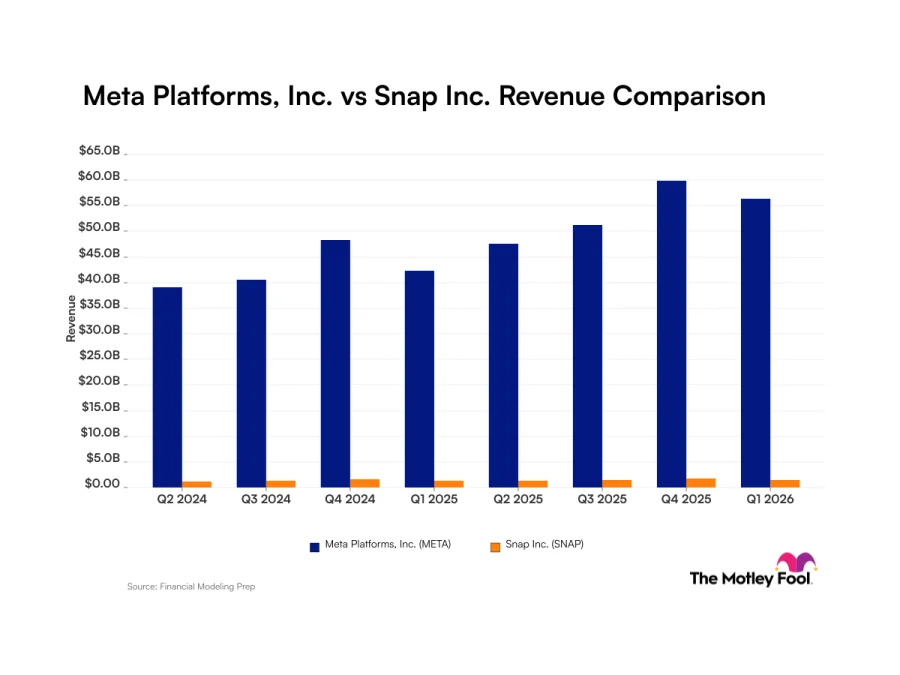
Two social media giants reported quarterly earnings this week, and the numbers tell a story of diverging fortunes. Meta Platforms posted $56.3 billion in Q1 revenue — a staggering 33% jump from last year. Snap, the company behind Snapchat, managed $1.5 billion, growing 12%. The contrast isn't just about size; it's about trajectory, strategy, and market dominance.
The Revenue Gap: More Than Just Numbers
Meta's quarterly revenue alone is nearly 38 times Snap's entire quarterly haul. To put it in perspective, Meta added more revenue in Q1 ($14 billion in year-over-year growth) than Snap generated in total. This isn't a new trend — the gap has been widening for years — but the acceleration is notable.
Why Meta Is Growing Faster
Meta's growth engine runs on multiple cylinders. Its Family of Apps — Facebook, Instagram, WhatsApp, and Messenger — generated $199 billion in 2025, according to company filings. AI-powered ad targeting has improved return on investment for advertisers, while Reels monetization has captured short-form video ad spend. Meta also benefits from a global user base of over 3 billion daily active people across its apps.
Snap's Challenge: Niche Audience, Slower Monetization
Snap's $5.36 billion in total 2025 revenue comes from a single segment: its Snapchat app. While the platform has a loyal, younger user base — particularly in North America and Europe — its ad revenue per user lags far behind Meta's. Snap's 12% growth rate, while respectable, reflects a smaller addressable market and slower adoption of its ad products among big-budget advertisers.
What This Means for Advertisers and Users
For businesses spending on digital ads, Meta offers scale, targeting precision, and proven ROI. Snap provides access to a hard-to-reach Gen Z audience but with less mature measurement tools. For users, Meta's dominance means more ads across its apps, while Snap remains a more curated, ad-light experience — for now.
How Both Companies Are Responding
Meta is doubling down on AI, with CEO Mark Zuckerberg emphasizing "AI-powered recommendations" and "automated ad creation" as growth drivers. Snap is investing in augmented reality (AR) shopping and its Spotlight feature to boost engagement and ad inventory. Both face regulatory pressure, particularly in Europe, around data privacy and antitrust.
The AI Factor: A Key Differentiator
Meta's massive data advantage fuels its AI models, making ad targeting more effective and driving higher prices per ad. Snap, with less user data and a smaller ad platform, cannot match this flywheel effect. Analysts believe Meta's AI investments will widen the gap further in 2026 and beyond.
Confirmed Facts vs What Remains Unclear
Confirmed: Meta's Q1 revenue of $56.3B (33% YoY growth); Snap's Q1 revenue of $1.5B (12% YoY growth); Meta's Family of Apps revenue of $199B in 2025; Snap's single-segment revenue of $5.36B in 2025.
Unclear: Whether Snap can accelerate growth to double digits consistently; how regulatory changes in Europe and the US will impact both companies' ad businesses; the long-term profitability of Snap's AR investments.
Meta's Moat: Network Effects and AI Scale
Meta's competitive advantage rests on three pillars: a global user network that attracts advertisers, AI infrastructure that improves ad performance, and a diversified app ecosystem that reduces dependency on any single product. Snap lacks this diversification and scale, making it more vulnerable to market shifts.
Risks and Balanced View
Meta faces antitrust investigations, privacy regulation, and the risk of user fatigue. Snap's smaller size means it could be an acquisition target, but also leaves it exposed to economic downturns that hit ad budgets. Critics argue that Snap's growth is too slow to justify its valuation, while supporters point to its unique AR capabilities and young user base as long-term assets.
Wider Trend: The Consolidation of Digital Advertising
The Meta-Snap gap reflects a broader industry shift: digital ad dollars are concentrating among the largest platforms — Meta, Google, Amazon, and TikTok. Smaller players like Snap, Pinterest, and Twitter (now X) struggle to compete for budget share. This trend benefits advertisers with scale but raises concerns about market concentration and reduced competition.
What Investors and Advertisers Should Watch
For investors, key metrics to track are Meta's ad revenue growth rate and Snap's path to profitability. For advertisers, the choice is between Meta's proven ROI and Snap's niche audience. Both companies will report Q2 results in July, which will provide the next data point on whether the gap is widening or stabilizing.
Future Outlook: Can Snap Close the Gap?
Most analysts believe Snap cannot close the revenue gap with Meta in the foreseeable future. However, Snap could carve out a profitable niche in AR advertising and younger demographics. Meta's challenge is maintaining growth as it faces regulatory headwinds and market saturation. The next 12-18 months will test both companies' strategies.
Our Take
The Meta vs Snap comparison is less a competition and more a study in scale economics. Meta's ability to invest billions in AI, acquire talent, and cross-sell across apps creates a virtuous cycle that Snap simply cannot replicate. That doesn't make Snap a bad company — it makes it a different kind of bet. For investors, Meta offers scale and momentum; Snap offers optionality and a younger user base. Both have merit, but the revenue numbers make clear which platform dominates the digital ad landscape today.
Frequently Asked Questions
How does Meta's revenue compare to Snap's?
Meta's Q1 2026 revenue of $56.3 billion is roughly 37.5 times larger than Snap's $1.5 billion. Meta's year-over-year growth rate of 33% also far exceeds Snap's 12%.
Why is Meta growing faster than Snap?
Meta benefits from a larger user base (over 3 billion daily active people), AI-powered ad targeting, diversified apps (Facebook, Instagram, WhatsApp), and better monetization of short-form video through Reels.
Is Snap a good investment compared to Meta?
Snap offers exposure to a younger, Gen Z audience and AR innovation, but its slower growth and smaller scale make it riskier. Meta provides more stable, large-scale revenue growth but faces regulatory risks. Investor goals and risk tolerance should guide the choice.
What does the revenue gap mean for advertisers?
Advertisers get better ROI and scale on Meta's platform due to its advanced targeting and larger audience. Snap offers a more niche, younger demographic but with less mature ad tools. Budget allocation depends on campaign goals.