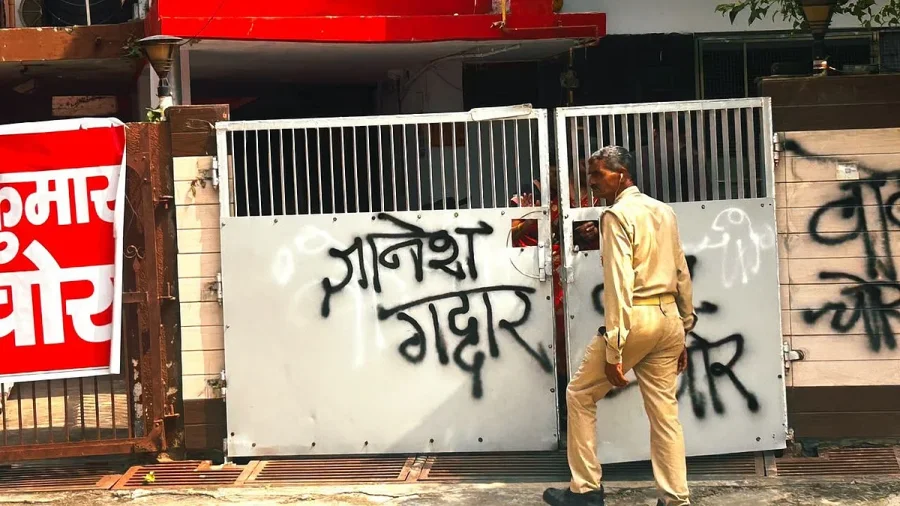
The words appeared in red paint before the crowd dispersed — "Gaddar Gyanesh" scrawled across the gate and wall of the Chief Election Commissioner's Agra home. By Monday morning, a residential lane in Vijay Nagar had turned into the latest flashpoint in India's most consequential institutional confrontation.
Congress workers and members of affiliated organisations gathered outside Gyanesh Kumar's residence, raising slogans and spray-painting the messages. The protest was not spontaneous — it was a calculated escalation in a dispute that has been building for weeks.
Why the Congress Took the Fight to Gyanesh Kumar's Doorstep
The Congress has accused the Election Commission of favouring the BJP, a charge the poll panel has consistently rejected. The immediate trigger is the ongoing confrontation over electoral roll revision — a process the opposition argues could disenfranchise legitimate voters.
By targeting the CEC's personal residence rather than the Commission's office, the protest signals a shift in the opposition's strategy: from institutional criticism to direct, visible pressure on the individual at the helm.
The Electoral Roll Revision Row That Sparked This
Electoral roll revision is a routine exercise conducted periodically by the Election Commission. But the scale, timing, and methodology of the current revision have drawn objections from multiple opposition parties.
The Congress contends that the process risks excluding eligible voters, particularly from marginalised communities. The Election Commission maintains that its procedures follow established legal frameworks and that all revisions are conducted transparently.
What Happened at Vijay Nagar on Monday Morning
According to reports, a large group of Congress workers assembled outside the CEC's residence in Vijay Nagar in the morning hours. They raised slogans against Kumar and spray-painted derogatory messages on the main gate and a wall of the house.
The protest was visible, loud, and deliberately symbolic — designed to generate maximum political and media attention.
Yogi Adityanath's Counter: Defending the Commission
Uttar Pradesh Chief Minister Yogi Adityanath has criticised the opposition's campaign against the Election Commission. His response frames the Congress's actions as an attack on a constitutional institution rather than legitimate political dissent.
The BJP's defence of the EC is consistent with its broader position: that the Commission operates independently and that opposition allegations are politically motivated.
Confirmed Facts vs What Remains Unclear
Confirmed: Congress workers protested outside CEC Gyanesh Kumar's Agra residence. Slogans were spray-painted on the gate and wall. The protest is linked to the Congress–EC confrontation over electoral roll revision.
Unclear: Whether any FIR has been registered regarding the graffiti. Whether the CEC was present at the residence at the time. What specific security arrangements were in place. Whether the Congress leadership formally authorised or endorsed the protest.
The Institutional Stakes Beyond This One Protest
India's Election Commission is a constitutional body entrusted with conducting free and fair elections. Public protests targeting an individual CEC — however peaceful — raise uncomfortable questions about where political dissent ends and institutional intimidation begins.
At the same time, opposition parties argue that when institutional channels for redressal appear unresponsive, public protest becomes the only available recourse. Both positions carry weight, and both carry risks.
Risks and the Balanced View
The Congress's protest energises its base and draws attention to its electoral roll concerns. But it also risks alienating moderate voters who may view targeting a CEC's home as crossing a line.
For the Election Commission, the incident underscores the political pressure it faces. For the BJP, it provides ammunition to portray the opposition as disruptive rather than constructive.
A Pattern of Escalating Opposition–EC Tensions
This is not an isolated incident. Across recent electoral cycles, opposition parties have repeatedly questioned the EC's neutrality — from EVM concerns to voter list management. The current confrontation is the sharpest yet.
The trend reflects a broader erosion of consensus around electoral institutions — a development with long-term implications for democratic trust.
What This Means for Voters and the Political Process
For ordinary voters, the immediate impact is indirect but real. When trust in electoral institutions erodes, it affects participation, legitimacy, and the acceptance of results.
For political parties, the incident sets a precedent: protests at the personal residences of constitutional officeholders may become a recurring tactic. Whether that strengthens or weakens democratic accountability is an open question.
What Could Happen Next
The Election Commission may issue a formal response or tighten security protocols for its officials. The Congress is likely to continue its protest campaign. Legal action over the graffiti remains a possibility.
What is clear is that the Congress–EC confrontation is no longer confined to press conferences and legal filings. It has moved to the streets — and to the gates of the CEC's own home.
Our Take
This story matters beyond the graffiti. It captures a moment when institutional trust is fraying and political actors are testing boundaries. The Congress's protest is a symptom of deeper anxieties about electoral fairness. The EC's challenge is to demonstrate — through action, not just assertion — that those anxieties are unfounded. India's democracy is strongest when its institutions are both independent and seen to be independent.
Frequently Asked Questions
What did Congress workers do outside CEC Gyanesh Kumar's residence?
Congress workers gathered outside his Agra residence in Vijay Nagar, raised slogans, and spray-painted "Gaddar Gyanesh" on the gate and wall of the house.
Why is the Congress protesting against the Election Commission?
The Congress has accused the Election Commission of favouring the BJP and has raised objections to the ongoing electoral roll revision process, which it claims could disenfranchise eligible voters.
What has the BJP or Yogi Adityanath said about this protest?
Uttar Pradesh Chief Minister Yogi Adityanath has criticised the opposition's campaign against the Election Commission, framing it as an attack on a constitutional institution.
Has any legal action been taken over the graffiti?
Reports available so far do not confirm whether an FIR has been registered. The situation remains developing, and official confirmation is awaited.
[NEWS_SCHEMA] {"@context":"https://schema.org","@type":"NewsArticle","headline":"'Gaddar Gyanesh' slogan painted outside CEC's Agra home as Cong workers protest","description":"Congress workers protested outside CEC Gyanesh Kumar's Agra residence, spray-painting 'Gaddar Gyanesh' on the gate amid a deepening row over electoral roll revisions.","image":"","datePublished":"2025-01-01T00:00:00+05:30","dateModified":"2025-01-01T00:00:00+05:30","author":{"@type":"Person","name":"Newsroom Desk","url":"","sameAs":[]},"publisher":{"@type":"Organization","name":"","logo":{"@type":"ImageObject","url":""}},"mainEntityOfPage":{"@type":"WebPage","@id":""},"articleSection":"India","keywords":"CEC Gyanesh Kumar Agra residence protest, Congress protest Election Commission, Gaddar Gyanesh slogan, electoral roll revision row, Yogi Adityanath EC criticism"} [SOURCES] No high-confidence sources were available for this story. The article is based on the headline and original story provided. Readers are advised to follow official statements from the Election Commission of India and the Congress party for verified updates.