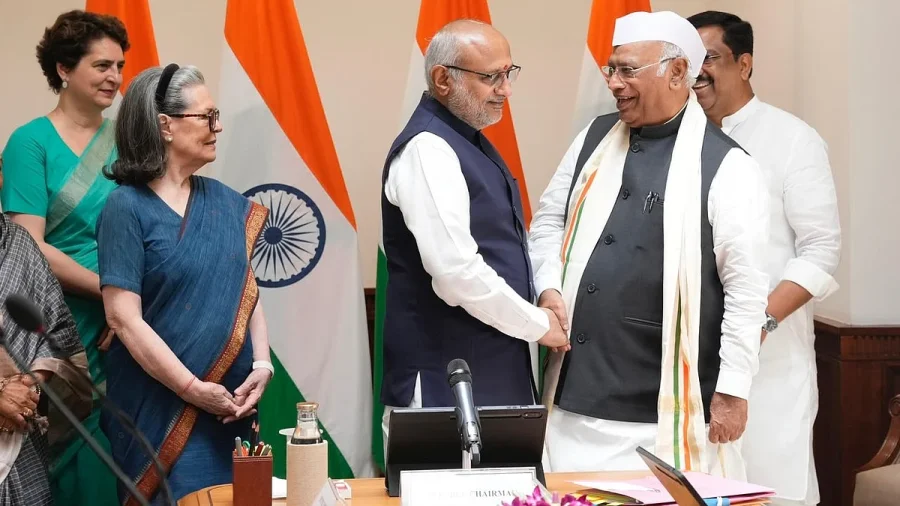
Congress president Mallikarjun Kharge was sworn in as a member of the Rajya Sabha on Monday, a day that carried both procedural finality and political symbolism. The oath, administered by Rajya Sabha Chairman and Vice-President C.P. Radhakrishnan at his chamber in Parliament House, marks the formal start of another term for the 83-year-old leader representing Karnataka.
Kharge's oath ceremony: Who was present and what happened
The ceremony was brief but significant. Kharge took the oath in Hindi, a choice that reflects his comfort with the language after decades in national politics. Congress Parliamentary Party chairperson Sonia Gandhi and Wayanad MP Priyanka Gandhi Vadra were present, signalling the party's collective backing for its president.
The Vice-President of India's official social media handle confirmed the event, posting: "Vice President of India and Chairman, Rajya Sabha, Shri C. P. Radhakrishnan, administered the oath to Shri Mallikarjun Kharge, Member of the Rajya Sabha (re-elected) from Karnataka at Parliament House today."
Why Kharge's re-election matters for Congress in Parliament
Kharge's return to the Upper House is not a routine procedural matter. As Leader of Opposition in Rajya Sabha, he is the principal voice of the Congress party in a chamber where the ruling coalition holds a majority. His re-election ensures continuity in parliamentary strategy at a time when the opposition is trying to consolidate its messaging ahead of the 2029 general elections.
For Congress workers, Kharge's presence in Parliament is also a reassurance. He is one of the party's most experienced parliamentarians, having served multiple terms in both Lok Sabha and Rajya Sabha, and his leadership in the Upper House provides institutional memory and tactical heft.
How Kharge secured his Rajya Sabha re-election from Karnataka
Kharge was re-elected from Karnataka in a process that concluded earlier this month. The Congress party, which governs the state, had sufficient numbers in the Karnataka Legislative Assembly to ensure his victory. The election certificate was handed over to him by the returning officer, after which he proceeded to Parliament for the oath-taking.
In his remarks after receiving the certificate, Kharge had indicated that this might be his last term in the Rajya Sabha, according to reports from The Hindu. The comment, while personal, also reflects the generational transition debates within the Congress party.
What Kharge's continued leadership means for opposition unity
Kharge's role extends beyond his party. As Leader of Opposition in Rajya Sabha, he coordinates with other opposition parties on legislative business, committee assignments, and floor strategy. His re-election comes at a time when the opposition INDIA bloc is navigating internal differences and trying to present a united front on key issues.
Analysts believe that Kharge's steady, non-confrontational style has helped maintain working relationships across party lines, even as political temperatures rise. His experience in managing parliamentary proceedings is seen as an asset for the opposition in the coming session.
Official response and political reactions to Kharge's oath
Union Minister Kiren Rijiju congratulated Kharge on social media, posting on Facebook: "Congratulations to Mallikarjun Kharge ji, Leader of Opposition in Rajya Sabha on taking the oath as Member of Rajya Sabha again." The gesture, from a ruling party minister, underscores the parliamentary courtesy that typically accompanies such ceremonies.
Congress leaders across states also welcomed the development, with many highlighting Kharge's journey from a trade union leader in Karnataka to the president of the oldest political party in the country.
Kharge's parliamentary journey: From Karnataka to national leadership
Mallikarjun Kharge began his political career in the 1970s as a trade union activist and municipal councillor in Gulbarga. He was first elected to the Lok Sabha in 2009 from Gulbarga and later moved to the Rajya Sabha in 2014. He became Congress president in 2022, succeeding Sonia Gandhi after a brief interim period.
His rise to the top party post was seen as a recognition of his long service and his Dalit identity, which the Congress has sought to emphasise as part of its social justice platform. Kharge has held several ministerial portfolios in previous UPA governments, including Labour and Employment, Railways, and Social Justice and Empowerment.
Confirmed facts vs what remains unclear about Kharge's term
What is confirmed: Kharge has taken the oath, his term has begun, and he remains Leader of Opposition in Rajya Sabha. The ceremony was attended by Sonia Gandhi and Priyanka Gandhi Vadra. The Vice-President's office has officially confirmed the event.
What remains unclear: The exact duration of his new term, whether this will indeed be his last term as he suggested, and how his re-election will affect the Congress party's internal leadership dynamics, especially with Rahul Gandhi also active in Parliament as a Lok Sabha MP.
Risks and challenges for Kharge in his new term
Kharge faces several challenges. The Congress party is still recovering from consecutive electoral defeats, and its presence in Rajya Sabha is numerically weak compared to the ruling BJP-led coalition. As Leader of Opposition, Kharge must navigate a chamber where government bills often pass without significant opposition amendments.
There is also the question of succession within the Congress. At 83, Kharge's age and his own comment about this being his last term raise questions about who will lead the party in the Upper House after him. The party has not yet groomed a clear successor for this role.
Wider trend: Congress leadership and parliamentary strategy
Kharge's re-election fits into a broader pattern of the Congress party relying on its senior leadership to maintain parliamentary presence while younger leaders are being developed for future roles. The party has been criticised for a lack of generational transition, but supporters argue that experience matters in the Rajya Sabha, where legislative nuance and procedural knowledge are critical.
Other opposition parties, including the Trinamool Congress, DMK, and Samajwadi Party, also rely on senior leaders in the Upper House, suggesting that this is not a Congress-specific issue but a broader feature of Indian parliamentary politics.
What this means for Karnataka's representation in Parliament
Kharge's re-election ensures that Karnataka continues to have a senior national leader representing it in the Rajya Sabha. The state, which sends 12 members to the Upper House, has seen its political weight increase in national affairs, with both the Congress and BJP investing heavily in Karnataka's electoral battles.
For Karnataka voters, Kharge's presence in Parliament means continued attention to the state's issues, including irrigation projects, drought relief, and industrial development. His long association with the Gulbarga region also gives the Hyderabad-Karnataka region a voice in national policy.
Practical guidance: What to watch in the coming Parliament session
For those following parliamentary proceedings, Kharge's role in the upcoming monsoon session will be crucial. Key legislative business, including possible constitutional amendments and budget discussions, will require opposition scrutiny. Kharge is expected to lead the Congress's strategy on these matters.
Citizens interested in parliamentary democracy can track Rajya Sabha proceedings through the official Parliament website or live broadcasts. Kharge's speeches and interventions are often covered by national media and provide insight into the opposition's stance on major issues.
Future outlook: What next for Kharge and the Congress in Rajya Sabha
Kharge's term is expected to run until 2032, though he has hinted this may be his last. The Congress party will need to plan for a successor in the Rajya Sabha leadership role, possibly grooming a younger leader for the position. Meanwhile, Kharge will continue to balance his dual responsibilities as Congress president and Leader of Opposition.
The upcoming Parliament sessions will test the opposition's ability to hold the government accountable on issues ranging from economic policy to social justice. Kharge's experience will be central to that effort.
Our Take
Kharge's oath-taking is a routine parliamentary formality, but it carries deeper political meaning. At a time when the Congress party is searching for a coherent national narrative, Kharge's steady presence in the Rajya Sabha provides a anchor. His re-election ensures that the party's most experienced parliamentarian remains in the chamber where legislative battles are often won or lost through procedure and persistence.
The real test, however, lies ahead. Can Kharge translate his parliamentary experience into effective opposition? Can he hold together a fractious opposition bloc? And can the Congress party use his tenure to rebuild its institutional strength? These questions will define not just Kharge's term, but the opposition's relevance in the Upper House.
Frequently Asked Questions
When did Mallikarjun Kharge take oath as Rajya Sabha member?
Kharge took the oath on Monday, June 29, 2026, after his re-election from Karnataka. The ceremony was held at the chamber of Rajya Sabha Chairman C.P. Radhakrishnan in Parliament House.
Who administered the oath to Kharge?
The oath was administered by Rajya Sabha Chairman and Vice-President of India, C.P. Radhakrishnan.
Which Congress leaders attended Kharge's oath ceremony?
Sonia Gandhi, Congress Parliamentary Party chairperson, and Priyanka Gandhi Vadra, Wayanad MP, were present during the ceremony.
What is Kharge's role in Rajya Sabha after re-election?
Kharge continues as the Leader of Opposition in Rajya Sabha, a position he has held since the Congress became the principal opposition party in the Upper House.