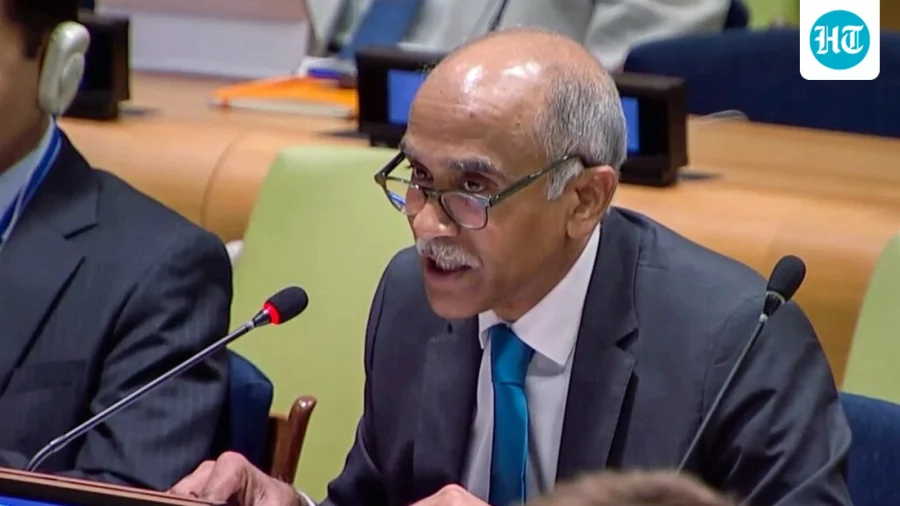
In a sharp diplomatic confrontation at the United Nations, India on Wednesday delivered a stinging rebuke to Pakistan after Islamabad attempted to raise the Jammu and Kashmir issue during an informal UN Security Council forum. India’s Permanent Representative to the UN, Ambassador Harish, did not mince words, accusing the co-chair of the forum of abandoning neutrality and politicising the platform for narrow national interests.
‘Incredible that a co-chair chose to politicise this forum’
“It is incredible that a co-chair expected to be balanced and unbiased in conduct has chosen to politicize this forum,” India said in its statement at the UNSC. The remark was a direct swipe at Pakistan, which was serving as a co-chair of the informal meeting. New Delhi made it clear that such behaviour undermines the credibility of multilateral forums meant for constructive dialogue.
Why this diplomatic clash matters for India’s sovereignty stance
For New Delhi, the message was unequivocal: Jammu and Kashmir is a bilateral issue between India and Pakistan, and no third-party mediation or forum discussion is acceptable. India’s position has been consistent since the abrogation of Article 370 in August 2019, and this latest exchange reinforces that there will be no shift in policy. For Indian readers, this is a reaffirmation of national sovereignty and a signal that the government will not tolerate external interference on a matter it considers purely internal.
How the UN forum exchange unfolded
The incident occurred during an informal meeting of the UN Security Council, a format often used for open discussions on regional issues. Pakistan, as co-chair, used the platform to raise the Kashmir issue, prompting an immediate and forceful response from India. The Indian delegation, led by Ambassador Harish, countered by reiterating that the Union Territory of Jammu and Kashmir “has always been, is, and will remain” an integral part of India. The exchange was brief but pointed, reflecting the deep-rooted tensions between the two nuclear-armed neighbours.
Who is affected by this diplomatic standoff
Beyond the diplomatic corridors, this exchange has implications for the people of Jammu and Kashmir, who have seen decades of conflict and cross-border tensions. For ordinary Indians, the government’s firm stance at the UN reinforces a sense of national pride and security. For the international community, it serves as a reminder that India will not entertain any attempts to internationalise the Kashmir issue, a position that has found support from several key allies.
India’s official response and what was said
India’s Permanent Mission to the UN issued a detailed statement, which was later shared by official channels. “Jammu and Kashmir has always been, is, and will remain an internal matter of India,” the statement read. The Indian delegation also reminded the forum that all outstanding issues between India and Pakistan should be resolved bilaterally, in accordance with the Simla Agreement and the Lahore Declaration. The statement did not name Pakistan directly but the target was unmistakable.
What this means for India-Pakistan relations at the UN
This is not the first time Pakistan has raised Kashmir at the UN, nor is it the first time India has pushed back. However, the tone of this particular exchange — with India calling out the co-chair for bias — signals a more aggressive diplomatic posture from New Delhi. Analysts believe India is increasingly unwilling to let Pakistan use multilateral forums to score political points without facing immediate and public rebuttal.
Confirmed facts vs what remains unclear
Confirmed: India’s Ambassador Harish made the statement at an informal UNSC forum. India accused the co-chair (Pakistan) of politicising the forum. India reaffirmed that J&K is an internal matter. Unclear: The exact wording of Pakistan’s remarks that triggered the response. Whether any other member nations commented on the exchange. The specific agenda item under which the issue was raised. All speculation about future UN resolutions or mediation remains unconfirmed.
India’s diplomatic strategy: Why this firm stance matters
India’s approach at the UN reflects a broader foreign policy doctrine: zero tolerance for external interference in domestic matters. By publicly calling out the co-chair, India is signalling to other nations that it will not remain silent when its sovereignty is questioned. This strategy has worked well for New Delhi in recent years, as it has successfully isolated Pakistan on the Kashmir issue at most international forums.
Risks and balanced view: The other side of the argument
While India’s stance is domestically popular, critics argue that the ongoing human rights situation in Kashmir and the lack of political dialogue within the region continue to draw international attention. Pakistan, despite its diminishing credibility, will likely continue to raise the issue at every available platform. Some diplomats suggest that India’s aggressive rebuttals, while effective, may also harden positions and reduce the space for any future bilateral engagement.
Wider trend: How India is reshaping its UN diplomacy
This incident is part of a larger pattern where India has become more assertive at the United Nations. From calling out Pakistan on terrorism to pushing for UN Security Council reform, New Delhi is no longer content to be a passive participant. The ability to quickly and forcefully respond to diplomatic provocations is now a hallmark of India’s UN strategy, reflecting its growing confidence on the global stage.
What Indians should understand about this diplomatic exchange
For the average reader, this story is a reminder that diplomacy is often conducted in sharp, public exchanges. India’s firm stance at the UN is not just about one statement — it is about setting a precedent that any attempt to question India’s territorial integrity will be met with an immediate and unequivocal response. Citizens should view this as a continuation of India’s consistent foreign policy, not a one-off reaction.
What could happen next at the UN and beyond
Pakistan is unlikely to stop raising the Kashmir issue at international forums, given its domestic political compulsions. India, in turn, will continue to counter these attempts with strong statements and diplomatic outreach to other member states. The next major test could come during the UN General Assembly session later this year, where both countries are expected to make their positions known. No immediate change in the status quo is expected.
Our Take
This diplomatic exchange, while brief, is significant because it shows India’s willingness to publicly embarrass Pakistan at a multilateral forum. By calling out the co-chair for bias, India has effectively turned the tables — making Pakistan’s attempt to internationalise Kashmir backfire. The statement was precise, legally sound, and diplomatically sharp. It reinforces the message that India will not be a silent spectator when its sovereignty is questioned. For readers, this is a moment of national assertion on the world stage, delivered with the kind of clarity that leaves no room for ambiguity.
Frequently Asked Questions
Why did India slam Pakistan at the UN?
India slammed Pakistan after Islamabad raised the Jammu and Kashmir issue during an informal UN Security Council forum. India accused the co-chair of politicising the forum and reaffirmed that J&K is an internal matter.
What did India say about Jammu and Kashmir at the UN?
India’s Ambassador Harish stated that Jammu and Kashmir “has always been, is, and will remain” an internal matter of India, rejecting any external interference or discussion at the UN.
What was Pakistan’s role in this UN forum exchange?
Pakistan was serving as the co-chair of the informal UNSC forum. India criticised the co-chair for abandoning neutrality and using the platform to raise the Kashmir issue, calling it a politicisation of the forum.
Does this mean India will not discuss Kashmir at the UN?
Yes, India’s consistent position is that Jammu and Kashmir is a bilateral issue between India and Pakistan, to be resolved under the Simla Agreement. India opposes any third-party mediation or UN discussion on the matter.