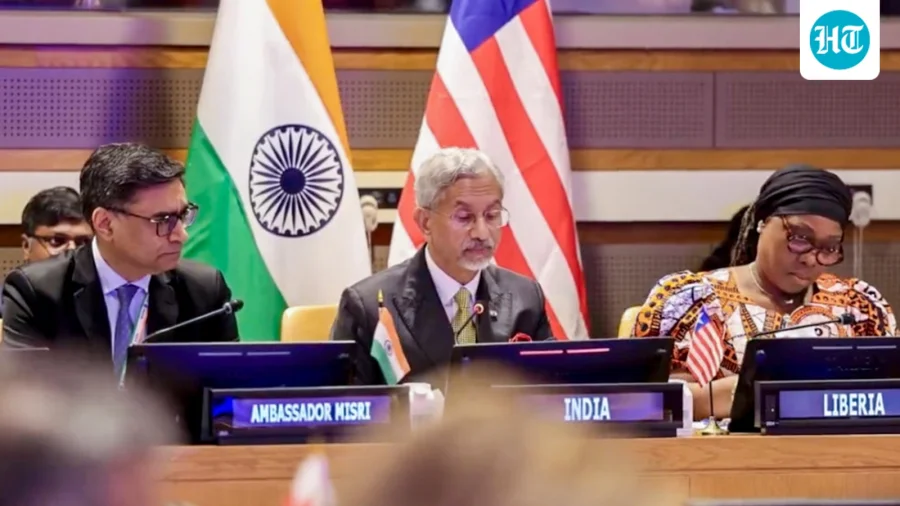
Every day, thousands of seafarers sail through some of the world's most dangerous waters to keep global trade moving. On the sidelines of the UN General Assembly's High Level Week in New York, India and Liberia moved to make their safety a formal international priority.
The two countries launched a new grouping — the 'Group of Friends on Safety and Security of Shipping and Seafarers' — aimed at rallying global attention to attacks on commercial vessels and the people who crew them.
A New Coalition Takes Shape at the UN
The announcement places maritime security squarely on the UNGA agenda. India, a major supplier of seafarers and a growing naval power, partnered with Liberia, whose flag is among the most widely used in global shipping.
That combination matters. One brings manpower and diplomatic weight; the other brings direct stakes in the commercial fleet that moves world trade.
Why This Grouping Matters Beyond the UN Floor
Attacks on shipping are not abstract. They disrupt supply chains, raise insurance costs, delay cargo, and — most critically — put lives at risk. Seafarers often work far from home, with limited protection and little recourse when violence strikes.
For India, the stakes are personal. A large share of the global maritime workforce is Indian, meaning any threat to shipping is, in effect, a threat to Indian families and livelihoods.
Jaishankar's Message: Action, Not Just Concern
External Affairs Minister S. Jaishankar used the platform to urge collective action against attacks on seafarers, framing the issue as one that demands more than statements of concern.
His message reflects a broader shift in Indian diplomacy — from raising maritime issues bilaterally to building coalitions that can shape international norms.
Who Is Affected — and Why It Matters to Real People
The people most directly affected are the crews aboard merchant ships: engineers, deck officers, and ratings who spend months at sea. Their families bear the uncertainty of not knowing what waters their loved ones are sailing into.
Beyond them, consumers feel it too — through higher freight costs that eventually feed into prices of fuel, food, and manufactured goods.
Confirmed Facts vs What Remains Unclear
Confirmed: The grouping was launched at UNGA High Level Week; India and Liberia are the founding partners; Jaishankar called for action against attacks on seafarers.
Unclear: The full list of member countries, the group's specific mandate, its meeting schedule, and any concrete enforcement mechanisms have not been publicly detailed.
Risks and a Balanced View
Groupings of this kind can raise awareness, but they do not automatically change behaviour on the water. Critics of such initiatives often note that without enforcement power or binding commitments, they risk becoming diplomatic talking points.
The real test will be whether the group can translate concern into coordination — on patrols, information-sharing, or legal accountability for attacks.
A Wider Pattern: Maritime Security Is Back on the Agenda
The launch fits a broader trend. In recent years, attacks on commercial shipping in key chokepoints have forced navies, insurers, and shipping companies to rethink risk. Multilateral platforms like this one reflect a growing recognition that no single country can secure the seas alone.
What Readers and Stakeholders Should Watch
Shipping companies, seafarer unions, and families of crew members should watch for the group's first formal meeting and any joint statements that follow. Those will indicate whether this is a symbolic gesture or the start of something operational.
Future Outlook
If the grouping attracts broad membership — particularly from flag states and major trading nations — it could become a useful forum for coordinating responses to maritime threats. If it remains limited, its impact may stay largely diplomatic.
Our Take
This is a small but meaningful step. India and Liberia have created a platform where the safety of seafarers can be discussed as a shared global interest rather than a scattered national concern. Whether it delivers will depend on what happens after the photo-ops end.
Frequently Asked Questions
What is the 'Group of Friends on Safety and Security of Shipping and Seafarers'?
It is a new international grouping launched by India and Liberia at the UN General Assembly to focus attention on protecting commercial shipping and seafarers from attacks.
Why did India and Liberia launch this group?
India supplies a large share of the world's seafarers, while Liberia's flag is widely used in global shipping. Both have direct stakes in maritime safety.
What did S. Jaishankar say at the launch?
He urged collective action against attacks on seafarers, stressing that the issue requires more than diplomatic concern.
Will this group have enforcement powers?
No enforcement mechanism has been announced. Its role appears to be diplomatic and coordinative, at least for now.