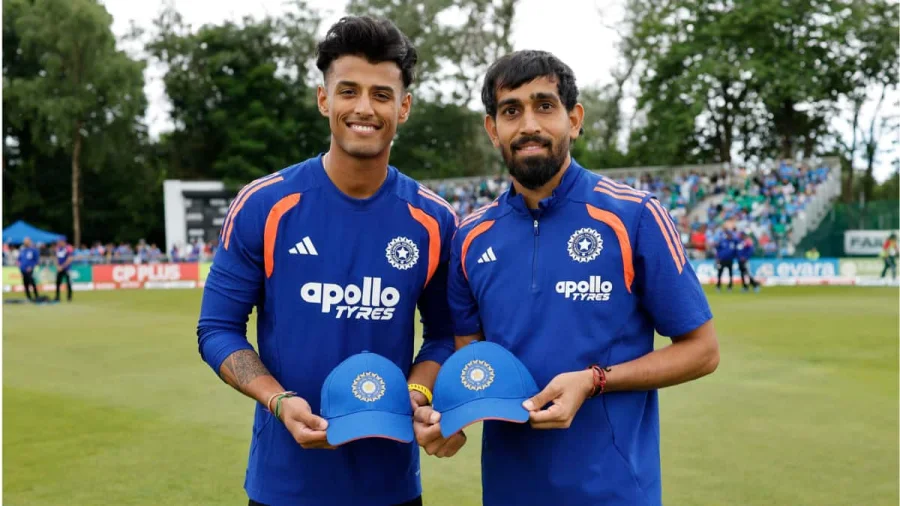
India added another chapter to their T20I history during the second match against Ireland as Suryansh Shedge and Prince Yadav received their maiden international caps. The duo became India's 120th and 121st T20I debutants, respectively, marking another milestone for the Men in Blue in the shortest format. With the latest additions, India now has the second-highest number of T20I debutants among all nations, trailing only Pakistan. The landmark also highlights India's continued effort to build depth across formats by rewarding strong performances in domestic cricket and the Indian Premier League.
Two New Faces Earn Their Opportunity
Suryansh Shedge, a hard-hitting all-rounder from Mumbai, and Prince Yadav, a promising fast bowler from Uttar Pradesh, were handed their T20I caps ahead of the second match against Ireland. Both players have impressed in domestic cricket and the IPL, earning their spots in the national squad through consistent performances. The decision to debut two players simultaneously reflects the team management's confidence in the bench strength and their willingness to test new talent in international conditions.
Why This Record Matters for Indian Cricket
The record of 121 T20I debutants is not just a statistic — it signals a deliberate strategy. India has been rotating players aggressively across formats, especially in T20Is, to build a deep pool of match-ready talent. This approach ensures that the team is not overly dependent on a few stars and can handle injuries, form slumps, and the demanding international calendar. For fans, it means more opportunities to see new heroes emerge, but it also raises questions about consistency and team stability.
How India Built This Record Over Time
India's journey to 121 T20I debutants began with the first T20I in 2006. Since then, the team has consistently introduced new players, especially in bilateral series and against associate nations. The IPL has played a crucial role in this pipeline, providing a platform for domestic talents to showcase their skills against international stars. The Board of Control for Cricket in India (BCCI) has also prioritized exposure tours and A-team fixtures to prepare players for the international stage.
What This Means for Players Like Shedge and Yadav
For Suryansh Shedge and Prince Yadav, the debut is a dream realized after years of hard work in domestic cricket. Shedge, known for his explosive batting and useful medium pace, has been a consistent performer for Mumbai in the Syed Mushtaq Ali Trophy. Yadav, a tall fast bowler, has impressed with his pace and bounce in the IPL and Ranji Trophy. Their selection sends a message to every domestic cricketer: consistent performances will be rewarded, regardless of the format or opposition.
Team India's Strategy Behind the Debuts
The Indian team management, led by head coach Gautam Gambhir and captain Shreyas Iyer, has emphasized the need to build a strong bench for future ICC tournaments. The decision to debut two players against Ireland, especially after losing the first match, shows a long-term vision rather than short-term results. Officials believe that exposing new players to international pressure, even in a series that may not be critical, will pay dividends in high-stakes tournaments like the T20 World Cup.
Breaking Down the Record: India vs Other Nations
India's 121 T20I debutants place them second only to Pakistan, who have introduced more players in the format. However, India's record is unique because of the quality and consistency of the players introduced. While many nations have experimented heavily, India has managed to maintain a high win rate despite frequent changes. This balance between experimentation and performance is what sets India apart in world cricket.
Confirmed Facts vs What Remains Unclear
Confirmed: Suryansh Shedge and Prince Yadav debuted in the second T20I against Ireland, becoming India's 120th and 121st T20I debutants. India now has the second-highest number of T20I debutants globally. Both players earned their spots through domestic and IPL performances.
Unclear: Whether both players will feature in the remaining matches of the series or if the team will continue to experiment. The long-term impact of this record on India's performance in major tournaments remains to be seen. Speculation: Some analysts believe this strategy could lead to a lack of settled combinations, but this is not confirmed by team management.
India's Domestic Cricket Pipeline: The Real Story Behind the Record
The record of 121 debutants is a direct result of India's robust domestic cricket structure. The Ranji Trophy, Syed Mushtaq Ali Trophy, and Vijay Hazare Trophy provide a steady stream of talent. The IPL acts as a finishing school, where domestic players train and compete alongside international stars. This ecosystem ensures that India never runs out of ready replacements, a luxury few other cricketing nations enjoy.
Risks and Balanced View: The Cost of Constant Experimentation
While the record is impressive, critics argue that constant experimentation can disrupt team chemistry and consistency. Players may feel insecure about their place in the XI, leading to performance anxiety. Additionally, debuting players against weaker opposition may not prepare them adequately for tougher challenges. Supporters counter that the strategy builds depth and ensures that no player is indispensable, fostering healthy competition within the squad.
A Wider Trend: How Other Teams Are Building Bench Strength
India is not alone in this approach. Teams like England, Australia, and New Zealand have also rotated players heavily in T20Is to build depth. However, India's sheer volume of debutants is unmatched among top-tier teams. This trend reflects the changing nature of international cricket, where bilateral series are increasingly used as testing grounds for future stars rather than just competitive contests.
What Fans and Aspiring Cricketers Should Take Away
For young cricketers in India, this record is a powerful reminder that the national team is always watching. Consistent performances in domestic cricket and the IPL can lead to an international call-up, even if the competition is fierce. For fans, it means every series offers the chance to witness the birth of a new star. The key is to support the team through the ups and downs of experimentation, knowing that the long-term goal is sustained success.
What Next for India's T20I Squad
India will look to level the series against Ireland in the remaining matches. The team management is expected to continue experimenting with the squad, giving opportunities to other fringe players. The focus will be on identifying a core group for the next T20 World Cup while ensuring that the bench remains strong. For Shedge and Yadav, the immediate goal will be to impress in the opportunities they get and cement their places in the squad.
Our Take
India's record of 121 T20I debutants is a testament to the depth of talent in the country and the forward-thinking approach of the team management. While constant experimentation carries risks, the benefits of a deep bench far outweigh the drawbacks in the long run. This record is not just about numbers — it is about building a system that ensures Indian cricket remains competitive for years to come. The real test will be how many of these debutants go on to become regulars in the XI and contribute to major tournament victories.
Frequently Asked Questions
What is India's new T20I record?
India created a unique T20I record by introducing Suryansh Shedge and Prince Yadav as debutants against Ireland, taking the total number of T20I debutants for India to 121, the second-highest in the world after Pakistan.
Who are Suryansh Shedge and Prince Yadav?
Suryansh Shedge is a hard-hitting all-rounder from Mumbai who has impressed in domestic cricket and the IPL. Prince Yadav is a fast bowler from Uttar Pradesh known for his pace and bounce. Both earned their India caps through consistent performances in domestic tournaments and the IPL.
Why does India debut so many players in T20Is?
India's strategy is to build a deep bench of match-ready players for all formats. By rotating players and giving opportunities to domestic talents, the team ensures it is not overly dependent on a few stars and can handle injuries, form slumps, and the demanding international calendar.
How does this record compare to other cricketing nations?
India now has the second-highest number of T20I debutants after Pakistan. Among top-tier teams, India's volume of debutants is unmatched, reflecting the country's robust domestic cricket structure and the IPL's role as a talent pipeline.
What does this mean for the future of Indian cricket?
The record signals a long-term vision to build sustained success. While constant experimentation may affect short-term consistency, the depth of talent ensures that Indian cricket remains competitive in all formats for years to come.