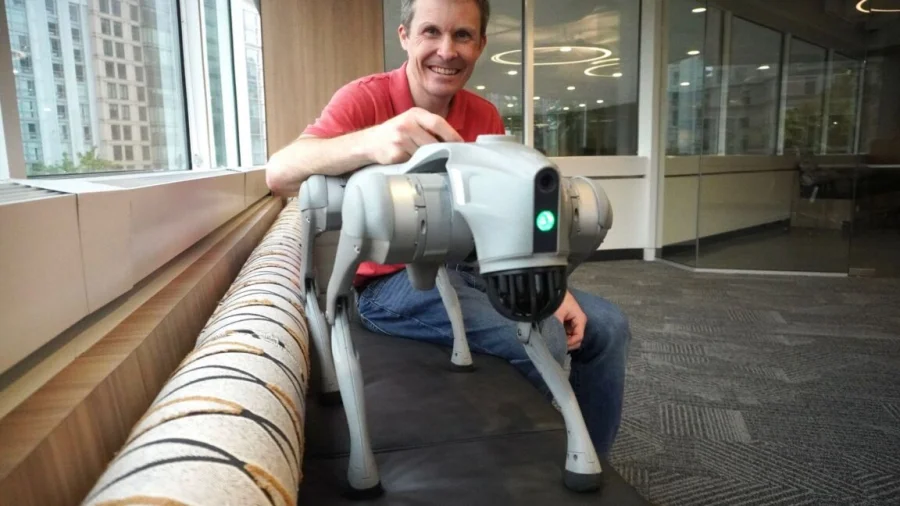
The reaction was immediate. Within minutes of stepping onto the sidewalk, the writer was surrounded — not by danger, but by curiosity. Strangers pulled out phones. Children pointed. A few asked if it was real.
It was. A quadruped robot dog, bought from China for roughly $4,000, was walking to work alongside its owner on a sunny June morning. And it turned an ordinary commute into a public spectacle.
A $4,000 Machine That Turns Heads and Raises Eyebrows
The robot dog — a four-legged machine designed to mimic the gait and posture of a biological canine — drew a crowd. According to the writer's account, people snapped pictures, asked whether it was homemade (it wasn't), and whether it was being used for surveillance (it wasn't).
That last question matters. It reveals something important: the public's first instinct when seeing a robot in public isn't wonder — it's suspicion.
Why a Robot Dog on a Sidewalk Feels Like a Glimpse of the Future
Affordable quadruped robots have moved from research labs to consumer storefronts. Chinese manufacturers have driven prices down dramatically, making machines that once cost tens of thousands of dollars available for the price of a used car.
That shift is significant. It means robots are no longer confined to factories or tech conferences. They're on sidewalks, in parks, and outside offices — and the people around them are still figuring out how to react.
Real Dogs Weren't Impressed
The writer noted that biological dogs kept their distance. Some growled. Others barked. The mechanical companion didn't respond — it simply kept walking.
That detail is more than anecdotal. It suggests that animals — and by extension, many humans — may struggle to categorize a machine that moves like a living creature but clearly isn't one.
The Surveillance Question Nobody Can Ignore
Several strangers asked if the robot was being used for surveillance. The answer was no. But the question itself reflects a broader anxiety: as robots become cheaper and more capable, who is watching whom?
Consumer quadruped robots typically come with cameras and sensors for navigation. Those same tools could, in theory, be used for monitoring. That ambiguity is likely to follow every robot dog into public space.
What This Says About China's Robotics Push
China has become a global leader in quadruped robotics, with companies like Unitree and others producing machines at price points that undercut Western competitors. The $4,000 price tag is part of that strategy — making advanced robotics accessible to individuals, not just institutions.
For buyers, that means more choice. For everyone else, it means more robots in shared spaces.
Confirmed Facts vs. What Remains Unclear
Confirmed: The writer bought a quadruped robot dog from China for about $4,000. They walked it in public. Strangers reacted with curiosity and questions. Real dogs reacted with distance or barking.
Unclear: The exact model, manufacturer, and technical specifications were not disclosed. The long-term reliability, repairability, and software support for such robots remain open questions.
Risks and Balanced View
Affordable robot dogs are impressive, but they're not without concerns. Battery life, durability, and the availability of spare parts can be issues. Privacy is another. And for every person who finds them charming, another may find them unsettling.
The writer's experience was positive — but it was also a novelty. Whether that novelty fades into normalcy or curdles into resentment depends on how the technology is used.
A Wider Trend: Robots Are Leaving the Lab
This isn't an isolated story. Quadruped robots are appearing in delivery trials, construction sites, and even as companions. The $4,000 price point is a milestone — it signals that the era of personal robots is no longer theoretical.
What happens when they become common? That's the question this walk to work quietly raised.
What Should Readers Take Away?
If you're considering buying a robot dog, know what you're getting: a machine, not a pet. It needs charging, maintenance, and patience. It will attract attention. And it may raise questions you didn't anticipate.
If you're simply encountering one in public, the writer's experience suggests curiosity is welcome — but so is caution.
Future Outlook
As prices fall and capabilities rise, robot dogs could become as common as e-bikes or drones. That will force new conversations about privacy, safety, and etiquette in shared spaces. The technology is here. The social rules aren't — yet.
Our Take
This story isn't really about a robot dog. It's about the gap between what technology can do and how society responds to it. A $4,000 machine from China can walk beside you. The harder question is whether we're ready to walk beside it.
Frequently Asked Questions
How much does a robot dog from China cost?
Prices vary by model and capability, but consumer quadruped robots from Chinese manufacturers can start around $1,600 and go up to $10,000 or more. The writer paid approximately $4,000.
Are robot dogs used for surveillance?
Some quadruped robots are equipped with cameras and sensors for navigation. While they are not inherently surveillance devices, their capabilities can be adapted for monitoring. The writer confirmed theirs was not used for that purpose.
Why do real dogs react to robot dogs?
Real dogs rely on scent, movement, and social cues. A machine that moves like a dog but lacks biological signals can confuse or unsettle them, leading to barking or avoidance.
Can anyone buy a quadruped robot?
Yes. Many Chinese manufacturers sell directly to consumers online. However, buyers should check import regulations, warranty terms, and software support in their country.