Usain Bolt's 9.58-second 100m world record stood as the ultimate test of human speed for over a decade. Now, a machine has beaten it — and the footage looks absolutely ridiculous.
The Moment Robots Outran the Fastest Human
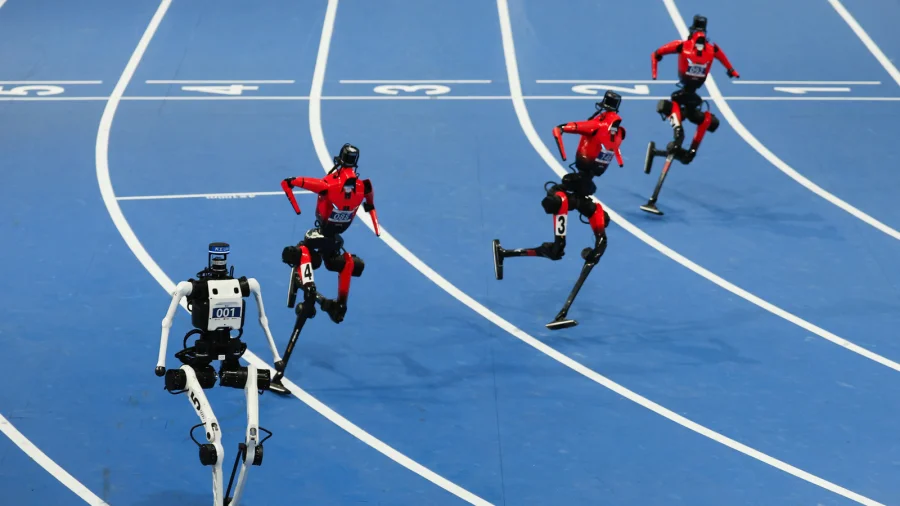
Humanoid robots have officially crossed the 100m finish line faster than Bolt's legendary time. The achievement is real, but the visual is pure comedy — robots flailing with exaggerated strides, arms pumping awkwardly, bodies leaning at unnatural angles.
It's not graceful. It's not smooth. But it is history.
Why This Feat Matters Beyond the Laughs
This isn't about robots being better athletes. It's about engineering breakthroughs in balance, torque, and real-time AI decision-making. For a bipedal machine to maintain stability at sprint speed is an enormous technical challenge.
Getting a robot to walk is hard. Getting one to run faster than the fastest human ever — that's a different league of control systems and hardware design.
How the Run Unfolded
The footage shows humanoid robots lined up on a standard track, then lurching forward with mechanical determination. Their form would make a sprint coach weep — but the stopwatch doesn't care about aesthetics.
Each stride covers massive ground, driven by powerful actuators and split-second balance corrections. The result: a time that shatters Bolt's mark, even if it looks like a robot having a tantrum.
What This Means for Everyday People
This breakthrough isn't just lab curiosity. Faster, more stable humanoid robots could transform disaster response, warehouse automation, elder care, and even space exploration. If a robot can sprint, it can navigate chaotic environments — collapsed buildings, factory floors, hospital corridors.
The technology behind this run will eventually walk into your daily life, whether it's delivering packages or assisting in emergencies.
No Official Word From Bolt Yet
As of now, there's no public response from Usain Bolt or his representatives. The Jamaican sprint legend has long been the gold standard for human speed, and seeing machines surpass his mark is bound to spark debate.
Bolt's record remains the human benchmark. The robot's time is a machine benchmark — impressive, but a different category entirely.
The Engineering Behind the Awkward Sprint
Humanoid running requires solving a brutal physics problem: stay upright while your entire body weight shifts violently with each stride. Engineers use advanced gyroscopes, force sensors, and predictive AI models to keep the robot from toppling.
The awkward arm flailing isn't a bug — it's a feature. Those movements help maintain angular momentum and balance at high speed.
Confirmed Facts vs What Remains Unclear
Confirmed: Humanoid robots have recorded a 100m time faster than 9.58 seconds. The footage shows the run clearly.
Unclear: The exact robot model, the precise recorded time, and the testing conditions have not been fully disclosed. Whether this was a single best run or a consistent capability remains unknown.
We'll update this story as more verified details emerge.
Why Robot Speed Is a Different Game
Comparing robots to human athletes is apples to oranges. Bolt's record is bound by human muscle, lungs, and bone structure. Robots have no such limits — they can be redesigned, reinforced, and optimized without biological constraints.
That's not to diminish the achievement. It's to put it in perspective: this is a robotics milestone, not an athletic one.
Risks and Balanced View
Not everyone is celebrating. Critics argue that chasing speed records distracts from more practical robotics challenges — like battery life, dexterity, and real-world reliability. A robot that can sprint but can't open a door has limited utility.
There are also concerns about the arms race in robotics development, with nations and corporations pouring billions into humanoid research. Ethical questions about automation displacing jobs remain unresolved.
The Bigger Pattern: Robots Are Getting Faster Everywhere
This sprint is part of a broader trend. From Boston Dynamics' parkour robots to Tesla's Optimus project, humanoid machines are advancing at breakneck pace. Each viral video marks a step toward robots that can work alongside humans in physical environments.
The 100m record is just the latest milestone in a decade of explosive progress.
What You Should Take Away From This
If you're watching the footage and laughing, enjoy it — but also pay attention. The same technology that looks silly on a track today will be doing serious work tomorrow. Whether it's in factories, hospitals, or disaster zones, these machines are coming.
For now, the takeaway is simple: human speed has a new rival, and it runs like a confused giraffe.
What Happens Next in Robot Racing
Expect faster times and smoother form. Engineers will refine gait algorithms, improve actuator response, and reduce mechanical lag. Within a few years, robots could run with something approaching human grace — or at least without looking like they're being chased by bees.
The record will fall again. That's the nature of technology.
Our Take
This story is equal parts impressive and absurd — and that's exactly why it matters. It reminds us that progress doesn't always look polished. Sometimes breakthroughs are clumsy, awkward, and a little ridiculous. But they're still breakthroughs.
Bolt's record remains a monument to human potential. The robot's run is a monument to human ingenuity. Both deserve respect — even if only one of them looks good doing it.
Frequently Asked Questions
Did a robot actually beat Usain Bolt's 100m record?
Yes, humanoid robots have recorded a 100m sprint time faster than Bolt's 9.58-second world record, according to the reported footage and claims. The exact time and robot model have not been fully verified.
How can a robot run faster than the fastest human?
Robots use powerful actuators, advanced balance sensors, and AI-driven gait control. Unlike human muscles, robot components can be engineered for maximum speed without biological limitations like oxygen debt or muscle fatigue.
Why does the robot look so awkward when running?
The exaggerated arm movements and strange strides help the robot maintain balance at high speed. It's a functional trade-off — stability over aesthetics.
Is this the end of human athletic records?
No. Human records like Bolt's remain benchmarks for biological performance. Robot records are a separate category, measuring machine engineering rather than human capability.