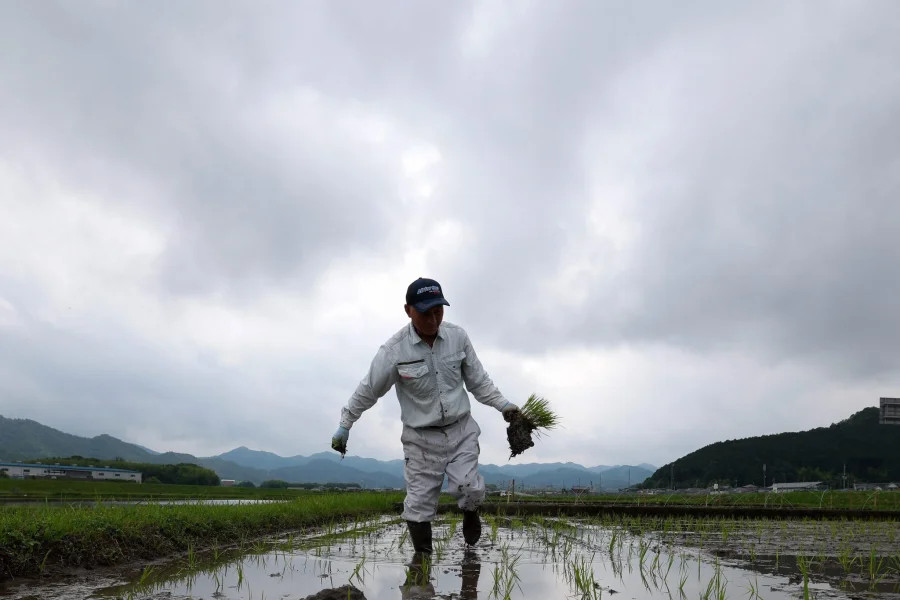
Two years ago, Japanese shoppers were being told to limit how much rice they bought. Today, the country is sitting on more of it than it knows what to do with — and the government is stepping in to buy it back.
It is one of the sharpest reversals in recent memory for a staple that sits at the centre of Japanese identity. And even the people who study Japanese agriculture for a living say they did not see it coming.
A Minister Lost His Job Over Empty Shelves
The shortage phase was severe enough to carry political consequences. A government minister resigned as the crisis deepened — a rare outcome for a food-supply issue in a country that has long treated rice as a matter of national stability.
For households, the shortage meant higher prices, purchase limits in some stores, and a sudden, uncomfortable uncertainty about a food most Japanese families had never had to think twice about.
Why a Rice Shortage in Japan Mattered Beyond Japan
Rice is not just a commodity in Japan. It is cultural infrastructure — tied to farming communities, regional economies, and a political system that has protected domestic growers for decades.
When supply tightened, the effects rippled outward: into household budgets, into restaurant pricing, and into a national conversation about whether Japan's food system was as resilient as it had assumed.
How the Shortage Built Up
According to the original reporting, the roots of the crisis trace back to 2023, when extreme heat and drought damaged the rice crop. That damage did not surface immediately — it worked its way through the supply chain and, a year later, turned into a national shortage.
Climate stress on a single harvest, in other words, was enough to destabilise a market that had been engineered for stability.
The Forces That Collided
Three pressures appear to have converged. Climate change disrupted yields. A tourism boom — with record numbers of visitors eating in Japan — added unexpected demand. And a trade fight with the United States introduced further uncertainty into agricultural markets.
None of these alone would likely have produced a crisis. Together, they did.
What the Experts Are Saying
Ryosuke Inoue, a visiting fellow at the CSIS Japan Chair in Washington, D.C., and an expert in Japanese agricultural policy, told Fortune that the scale of the swing surprised him.
"Every expert is actually surprised by this fluctuation," Inoue said, adding that he had not anticipated the size of the supply-demand gap.
From Shortage to Surplus — and a Buyback
By 2026, the picture had inverted. Japan was holding a record surplus, and the government began buying rice back off the market to keep prices from falling further.
That is a familiar tool in agricultural policy — but its use here signals how far the market had swung in the opposite direction.
Confirmed Facts vs What Remains Unclear
Confirmed: A 2023 heat and drought event damaged the crop. A national shortage followed in 2024, prompting a ministerial resignation. By 2026, Japan held a record surplus and the government was buying rice back.
Unclear: The precise weighting of climate, tourism, and trade factors in producing the swing. Analysts have not settled on a single dominant cause, and the full supply-demand data behind the reversal is still being examined.
Why the Swing Is So Hard to Explain
Agricultural markets usually move slowly. A shortage-to-surplus reversal of this magnitude, in roughly two years, is unusual — which is why researchers are still working through the mechanics.
Part of the difficulty is that the causes are not independent. A tourism surge changes demand. A trade dispute changes trade flows. A heatwave changes supply. When all three land in the same window, the resulting market signal becomes hard to read.
The Risks of Overcorrecting
Buying rice back off the market can stabilise prices in the short term, but it also raises questions about storage costs, long-term price signals to farmers, and whether the intervention masks a deeper structural problem.
If growers respond to the surplus by planting less, the next shortage could arrive faster than expected.
A Wider Pattern in Global Food Markets
Japan's experience fits a broader pattern: climate volatility is making once-predictable food systems less predictable, while tourism and trade policy add demand-side shocks that traditional agricultural planning was not built to absorb.
Countries that treat food security as a settled question may find it is not.
What This Means for Readers
For Japanese households, the immediate pressure of the shortage has eased — but the buyback suggests prices are now being managed downward rather than left to the market.
For anyone watching global food systems, the lesson is simpler: two years is enough time for a stable market to become a crisis, and for a crisis to become a surplus.
What Could Happen Next
Much depends on the next harvest, on whether tourism demand holds, and on how the trade dispute with the United States evolves. If any of those shift again, the market could move again — and quickly.
Officials have not signalled a change in the buyback approach. Analysts are watching for signs that the surplus is structural rather than temporary.
Our Take
The most striking thing about Japan's rice story is not the shortage or the surplus — it is the speed. A system built for stability moved from crisis to oversupply in the time it takes to complete a university degree.
That should worry any country that assumes its food supply is insulated from climate, tourism, and trade at the same time.
Frequently Asked Questions
Why did Japan have a rice shortage in 2024?
Extreme heat and drought in 2023 damaged the rice crop. The effects worked through the supply chain and produced a national shortage the following year, severe enough to force a government minister to resign.
Why does Japan now have a rice surplus?
By 2026, supply had recovered and demand dynamics had shifted, leaving Japan with a record surplus. The government is buying rice back off the market to prevent prices from falling further.
What role did tourism and the US trade fight play?
A tourism boom added demand for rice inside Japan, while a trade dispute with the United States introduced uncertainty into agricultural markets. Combined with climate-driven supply damage, these pressures collided.
What happens to the surplus rice now?
The government is purchasing rice back from the market to stabilise prices. How the surplus is ultimately managed — through storage, release, or other measures — remains a subject of ongoing policy discussion.