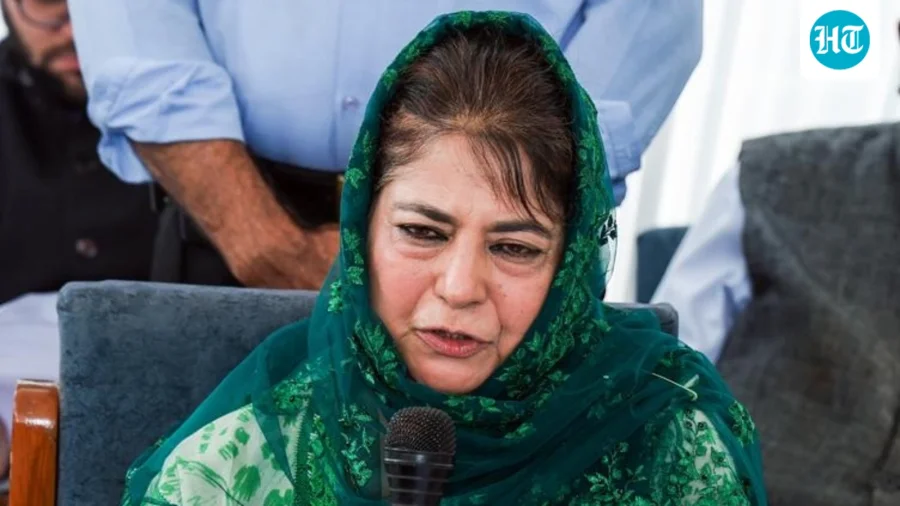
Former Jammu and Kashmir chief minister Mehbooba Mufti has sharpened her criticism of Prime Minister Narendra Modi over his address at the BRICS summit, saying India had the platform but chose not to use it. Her remark — "got the chair, kept mouth shut" — has quickly travelled across political circles and social media, turning a diplomatic speech into a domestic political flashpoint.
What Mehbooba Mufti Actually Said — And Why It Landed
According to the original report, Mufti argued that PM Modi missed an opportunity at the BRICS summit to reiterate India's role in global human rights. Her phrasing was deliberately blunt: India, she suggested, had secured a seat at the table but stayed silent on issues where its voice could have mattered.
The comment was not a policy paper — it was a political jab. But it landed because it touched a nerve: what does India say, and not say, when it holds the microphone at a global forum?
Why a BRICS Speech Became a Domestic Political Issue
BRICS — Brazil, Russia, India, China and South Africa, now expanded — is primarily an economic and geopolitical grouping. Human rights is not its central agenda. That is precisely why Mufti's criticism is being debated: should India raise rights concerns at a forum built around trade, energy and multipolarity, or does that risk its strategic balancing act?
For opposition voices, the silence is a missed moral moment. For the government's supporters, it is diplomatic pragmatism. Both readings are now competing in public discourse.
How This Fits Into a Longer Political Pattern
Mehbooba Mufti has repeatedly positioned herself as a critic of the central government's policies, particularly on Jammu and Kashmir. Her comments on foreign policy are less frequent, which is why this intervention stands out. It signals an attempt to widen her critique from regional governance to India's global image.
Whether that resonates beyond her existing support base is an open question. The source material does not indicate any coordinated opposition response so far.
Who This Actually Affects — Beyond the Headlines
For ordinary readers, the immediate impact is rhetorical, not material. No policy has changed. No diplomatic position has formally shifted. But the exchange matters because it shapes how India's global posture is debated at home — and how voters, students of international relations, and civil society groups interpret the country's silence or speech on the world stage.
Official Response: What We Know — And What We Don't
As of the source material available, there is no reported official response from the Prime Minister's Office, the Ministry of External Affairs, or the BJP to Mufti's specific remark. That absence is itself notable — but it should not be read as confirmation of anything beyond the fact that no response has been reported.
Reading the Subtext: Diplomacy vs. Domestic Messaging
Mufti's phrasing — "got the chair, kept mouth shut" — is designed for recall, not nuance. It frames India's global role as one of presence without voice. Critics of this framing argue that multilateral diplomacy is rarely about dramatic declarations; it is about quiet positioning, trade leverage and strategic ambiguity.
Both views can coexist. The real question is whether India's silence at BRICS was a calculated choice or a missed opportunity — and that depends on information the public does not fully have.
Confirmed Facts vs What Remains Unclear
Confirmed: Mehbooba Mufti made the statement criticising PM Modi's BRICS speech and said he missed a chance to reiterate India's role in global human rights.
Unclear: Whether the government will respond, whether other opposition leaders will amplify the remark, and what specific human rights issues Mufti was referring to. Any speculation beyond this is exactly that — speculation.
Risks and Balanced View
The risk in stories like this is over-reading a single political statement. Mufti's comment is a critique, not a policy shift. It does not change India's diplomatic stance, nor does it reflect a formal opposition position unless other leaders echo it.
At the same time, dismissing it entirely would miss the point: in a democracy, how leaders speak — or don't — on the global stage is a legitimate subject of public debate.
The Wider Trend: Foreign Policy as Domestic Politics
This is not an isolated incident. Across democracies, foreign policy speeches are increasingly consumed as domestic political content. A summit address is no longer just diplomacy — it is a signal to voters at home. Mufti's remark fits that pattern, and so does the speed with which it circulated.
What Readers Should Take Away
If you follow Indian politics, treat this as a political statement, not a diplomatic event. If you follow foreign policy, note that India's multilateral messaging is being watched closely — and criticised — from within. Either way, wait for an official response before drawing conclusions about what India did or did not say at BRICS.
Future Outlook
It remains to be seen whether this remains a one-day political remark or grows into a larger opposition talking point. If other leaders pick it up, it could become part of a broader critique of the government's foreign policy messaging. If not, it will likely fade — as most single-statement controversies do.
Our Take
Mehbooba Mufti's comment is sharp, quotable and politically pointed — but it is also a reminder that India's global voice is now judged as much at home as abroad. The story is not really about BRICS. It is about who gets to define what India's silence means.
Frequently Asked Questions
What did Mehbooba Mufti say about PM Modi's BRICS speech?
She said PM Modi missed an opportunity to reiterate India's role in global human rights at the BRICS summit, using the phrase "got the chair, kept mouth shut" to criticise the silence.
Why is this statement significant?
It shifts a diplomatic event into domestic political debate, questioning whether India should use global platforms to speak on human rights — a sensitive and contested issue.
Has the government responded to Mehbooba Mufti's remark?
No official response from the PMO, MEA or BJP has been reported in the available source material.
What is BRICS, and why does India's role matter?
BRICS is a grouping of major emerging economies — Brazil, Russia, India, China, South Africa and newer members. India's participation shapes its global positioning on trade, energy and multipolar diplomacy.