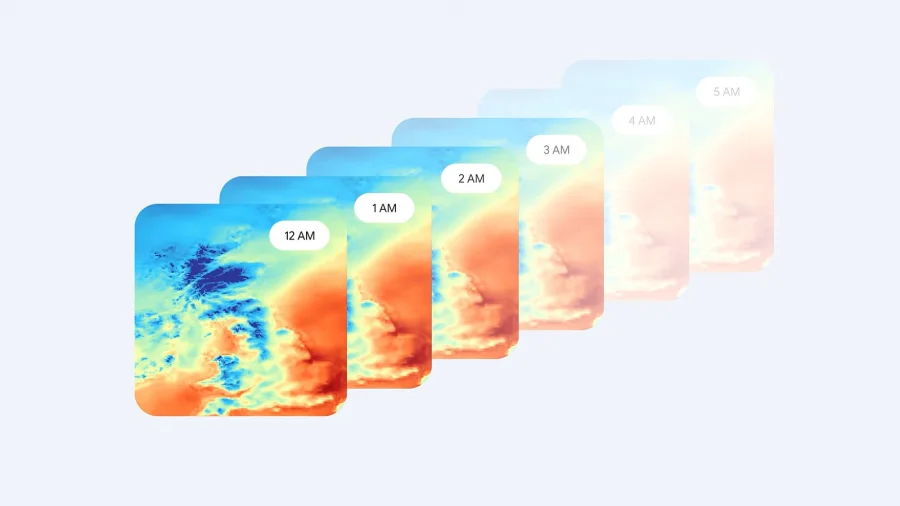
The next time you check your phone for rain, the forecast might have been generated by artificial intelligence that is watching the clouds form in real-time. Google has introduced WeatherNext 3, an AI weather model that pulls in live satellite data to create sharper, more accurate forecasts — with a particular focus on getting precipitation right.
What Makes WeatherNext 3 Different from Traditional Forecasts
Conventional weather forecasting relies on massive supercomputers running physics-based simulations. WeatherNext 3 takes a different path. It uses machine learning trained on vast amounts of atmospheric data, and now it can incorporate live satellite feeds directly into its predictions.
This allows the model to update its forecasts based on what is actually happening in the sky right now, rather than relying solely on initial conditions from hours ago. The result is a higher-resolution picture of weather systems as they develop.
Why Better Precipitation Prediction Matters for Everyday Life
Rain and snow are notoriously difficult to forecast. A few kilometers can separate a dry day from a downpour. For farmers deciding when to harvest, event organizers planning outdoor gatherings, or city authorities preparing for flash floods, accurate precipitation prediction is not a luxury — it is a necessity.
Google claims WeatherNext 3 is significantly better at predicting precipitation than previous models. If this holds up in practice, it could mean fewer surprise storms and more reliable warnings for the public.
The Evolution of AI in Weather Forecasting
Google's push into weather AI did not happen overnight. The company has been developing machine learning models for atmospheric science for years, gradually improving their ability to handle the chaotic nature of weather systems.
WeatherNext 3 represents the next logical step: moving from static data analysis to dynamic, real-time integration. By feeding the model live satellite imagery, Google is essentially giving the AI eyes that can watch storms form and evolve.
Who Stands to Benefit Most from This Technology
The most immediate beneficiaries are likely to be industries that depend heavily on weather accuracy. Aviation, shipping, agriculture, and renewable energy companies all make decisions based on forecast confidence.
For the general public, the impact could be felt through more accurate weather apps and earlier warnings for severe weather events. In a country like India, where monsoons dictate agricultural cycles and daily life, improved precipitation forecasting could have profound practical implications.
What Google Has Said About WeatherNext 3
Google has highlighted WeatherNext 3's ability to deliver higher-resolution forecasts as a key breakthrough. The company emphasizes that the model's strength lies in its use of live satellite data, which allows it to adapt quickly to changing atmospheric conditions.
While detailed technical specifications are still emerging, the core claim is clear: this AI model is designed to see weather more clearly and predict rain more accurately than what has come before.
Analyzing the Shift Toward AI-Driven Meteorology
The move toward AI weather models represents a philosophical shift in meteorology. Traditional models solve complex physics equations. AI models learn patterns from historical and real-time data. Neither approach is perfect, but AI offers speed and adaptability that physics-based models struggle to match.
WeatherNext 3 does not necessarily replace traditional forecasting — it augments it. The real question is how quickly these AI systems can earn the trust of meteorologists who have relied on conventional methods for decades.
What Is Confirmed vs What Still Needs Proof
What is confirmed is that Google has developed an AI weather model that uses live satellite data and claims improved precipitation prediction. The technical architecture and training methodology are part of Google's announcement.
What remains unclear is how WeatherNext 3 performs in real-world operational settings compared to established forecasting systems. Independent validation and peer review will be essential before the broader meteorological community fully embraces these results.
Why Google's Approach to Weather AI Matters
Google brings unique advantages to weather forecasting: massive computational resources, advanced machine learning expertise, and access to vast datasets through its cloud infrastructure. This combination allows the company to push the boundaries of what AI can achieve in atmospheric science.
The company's ability to process and learn from live satellite feeds at scale is a technical moat that few competitors can easily replicate. This positions Google as a serious player in the future of weather intelligence.
Potential Limitations and Open Questions
AI weather models are not without their critics. Some meteorologists worry about the "black box" problem — AI systems can produce accurate forecasts without explaining why, which makes it difficult to understand failures when they occur.
There are also questions about data quality. Live satellite data is only as good as the sensors that collect it, and gaps in coverage can lead to blind spots. WeatherNext 3's performance in data-sparse regions, particularly over oceans and developing countries, remains to be tested.
The Broader Trend of AI in Climate and Weather Tech
WeatherNext 3 is part of a larger wave of AI applications in climate science. From predicting extreme weather events to modeling long-term climate change, machine learning is becoming an indispensable tool for understanding our atmosphere.
Google's investment in this space signals that tech giants see weather intelligence as both a scientific challenge and a commercial opportunity. The ability to forecast weather more accurately has value across insurance, logistics, agriculture, and disaster management.
What You Should Know About the Future of Weather Forecasts
For the average person, the practical takeaway is that weather forecasts are likely to become more accurate over time. AI models like WeatherNext 3 are pushing the boundaries of what is possible, and the benefits will eventually trickle down to the apps and services people use daily.
If you rely on weather forecasts for work or travel, it is worth paying attention to how AI models are being integrated into the services you use. The days of checking the sky and hoping the forecast matches may be numbered.
What Could Happen Next with WeatherNext 3
The immediate next step is likely to be rigorous testing and validation. Google will need to demonstrate that WeatherNext 3 performs reliably across different geographies and weather conditions before it can be widely adopted.
Longer term, this technology could be integrated into Google's consumer weather products or offered as a service to meteorological agencies and businesses. The potential for AI to transform weather forecasting is only beginning to be realized.
Our Take
WeatherNext 3 is a reminder that artificial intelligence is moving from answering questions to predicting the future. The ability to forecast rain with greater precision is not just a technical achievement — it has real consequences for food security, public safety, and economic productivity.
But the hype around AI weather models should be tempered with patience. The proof will come not in press releases, but in months and years of operational performance. If WeatherNext 3 delivers on its promise, it could mark a turning point in how the world prepares for weather. If it falls short, it will be a valuable lesson in the limits of AI.
Frequently Asked Questions
What is Google's WeatherNext 3?
WeatherNext 3 is Google's new AI weather model that uses live satellite data to generate higher-resolution forecasts. It is specifically designed to improve precipitation prediction compared to earlier AI weather models.
How is WeatherNext 3 different from traditional weather forecasting?
Traditional forecasting relies on physics-based supercomputer simulations, while WeatherNext 3 uses machine learning trained on atmospheric data. Its key differentiator is the ability to incorporate live satellite data in real-time for more adaptive and higher-resolution predictions.
Why is better precipitation prediction important?
Accurate rain and snow forecasts are critical for agriculture, disaster preparedness, aviation, and daily planning. Small differences in predicted precipitation can have major impacts on farming decisions, flood warnings, and outdoor activities.
Is WeatherNext 3 available to the public?
Google has announced the model, but details about public availability or integration into consumer weather products have not been fully disclosed. The immediate focus is likely on validation and potential partnerships with meteorological organizations.