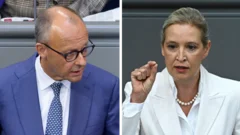
Chancellor's Sharp Rebuke in Parliament
In a debate marked by visible tension, Merz did not hold back. He directly challenged Weidel's stance on immigration, framing her policies as not just restrictive but fundamentally discriminatory. The chancellor's use of the term "ethnic cleansing" was a deliberate and powerful escalation, designed to draw a clear moral line against the AfD's platform. The accusation dominated the session, turning the debate into a referendum on the country's direction.Why the Far-Right Surge is Shifting Germany's Political Center
This fiery exchange is not merely a parliamentary spat; it is a symptom of a profound shift in Germany's political landscape. The AfD's electoral win has broken traditional taboos and forced migration policy to the center of national discourse. For many citizens, the rise of the AfD represents a growing anxiety about immigration and cultural change, while for others, it is a dangerous echo of the past. This debate encapsulates that societal fracture, with the chancellor positioning himself as the guardian of a more inclusive Germany.From Election Night to Parliamentary Showdown
The path to this confrontation began with the AfD's landmark performance at the polls, which marked the party's strongest showing to date. The result immediately put the mainstream parties on the defensive. In the days that followed, pressure mounted on Merz to articulate a clear response. The debate served as the primary stage for this response, where the chancellor sought to reclaim the narrative on migration and define the AfD's policies as outside the bounds of acceptable governance.The Human Cost Behind the Political Rhetoric
Beyond the political maneuvering, the debate touches on the lives of thousands of skilled migrants who call Germany home. Merz's argument suggests that the AfD's vision would not only close the door to new talent but also alienate the foreign-born workers already integral to Germany's economy. From engineers in Bavaria to doctors in Berlin, these individuals represent the human stakes of the policy clash. The chancellor's rhetoric aimed to highlight the practical and moral consequences of the AfD's agenda for these communities.Official Positions and the Battle for the Narrative
According to reports from the debate, Weidel defended her party's platform, arguing that her policies are about preserving German culture and securing national borders. She dismissed the chancellor's accusations as scaremongering from an out-of-touch elite. The exchange underscores a fundamental disagreement over the very definition of German identity in the 21st century. Both leaders are now appealing to different visions of the nation, with the AfD tapping into frustration and Merz appealing to established democratic norms.Decoding the 'Ethnic Cleansing' Accusation
The chancellor's choice of words was calculated to resonate historically. By invoking a term associated with genocide, Merz aimed to frame the AfD's migration policy not as a legitimate political alternative, but as a moral transgression. Analysts suggest this is an attempt to create a "cordon sanitaire" around the AfD, making them a pariah in coalition politics. The strategy is high-risk; while it may energize the chancellor's base, it could also be seen as hyperbolic by voters who are concerned about immigration pressures.What is Confirmed vs. What Remains a Point of Contention
What is confirmed is that Merz made the explosive accusation during the debate and that the session was notably confrontational. It is also a fact that the AfD recently achieved a historic electoral victory. However, the characterization of the AfD's policy as "ethnic cleansing" remains a matter of intense political debate, not a legal or historical fact. The long-term political fallout of this clash is still unclear, as is the question of whether this rhetoric will galvanize opposition to the AfD or further polarize the electorate.Germany's Democratic Guardrails Under Pressure
This confrontation is a test of Germany's post-war democratic resilience. The country's political system was built on the principle of never again allowing extremism to take hold. The AfD's success challenges this foundational premise. The debate highlights the struggle of established parties to counter a populist force that operates outside traditional norms. How Germany navigates this challenge will be a defining issue for the continent, as other European nations watch closely to see if the democratic center can hold.Risks and the Battle Lines Being Drawn
Critics of the chancellor's approach argue that attacking the AfD with such forceful language only serves to amplify their message and cast him as part of a detached elite. They suggest that engaging in a war of words legitimizes the far-right as a primary opposition. Conversely, supporters of Merz believe that a strong moral stance is essential to prevent the normalization of extremist views. The risk for the government is that this debate could overshadow its own policy agenda, keeping the focus on the AfD's talking points rather than the ruling coalition's plans.A Pattern of Rising Nationalism Across Europe
Germany's situation is not isolated. The AfD's surge mirrors a broader trend of rising nationalist and populist parties across Europe, from France to Italy. This pattern suggests a continental shift in voter priorities, driven by concerns over globalization, security, and identity. The German debate is therefore a microcosm of a larger European struggle over the future of the European Union and the values it represents. The outcome of this clash in Berlin could have ripple effects on policy and political strategy in capitals across the bloc.What Germans and Observers Should Watch For Now
For voters and political observers, the immediate takeaway is that Germany is entering a period of heightened political volatility. The debate signals that the government will likely take a harder line against the AfD, but it also reveals deep societal divisions. For citizens concerned about the far-right's rise, this moment calls for increased civic engagement and support for democratic institutions. For the international community, it is a reminder that the stability of Europe's largest economy is not a given, but a continuous project that requires active defense.The Road Ahead for Germany's Coalition
Looking forward, the central question is how Chancellor Merz will translate this rhetorical offensive into policy. The debate may be the opening salvo in a campaign to isolate the AfD, but it also raises the stakes for the government to deliver on its own promises regarding immigration and the economy. The coming months will reveal whether this strong stance can unify the pro-democratic parties or if it will further fragment an already volatile political landscape.Our Take
This stormy debate is more than a clash of personalities; it is a defining moment for the German republic. Chancellor Merz's forceful language signals a new, uncompromising phase in the fight against political extremism. While the "ethnic cleansing" accusation is provocative, it serves to draw an unambiguous line in the sand. The true test, however, lies ahead. The government must now prove that it can address the legitimate concerns of its citizens while steadfastly defending the democratic values that the AfD's rise threatens to undermine. This is not just a political battle; it is a battle for the soul of modern Germany.Frequently Asked Questions
What did Chancellor Merz accuse the AfD of?
Chancellor Friedrich Merz accused the AfD, led by Alice Weidel, of pursuing a migration policy that amounts to "ethnic cleansing" for skilled workers, a sharp escalation in political rhetoric during a parliamentary debate.
Why is the debate between Merz and Weidel significant?
The debate is significant because it follows a historic electoral win for the far-right AfD and highlights the deep political polarization in Germany over immigration, national identity, and the future direction of the country.
What is the context of the AfD's recent election win?
The AfD recently achieved its strongest electoral result to date, marking a major shift in Germany's political landscape and prompting mainstream parties, including Chancellor Merz's, to adopt a more confrontational stance against the far-right party.
How has Alice Weidel responded to the chancellor's attack?
Alice Weidel has defended her party's platform, framing her policies as necessary for preserving German culture and securing borders, and dismissing the chancellor's accusations as scaremongering from the political elite.