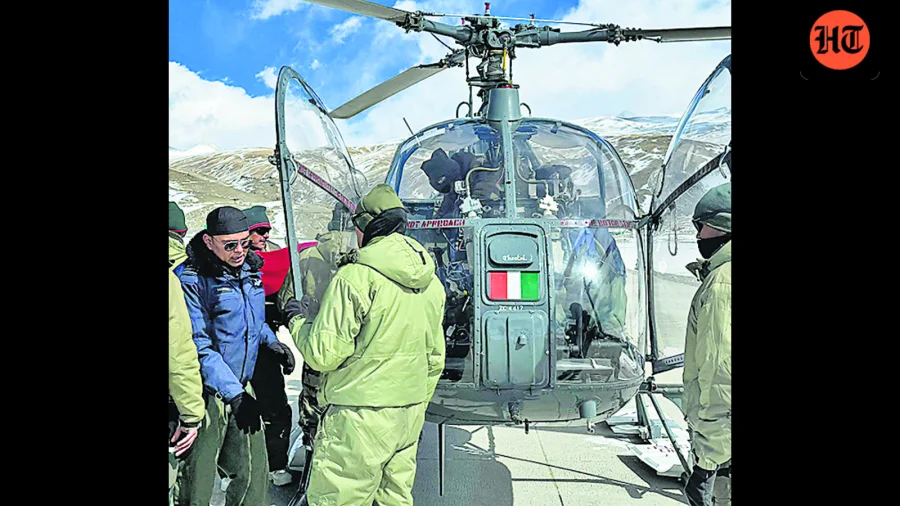
Every day, Cheetal helicopters lift off from dusty airstrips in Ladakh, ferrying supplies and soldiers to some of the world’s highest battlegrounds. They do so even as investigators sift through wreckage from a May 20 crash that killed one pilot — a crash now believed to have been caused by a material failure in the helicopter’s transmission system.
Crash probe zeroes in on transmission failure
The May 20 crash has become a focal point for concerns about the ageing fleet. According to sources familiar with the investigation, the probe has narrowed in on a possible material failure in the single-engine Cheetal’s transmission system. This is a critical component that transfers power from the engine to the rotor blades. A failure here, especially during a high-altitude manoeuvre, leaves the pilot with almost no margin for error. The exact cause, however, has not been officially confirmed, and investigators are still examining metallurgical samples.
Why Ladakh cannot afford to ground the Cheetal
For the Indian Army, grounding the Cheetal fleet is not an option. In Ladakh, where roads are seasonal and oxygen is thin, these helicopters are the only reliable way to move men and material to forward posts at altitudes above 15,000 feet. The Cheetal, a high-altitude variant of the Cheetah, is uniquely suited for this role due to its light weight and powerful engine. Without it, supply lines to remote border outposts would be severely strained, especially during winter when ground routes are blocked by snow.
Six decades old and still irreplaceable
The Cheetal, along with its siblings the Cheetah and Chetak, is a design from the 1960s. Originally built under licence from France’s Aérospatiale, these helicopters have outlived every planned replacement cycle. Successive attempts to find a modern substitute — from the indigenous Light Utility Helicopter (LUH) to the Dhruv and Light Combat Helicopter (LCH) — have faced delays, technical issues, or have not been cleared for the same high-altitude roles. The result: a fleet of helicopters older than most of their pilots remains the backbone of Army aviation in the Himalayas.
The human cost of flying ageing machines
For the pilots and crew operating in Ladakh, every flight carries an unspoken weight. The Cheetal is a single-engine helicopter — if the engine or transmission fails, there is no backup. The terrain below offers no safe landing zones. The May 20 crash was a grim reminder of this reality. While the Army maintains rigorous safety protocols and the fleet undergoes regular overhauls, the fundamental risk of flying a 60-year-old design in extreme conditions cannot be eliminated. The pilot who died was performing a routine mission when the transmission failed.
Army’s response: balancing risk and necessity
The Indian Army has not officially commented on the crash investigation, but its actions speak clearly. By keeping the Cheetal fleet operational, the service has signalled that the immediate need to maintain logistics in Ladakh outweighs the risk of a temporary grounding. Officials have stated that safety checks have been intensified and that any aircraft showing signs of transmission wear is being pulled for inspection. However, with no replacement available, the Army is effectively managing risk rather than eliminating it.
What a transmission failure means at 15,000 feet
To understand the danger, consider what a transmission system does. It is the mechanical link between the engine and the rotor blades. In a helicopter, if the transmission fails, the rotor can stop or lose power, causing an immediate loss of lift. At sea level, a skilled pilot might autorotate to a landing. At 15,000 feet in the Himalayas, the air is too thin for a safe autorotation, and the terrain is too rugged for an emergency landing. A transmission failure at altitude is often catastrophic. This is why the probe’s focus on material failure is so significant — it points to a systemic vulnerability in the fleet.
Confirmed facts vs what remains unclear
Confirmed: A Cheetal helicopter crashed in Ladakh on May 20, killing one pilot. The investigation is focused on a possible material failure in the transmission system. The Cheetal fleet remains operational. The Army has no immediate replacement for these helicopters.
Unclear: The exact cause of the material failure — whether it was a manufacturing defect, metal fatigue, or maintenance issue — has not been determined. The timeline for introducing replacement helicopters is uncertain. It is also unclear if the Army has grounded any specific aircraft pending inspection results.
Why the Cheetal’s design still matters
The Cheetal’s longevity is not just about a lack of alternatives. The helicopter’s design — light, simple, and powerful — is uniquely suited to high-altitude operations. Its single engine, while a risk, also makes it lighter and more fuel-efficient than twin-engine alternatives. The Cheetal can operate from small, unprepared landing zones that larger helicopters cannot access. This combination of simplicity and capability has made it irreplaceable for the Army’s high-altitude needs. No modern helicopter has yet matched this specific performance profile at the same cost and reliability.
Risks and the case for caution
Critics argue that continuing to fly a fleet with a suspected systemic failure is an unacceptable risk. They point to the single-engine design as an inherent vulnerability that no amount of maintenance can fully address. The May 20 crash, they say, is a warning that cannot be ignored. On the other hand, military planners counter that grounding the fleet would create a greater risk — leaving troops in forward posts without supply. The debate is not about safety versus necessity; it is about which risk is more acceptable in a high-stakes operational environment.
A wider pattern: India’s struggle to replace old workhorses
The Cheetal’s story is part of a larger pattern in Indian defence procurement. From the INS Vikramaditya to the Avro replacement programme, the military has repeatedly struggled to replace ageing platforms on time. The Cheetah/Cheetal/Chetak fleet is one of the most extreme examples — a design that has been in service for over six decades with no clear successor. The delays in the Light Utility Helicopter programme, which was supposed to replace these helicopters, reflect broader challenges in indigenous manufacturing, testing, and certification.
What this means for soldiers and families
For the soldiers stationed in Ladakh, the Cheetal is both a lifeline and a source of anxiety. Every supply drop, every medical evacuation, every troop rotation depends on these helicopters. The crash has reminded everyone of the risks involved. Families of pilots and crew live with the knowledge that a routine mission can turn into a tragedy. The Army’s decision to keep flying is understood, but it does not erase the fear. The only real solution is a modern, safe replacement — and that remains years away.
What happens next
The crash investigation is expected to conclude in the coming weeks, with a final report that will likely recommend design changes, maintenance protocol updates, or both. In the meantime, the Army will continue to operate the Cheetal fleet with enhanced inspections. The induction of the Light Utility Helicopter is expected to begin in the next two to three years, but it will take longer to fully replace the ageing fleet. Until then, the Cheetal will keep flying — because in Ladakh, there is no other choice.
Our Take
The Cheetal story is not just about an ageing helicopter. It is about the gap between strategic intent and operational reality. India has spent decades planning to replace these helicopters, but the replacements have not arrived. Meanwhile, soldiers on the ground depend on machines that were designed when their grandparents were young. The crash investigation will likely lead to better maintenance, but it will not solve the fundamental problem: the Army needs a modern, safe, high-altitude helicopter, and it needs it now. Until that happens, every flight in Ladakh will carry an element of faith — in the machine, in the pilot, and in luck.
Frequently Asked Questions
Why are Cheetal helicopters still flying in Ladakh after the crash?
The Indian Army has no immediate replacement for the Cheetal fleet. These helicopters are essential for supplying troops and moving personnel in Ladakh’s high-altitude terrain. Grounding them would severely impact military logistics along the border.
What caused the May 20 Cheetal crash in Ladakh?
Investigators suspect a material failure in the helicopter’s transmission system. The exact cause, including whether it was a manufacturing defect or metal fatigue, is still under investigation.
How old are the Cheetal helicopters?
The Cheetal is a high-altitude variant of the Cheetah helicopter, which is based on a 1960s French design. The fleet has been in service for over six decades.
When will the Indian Army get new helicopters to replace the Cheetal?
The Light Utility Helicopter (LUH) is expected to begin induction in the next two to three years, but a full replacement of the Cheetal fleet will take longer. The Light Combat Helicopter (LCH) is also being inducted but for different roles.