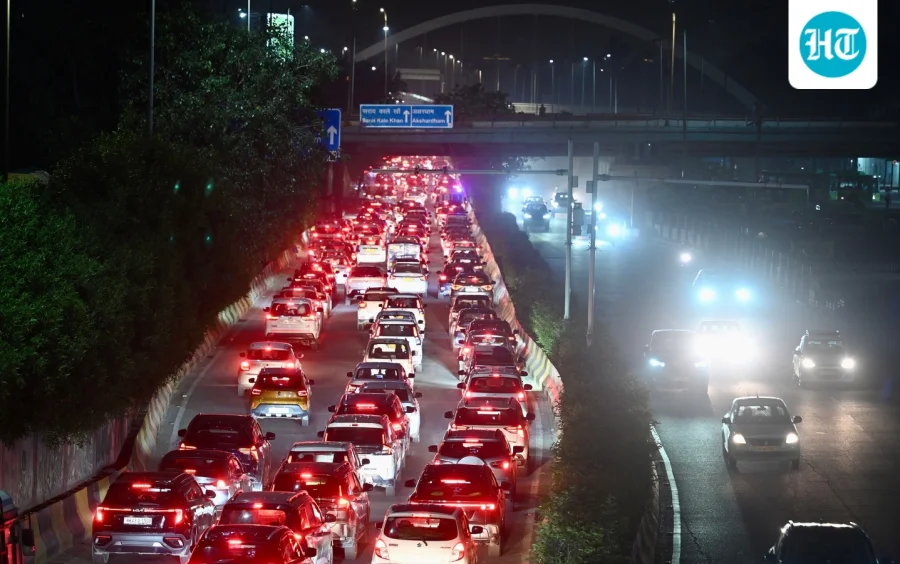
The promise was a faster commute. The reality, for thousands of Delhiites, is a new daily bottleneck. The newly opened stretch of the Barapullah Phase-III corridor, designed to connect Mayur Vihar to the main elevated road, has become a source of traffic chaos, with commuters pointing to fundamental design flaws as the culprit.
A Sharp Turn That Stalls a City's Pace
At the heart of the problem is a reported 90-degree angle on the corridor. For a high-speed elevated road, such a sharp turn is a critical design flaw. It forces vehicles to slow down drastically, creating a ripple effect of braking and queuing that quickly escalates into a massive traffic jam.
The issue is compounded by bottlenecks at key entry and exit points. Instead of a smooth flow, the corridor is experiencing a constant stop-and-go movement, defeating the very purpose of an elevated expressway.
Diverted Traffic, Multiplied Problems
The new stretch was intended to bring relief. It was designed to draw traffic away from the already congested NH-24 and the DND Flyway, offering a direct and faster route for those travelling between East Delhi and South Delhi.
However, the design flaws have turned this solution into a new problem. The traffic that has shifted to the Barapullah corridor is now stuck in a new kind of gridlock, while the promised relief for other routes remains uncertain.
How a Solution Became a New Headache
The Barapullah corridor project has been in development for years, envisioned as a key piece of infrastructure to decongest the capital. Phase-III was a critical link, meant to complete the loop and provide seamless connectivity.
Its opening was met with anticipation. But the on-ground reality has been starkly different. The gap between the project's design on paper and its real-world execution is now painfully evident to anyone who uses it.
The Human Cost of a Daily Detour
For the daily commuter, this isn't just an inconvenience; it's a daily tax on their time, fuel, and patience. Hours are lost in traffic, leading to stress, missed appointments, and increased vehicle running costs.
This chaos affects not just those on the new corridor but also spills over onto connecting roads, impacting a wider network of Delhi's residents who rely on these arterial routes to get to work, school, and home.
Awaiting Answers from the Authorities
As of now, there has been no official statement from the agencies responsible for the corridor's construction or management regarding the reported design flaws. There is no public timeline for when a fix might be implemented.
Commuters and experts alike are asking a simple question: how did a project of this scale get approved with such apparent planning oversights? The silence from official channels is adding to the frustration.
What We Know and What We Don't
Confirmed: The Barapullah Phase-III stretch is open and is experiencing severe traffic congestion. The route has drawn traffic from NH-24 and DND Flyway.
Unclear: The exact cause of the bottlenecks has not been officially confirmed. It is not known if the 90-degree angle was part of the original approved design or a construction deviation. There is no information on planned corrective measures or their timeline.
The Bigger Picture: A Pattern of Planning Gaps?
This situation is not an isolated incident. It raises broader questions about urban infrastructure planning in India, where projects are often inaugurated with much fanfare but face immediate operational issues.
The focus on completing projects often overshadows the critical need for robust, people-centric design that anticipates real-world traffic behaviour. The Barapullah Phase-III issue is a stark reminder that a road is only as good as its design.
What Should Commuters Do Now?
Until a solution is found, commuters are advised to plan their journeys with extra time. If possible, consider alternative routes, though they may also be congested due to the spillover effect.
Staying updated through local traffic advisories and radio stations can help in making informed decisions. For now, patience is the most essential part of the daily commute.
The Road Ahead
The future of this corridor depends entirely on how quickly and effectively the authorities respond. A swift, transparent investigation into the design flaws and a clear plan for rectification are the need of the hour.
Without this, the Barapullah Phase-III will remain a symbol of a good idea poorly executed, a permanent scar on Delhi's traffic map.
Our Take
This story is more than a traffic update; it's a case study in the consequences of flawed urban planning. It highlights the critical importance of design thinking and quality control in public infrastructure. A project meant to be a solution has become a problem, eroding public trust and wasting taxpayer money. The real fix isn't just about smoothing a turn; it's about ensuring accountability and a commitment to building for the people, not just for the ribbon-cutting ceremony.
Frequently Asked Questions
What is the Barapullah Phase-III corridor?
It is a newly opened section of the Barapullah elevated road in Delhi, designed to connect Mayur Vihar to the main corridor to ease traffic on other routes.
Why is there traffic chaos on the new Barapullah stretch?
According to reports, the chaos is due to design flaws, primarily an abrupt 90-degree turn and bottlenecks that force vehicles to slow down, causing long jams.
Which areas are most affected by this traffic?
The congestion directly impacts the Barapullah corridor and has a spillover effect on connecting roads like NH-24 and the DND Flyway.
Is there any official plan to fix the design flaws?
As of now, there has been no official announcement or statement from authorities regarding a plan to fix the reported design issues or a timeline for the same.