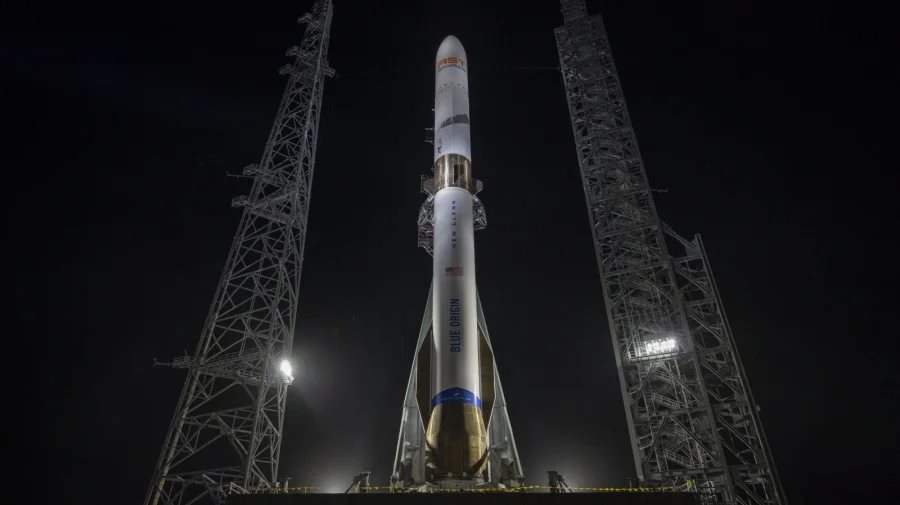
In a dramatic turn of events at Cape Canaveral, a Blue Origin New Glenn rocket exploded on its launchpad during a test firing on Thursday, May 28, 2026. The U.S. Space Force confirmed the anomaly, and footage captured across the Florida coast shows a massive fireball and thick smoke rising from the site. For Blue Origin, this is more than a setback — it’s a crisis that could reshape the future of its heavy-lift ambitions.
What Happened During the New Glenn Test
The incident occurred during a static fire test, a routine procedure where the rocket’s engines are ignited while the vehicle remains anchored to the launchpad. These tests are designed to validate engine performance and systems before a launch. But something went catastrophically wrong. The explosion destroyed the rocket and caused significant damage to the launchpad itself.
Blue Origin said it experienced an anomaly, but has not yet provided details on what caused the failure. The U.S. Space Force, which oversees operations at Cape Canaveral, confirmed the event and is likely to be involved in the investigation.
Why This Matters Right Now
This explosion is not just a technical failure — it’s a major blow to Blue Origin’s credibility and timeline. The New Glenn rocket is central to the company’s strategy to compete with SpaceX and other heavy-lift providers. It is designed to carry satellites, cargo, and eventually humans to orbit. A launchpad explosion raises immediate questions about the rocket’s design, safety protocols, and the company’s ability to deliver on its promises.
For the broader space industry, this incident adds to a growing list of high-profile test failures. It also puts renewed scrutiny on the safety of launch operations at Cape Canaveral, one of the busiest spaceports in the world.
How the Situation Developed
The New Glenn rocket had been undergoing pre-launch preparations for weeks. The static fire test was seen as a final major milestone before an uncrewed orbital test flight. The explosion occurred without warning, according to initial reports. Emergency response teams were deployed, but there is no immediate word on injuries or casualties.
Video footage from multiple angles shows the rocket engulfed in flames moments after the test began. The blast was powerful enough to be seen and heard across the Cape Canaveral area.
Who Is Affected and What Officials Are Saying
The immediate impact is on Blue Origin’s workforce and its commercial and government customers. The company has contracts with NASA, the U.S. Space Force, and private satellite operators. A destroyed rocket and damaged launchpad mean delays that could stretch for months or longer.
The U.S. Space Force confirmed the anomaly in a brief statement. Blue Origin has not yet held a press conference or released a detailed statement beyond acknowledging the incident. The lack of immediate transparency is likely to fuel speculation and concern among stakeholders.
What We Know So Far — and What Remains Unclear
Here’s what is confirmed: A New Glenn rocket exploded on its launchpad during a static fire test. The U.S. Space Force acknowledged the event. Blue Origin called it an anomaly. The rocket and launchpad are destroyed.
What remains unclear: The exact cause of the explosion. Whether there were any injuries. The extent of the damage to the launchpad and surrounding infrastructure. The impact on Blue Origin’s launch schedule. And whether this failure is an isolated incident or a sign of deeper engineering problems.
Risks, Concerns, and the Balanced View
The risks are significant. Blue Origin now faces a lengthy investigation, a destroyed rocket, and a damaged launchpad. The company’s timeline for reaching orbit with New Glenn — already delayed — will likely be pushed back further. There is also reputational risk. Investors and customers may lose confidence if the root cause is found to be a fundamental design flaw.
However, it is important to note that static fire test failures, while rare, are not unprecedented in the aerospace industry. Other companies, including SpaceX, have experienced launchpad explosions during testing and recovered. The key will be how Blue Origin handles the investigation and communicates its findings.
Why Similar Trends Are Increasing
The space industry is seeing an acceleration of testing activity as private companies race to develop new rockets. With that acceleration comes increased risk. Static fire tests, while safer than actual launches, still involve highly volatile propellants and extreme pressures. As more companies push the boundaries of rocket design, the probability of anomalies increases.
This incident also highlights the growing complexity of operations at Cape Canaveral, where multiple companies conduct simultaneous tests and launches. Coordination and safety protocols are under constant pressure.
- The New Glenn rocket uses liquid oxygen and methane propellants, which are highly volatile.
- Static fire tests are typically conducted with the rocket fully fueled, simulating launch conditions.
- Blue Origin has not yet released any telemetry data from the test.
"Blue Origin said it experienced an anomaly that led to the explosion of its New Glenn rocket and its launchpad during testing." — Blue Origin statement
What Readers, Users, or Investors Should Know Now
For now, the situation is developing. Investors should watch for Blue Origin’s official statement and any updates from the U.S. Space Force. Customers with payloads scheduled for New Glenn should prepare for delays. The broader space community will be watching the investigation closely, as the findings could have implications for other methane-fueled rocket programs.
For the general public, this incident is a reminder that spaceflight remains a high-risk endeavor. Even routine tests can go wrong. The key is learning from failures and improving safety.
What Could Happen Next
The immediate next step is a formal investigation led by Blue Origin, likely with oversight from the U.S. Space Force and possibly NASA. The investigation will focus on determining the root cause of the anomaly. Depending on the findings, Blue Origin may need to redesign components, revise test procedures, or replace the damaged launchpad.
In the medium term, Blue Origin’s launch schedule will be disrupted. The company had hoped to launch New Glenn on its maiden orbital flight later this year. That timeline is now in serious doubt. The financial impact could be significant, as delays often lead to cost overruns and contract penalties.
Our Take: Why This Story Matters Beyond One Incident
This explosion is a defining moment for Blue Origin. The company has long been seen as a cautious, methodical player in the space industry, often criticized for moving too slowly. A catastrophic test failure changes that narrative. It raises questions about whether Blue Origin’s engineering culture is as robust as it needs to be for the high-stakes world of orbital launch.
But it also matters for the industry as a whole. The success of New Glenn is important for competition in the launch market. A healthy Blue Origin means more options for customers and lower prices. A struggling Blue Origin means less competition and more dominance for SpaceX. That is a outcome no one in the space industry wants.
FAQs
What exactly happened to the Blue Origin New Glenn rocket?
The New Glenn rocket exploded on its launchpad at Cape Canaveral during a static fire test on May 28, 2026. Blue Origin called it an anomaly. The rocket and launchpad were destroyed.
Was anyone hurt in the Blue Origin rocket explosion?
There is no immediate word on injuries or casualties. Emergency response teams were deployed, but Blue Origin and the U.S. Space Force have not released details about personnel safety.
What is a static fire test and why is it dangerous?
A static fire test is a routine procedure where a rocket’s engines are ignited while the vehicle is held down on the launchpad. It is used to verify engine performance. It is dangerous because the rocket is fully fueled with volatile propellants under high pressure.
Will this explosion delay Blue Origin’s launch schedule?
Yes, significantly. The New Glenn rocket and launchpad are destroyed. An investigation will take months. Blue Origin’s planned maiden orbital flight is now likely delayed by at least a year, possibly longer.