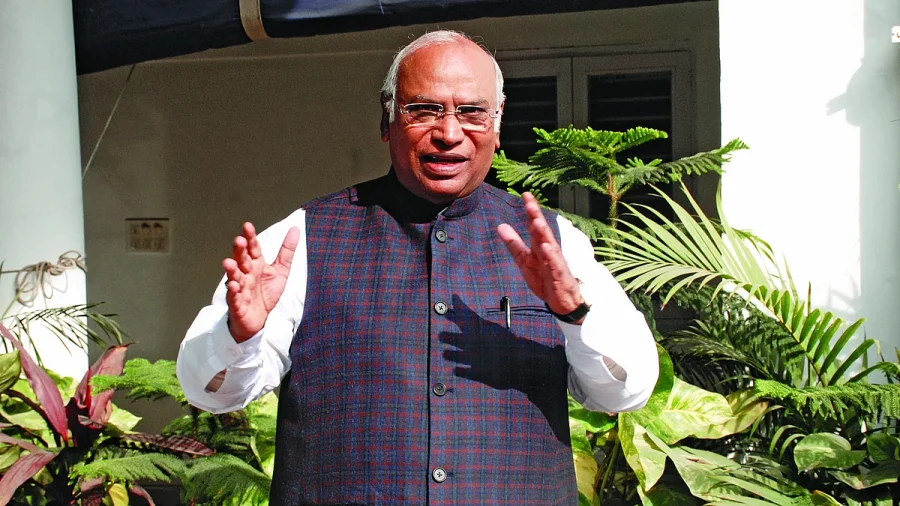
Congress president Mallikarjun Kharge on Saturday delivered a blistering attack on the Narendra Modi government, accusing it of being so consumed with engineering defections from opposition parties that it has lost sight of the economic distress gripping ordinary Indians. "BJP is busy shopping for parties, while people can't afford basics," Kharge said in a post on X, capturing the core of his party's latest offensive against the ruling dispensation.
Kharge's economic indictment: Inflation, savings, and unemployment
Kharge painted a stark picture of the Indian economy, arguing that the financial situation of millions of families had worsened dramatically. "Rapidly depleting savings due to high inflation. Unaffordable essentials. Growing unemployment. This is the reality of India under the Modi government," he wrote. The Congress chief claimed that households across the country were struggling under an "unbearable burden" caused by what he termed the government's economic mismanagement.
Why this attack matters now: The politics of rising prices
Kharge's broadside comes at a time when inflation remains a politically charged issue. For millions of Indian families, the cost of everyday essentials — from cooking oil to vegetables — has climbed steadily, squeezing household budgets. The Congress leader's framing directly ties the government's political strategy — wooing and poaching opposition legislators — to the economic pain felt by ordinary voters. This is not just a policy critique; it is a political narrative designed to resonate with voters who feel left behind.
How the situation developed: A pattern of Congress attacks
This is not the first time Kharge has targeted the Modi government over economic issues. In recent months, the Congress president has repeatedly highlighted rising prices, joblessness, and the erosion of household savings. Saturday's post, however, sharpened the attack by explicitly accusing the BJP of prioritizing political consolidation over public welfare. The phrase "BJP busy shopping" refers to the ruling party's recent success in winning over MLAs and MPs from opposition parties, a strategy that has bolstered its numbers in several state assemblies and Parliament.
Who is affected and why it matters to real people
The impact of rising prices is not abstract. For a salaried worker in a city, the monthly grocery bill has grown heavier. For a farmer, the cost of inputs like fertilizer and diesel has eaten into already thin margins. For a daily-wage labourer, even a small spike in food prices can mean cutting back on meals. Kharge's message taps into this lived reality — a reality that, according to official data, has seen household savings drop to multi-year lows. The Reserve Bank of India's own surveys have flagged concerns about declining household financial resilience.
What the Congress chief said: The full context
In his post on X, Kharge wrote: "Rapidly depleting savings due to high inflation. Unaffordable essentials. Growing unemployment. This is the reality of India under the Modi government. While the BJP is busy shopping for parties, people can't afford basics." The Congress party's official handle amplified the message, accusing the government of "economic mismanagement" and "prioritizing power over people." The attack was coordinated, with other Congress leaders also posting similar messages on social media.
Beyond the rhetoric: What the data shows
While Kharge's language is political, the underlying concerns are backed by data. India's retail inflation, as measured by the Consumer Price Index, has remained above the RBI's comfort zone for several months. Food inflation, in particular, has been stubbornly high. Household savings as a percentage of GDP have declined, according to recent national accounts data. Unemployment, especially among youth, remains a structural challenge. These are not partisan claims; they are documented trends that have been flagged by economists across the spectrum.
Confirmed facts vs what remains unclear
Confirmed: Kharge posted the attack on X on Saturday. The Congress party has been consistently criticizing the government over inflation and unemployment. Official data shows elevated food inflation and declining household savings in recent quarters. The BJP has indeed been successful in engineering defections from opposition parties in several states.
Unclear: Whether the government's economic policies are directly responsible for the inflation trend, or whether global factors (such as commodity prices and supply chain disruptions) are the primary drivers. The exact impact of defections on the government's legislative agenda is also a matter of political interpretation.
Risks and balanced view: The government's defence
The BJP has consistently defended its economic record, pointing to India's strong GDP growth, infrastructure spending, and targeted welfare schemes for the poor. Government officials argue that inflation is a global phenomenon and that India has managed it better than many other countries. They also highlight schemes like free food grains and direct benefit transfers that have provided a safety net for the vulnerable. Critics, however, counter that these measures have not been enough to offset the erosion of purchasing power for the middle class and the poor.
Wider trend: The politics of inflation in election season
Kharge's attack is part of a broader opposition strategy to make inflation a central electoral issue. With several state elections and the next general election on the horizon, the Congress and other opposition parties are betting that economic distress will trump the BJP's narrative of development and national pride. The challenge for the opposition is to translate this discontent into votes, especially in a political landscape where the BJP's organizational strength and welfare delivery remain formidable.
What readers should understand about this debate
For the average Indian voter, the inflation debate is not abstract. It affects daily decisions — what to cook, how much to save, whether to delay a major purchase. Kharge's message is designed to make voters feel that the government is out of touch with their struggles. Whether this resonates will depend on how the economic situation evolves in the coming months and whether the government can offer credible relief.
What could happen next
The Congress is likely to intensify its economic messaging in the run-up to elections. The government, in turn, may announce additional measures to control prices or boost rural incomes. The Reserve Bank of India's monetary policy decisions will also play a key role. If inflation eases, the BJP's position will strengthen. If it persists, the opposition's attacks will gain more traction.
Our Take
Kharge's attack is politically sharp but not new. The Congress has been hammering the inflation theme for months. What makes this intervention notable is the direct linkage between the BJP's political tactics — poaching opposition legislators — and the economic pain of ordinary citizens. It is a narrative that frames the ruling party as more interested in power than in governance. Whether this narrative gains traction will depend on whether voters see the government's economic record as a failure or as a work in progress. The data on inflation and savings is concerning, but the government has tools to respond. The real test will be whether the opposition can offer a credible alternative, not just a critique.
Frequently Asked Questions
What did Mallikarjun Kharge say about the BJP and inflation?
Kharge accused the BJP of being "busy shopping for parties" — meaning engineering defections from opposition parties — while ordinary Indians struggle with rising prices, depleted savings, and unemployment. He said households are under an "unbearable burden" due to the government's economic mismanagement.
Is India's inflation really as bad as Kharge claims?
Official data shows that retail inflation, especially food inflation, has remained elevated. Household savings as a percentage of GDP have declined. However, the government argues that inflation is a global problem and that India's economy is growing strongly. The reality is mixed, with different indicators pointing in different directions.
What is the BJP's response to these allegations?
The BJP has defended its economic record, citing strong GDP growth, infrastructure development, and welfare schemes. Government officials argue that India has managed inflation better than many other countries and that targeted programs have protected the poor.
Why is Kharge linking inflation to BJP's political strategy?
This is a political framing designed to paint the BJP as more focused on power consolidation than on public welfare. By linking the two, Kharge hopes to make the inflation issue more emotionally resonant and politically damaging for the ruling party.