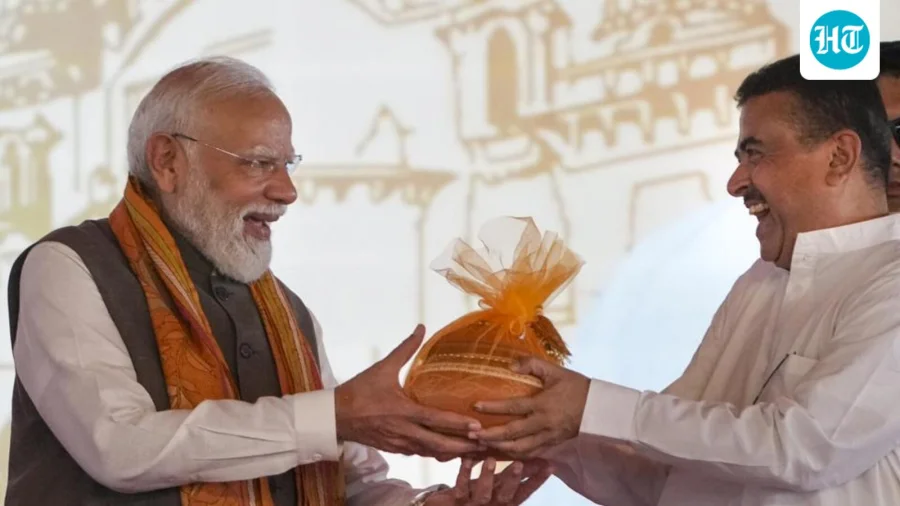
Prime Minister Narendra Modi on Saturday declared that Bengal is finally on the path envisioned at its creation in 1947, speaking at the Paschimbanga Divas event in Hooghly district. The statement, delivered on West Bengal Day, carries deep political and historical weight in a state where identity and development have long been contested.
What PM Modi said at Paschimbanga Divas in Hooghly
Addressing a gathering in Hooghly, PM Modi said Bengal is now moving in the direction its founders had imagined when the state was carved out after Partition. He linked this to ongoing central projects, governance changes, and a renewed sense of purpose among the people. The event was organised to mark West Bengal Day, commemorating the state's formation on August 15, 1947.
Why this statement matters for Bengal’s political landscape
The remark directly challenges the narrative of the ruling Trinamool Congress, which has often accused the Centre of neglecting Bengal. By invoking the 1947 vision, PM Modi is positioning the BJP as the party that can fulfil the state's original promise. For ordinary Bengalis, the statement raises questions about whether development and governance have finally caught up with historical aspirations.
The historical context of Bengal’s creation in 1947
West Bengal was formed on August 15, 1947, following the Partition of Bengal. The new state was envisioned as a cultural and economic hub for the eastern region, with Kolkata as its capital. Over the decades, political instability, industrial decline, and migration challenges have often been cited as reasons for the state lagging behind other regions. PM Modi’s reference to the “path envisioned in 1947” taps into this long-standing narrative of unfulfilled potential.
How this connects to Bengal’s development reality
PM Modi highlighted central schemes in infrastructure, healthcare, and education that he said are transforming Bengal. He pointed to projects like the expansion of the Kolkata Metro, highway development, and digital connectivity. For residents, the question is whether these initiatives are translating into jobs, better services, and improved quality of life — especially in rural and semi-urban areas like Hooghly.
Official response from the state government
The Trinamool Congress government has not yet issued a formal response to PM Modi’s statement. However, party leaders have previously dismissed central claims about Bengal’s development, arguing that the state’s own schemes have delivered more. The political back-and-forth is expected to intensify as both sides prepare for the next round of elections.
What PM Modi’s vision means for Bengal’s future
By framing Bengal’s current trajectory as a return to its founding ideals, PM Modi is attempting to rewrite the state’s political narrative. Analysts say this could resonate with voters who feel left behind by decades of political infighting. However, critics argue that the statement glosses over persistent issues like unemployment, industrial stagnation, and communal tensions.
Confirmed facts vs what remains unclear
Confirmed: PM Modi made the statement at Paschimbanga Divas in Hooghly on Saturday. The event was officially organised to mark West Bengal Day. Unclear: Whether the statement reflects actual policy shifts or is primarily political rhetoric. The specific metrics or timelines for achieving the “1947 vision” were not detailed.
Risks and balanced view
While PM Modi’s statement may energise supporters, it also risks deepening political polarisation in Bengal. Critics point out that the state’s development challenges — including industrial decline, migration, and infrastructure gaps — cannot be solved by rhetoric alone. The opposition may use the statement to question the Centre’s track record in Bengal, especially on issues like the Poshan scheme and rural employment.
Wider trend: Centre-state dynamics in India
PM Modi’s Bengal address is part of a broader pattern where the Centre uses state-specific events to project its development agenda. Similar statements have been made in Tamil Nadu, Kerala, and Punjab. This strategy aims to bypass state governments and connect directly with voters, especially in states ruled by opposition parties.
What this means for Bengal’s voters
For residents of Bengal, the key takeaway is whether central promises will translate into tangible benefits. Voters in Hooghly and across the state will be watching for job creation, better roads, improved healthcare, and educational opportunities. The statement may influence voting behaviour if backed by visible progress.
Future outlook: What could happen next
Political analysts expect PM Modi to make more such statements in Bengal as elections approach. The BJP is likely to highlight central schemes and contrast them with state-level governance. The Trinamool Congress will counter by pointing to its own welfare programmes and questioning the Centre’s financial allocations. The real test will be in how voters perceive the competing narratives.
Our Take
PM Modi’s statement is significant not just for its political timing but for its attempt to reclaim Bengal’s historical narrative. By linking current development to the state’s founding vision, he is offering a hopeful frame for a state often mired in pessimism. However, the gap between rhetoric and reality remains wide. For Bengal to truly walk the path envisioned in 1947, sustained investment, good governance, and political stability will be essential — not just speeches.
Frequently Asked Questions
What did PM Modi say about Bengal at the Hooghly event?
PM Modi said Bengal is finally on the path envisioned at its creation in 1947, speaking at the Paschimbanga Divas event in Hooghly district on Saturday.
What is Paschimbanga Divas?
Paschimbanga Divas, or West Bengal Day, is observed on August 15 to commemorate the formation of West Bengal after the Partition of Bengal in 1947.
Why did PM Modi make this statement now?
The statement is seen as part of the BJP’s strategy to project its development agenda in Bengal ahead of upcoming elections, directly challenging the ruling Trinamool Congress.
What does “path envisioned in 1947” mean?
It refers to the aspirations for West Bengal at its founding — as a cultural, economic, and industrial hub for eastern India — which many believe have not been fully realised.