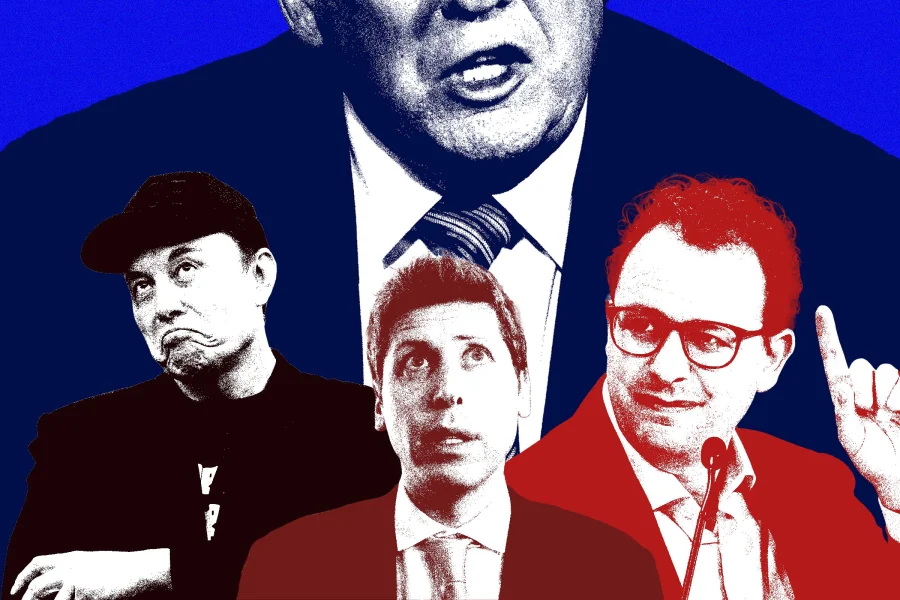
The people building the world's most powerful artificial intelligence systems are now asking whether they should slow down. The people running the United States are asking why they would.
Over the weekend, Sam Altman and Elon Musk backed a call for restraint in AI development — a position first pushed into the open by Anthropic CEO Dario Amodei, who urged Washington to consider slowing the pace. The Trump administration's response, in effect: that's your call, not ours.
Three Rivals, One Uncomfortable Agreement
Altman, Musk and Amodei run competing companies. They disagree on almost everything — from open-source models to safety frameworks to who is winning. Yet all three have now signalled that the speed of AI development deserves a second look.
That convergence is notable precisely because it is rare. When rivals who spend their days fighting for talent, compute and market share start saying the same thing about pace, it tends to reflect genuine internal concern rather than coordinated messaging.
Why This Collides With the White House's Core Goal
Donald Trump has made one thing clear about AI: the United States must stay ahead of China. That framing treats speed as an asset, not a risk. A slowdown — voluntary or otherwise — reads to the administration as a gift to Beijing.
So when AI leaders talk about restraint, they are not just talking to regulators. They are talking against the grain of the current political consensus in Washington, where AI leadership is treated as a national security priority.
How the Debate Reached This Point
Amodei's call was the trigger. By publicly asking Washington to consider slowing AI development, he moved a conversation that had mostly lived inside company blogs and safety papers into the political arena.
Altman and Musk backing that call gave it weight. Musk, who has repeatedly warned about AI risk, and Altman, who has testified before Congress on the need for guardrails, now sit on the same side of an argument that puts them at odds with the administration's competitive logic.
Who Actually Feels This Decision
For ordinary users, the stakes are less abstract than they sound. Slower development could mean longer gaps between model releases, more testing before deployment, and stricter internal review — changes that affect what tools reach the public and when.
For investors and employees in the AI sector, the question is sharper: if the biggest labs genuinely slow down, does that open space for competitors — including Chinese firms — to close the gap?
What the Administration Has Actually Said
Trump's team has not proposed regulation to force a slowdown. Its position, as reported, is that the decision belongs to the companies. If AI leaders believe restraint is right, they are free to practise it — but the government will not impose it while China is racing ahead.
That stance effectively shifts responsibility back onto the labs. It also creates a political shield: any slowdown that hurts US competitiveness becomes the industry's choice, not the administration's.
The Real Tension Beneath the Statements
This is not a simple safety-versus-speed story. It is a question of who bears the cost of caution. If one lab slows down and another does not, the cautious one loses ground. If all slow down together, China may not.
That collective action problem is why voluntary restraint has always been fragile in AI. Everyone agrees in principle; nobody wants to move first.
Confirmed Facts vs What Remains Unclear
Confirmed: Altman and Musk backed a call for restraint. Amodei urged Washington to slow AI development. Trump's team has positioned the decision as the industry's responsibility, while prioritising US competitiveness against China.
Unclear: Whether any company will actually change its release cadence. Whether the administration will face pressure to act if safety incidents occur. Whether China's response shapes the next move.
Why These Companies Still Hold the Cards
OpenAI, Anthropic, xAI and their peers control the models, the compute and the talent. No government directive currently forces their pace. That gives them unusual leverage — and unusual responsibility.
Their moat is not just technology. It is the ecosystem of developers, enterprise contracts and user habits built around their platforms. Slowing down internally does not erase that advantage, but it does test how durable it is.
The Risks on Both Sides
If AI leaders slow down voluntarily, critics will argue they are ceding ground to China and slowing economic gains. If they do not, safety advocates will say the warnings were never serious.
There is also a credibility risk. Public calls for restraint from companies still shipping models at pace can read as positioning rather than principle — a charge all three executives are now exposed to.
A Pattern That Keeps Repeating
This is the latest round of a cycle that has run for years: warnings about AI risk, calls for guardrails, then continued acceleration. What is different now is that the warnings are coming from the people with the most to gain from speed.
Whether that changes anything depends less on what they say and more on what they ship.
What Readers Should Take From This
Watch the release cadence, not the statements. If major labs genuinely stretch their timelines, that is the signal. If model launches continue at the same pace, the calls for restraint were rhetorical.
For anyone working in or investing around AI, the practical question is simple: does the next six months look different from the last six?
What Could Happen Next
The administration could face pressure to formalise a position if safety concerns escalate. AI labs could announce voluntary commitments — or quietly do nothing. China's progress will remain the backdrop against which every US decision is judged.
For now, the debate is public, unresolved, and unusually candid.
Our Take
The most striking thing here is not that AI leaders want restraint. It is that they are asking for it while holding the power to act unilaterally. Trump's team has effectively said: prove it. That puts the burden exactly where it belongs — on the companies that built the race.
Frequently Asked Questions
Who called for slowing down AI development?
Anthropic CEO Dario Amodei urged Washington to consider slowing AI development. Sam Altman and Elon Musk subsequently backed calls for restraint over the weekend.
What is the Trump administration's position on AI slowdown?
Trump's team has indicated that the decision to slow down rests with the AI companies themselves, not the government, as the US prioritises maintaining its lead over China.
Will AI development actually slow down?
No formal policy change has been announced. Whether companies adjust their release timelines remains unclear and depends on their own decisions rather than any government mandate.
Why does the US-China AI race matter here?
The administration views AI leadership as a national security priority. Any slowdown by US companies could be seen as giving China an opportunity to close the gap, which is why the White House is reluctant to impose restraint.