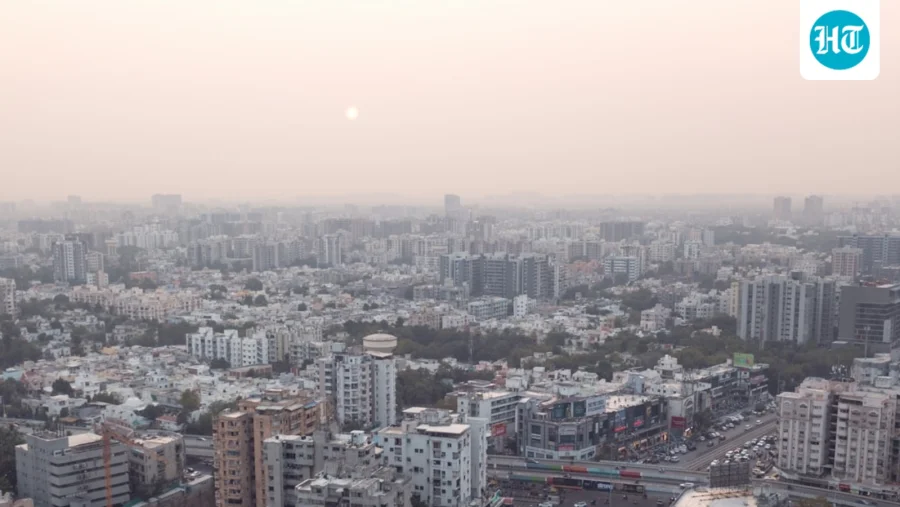
Ahmedabad has been ranked as the world’s second most heat-risk city in a new study by the University of Oxford, placing it just behind China’s Guangzhou. The report, which analysed 205 cities globally, found that India has the highest number of cities — 14 — among the top 50 most heat-vulnerable urban centres, more than any other nation.
Which Indian cities made the top 50 heat-risk list?
According to the Oxford study, Ahmedabad tops the Indian list at global rank 2. It is followed closely by Nagpur at rank 4 and Madurai at rank 7. Other Indian cities in the top 50 include Bengaluru, Mumbai, Delhi, Chennai, Hyderabad, Kolkata, Pune, Jaipur, Lucknow, Surat, and Kanpur. The study assessed heat risk by combining population exposure, socio-economic vulnerability, and a city’s capacity to respond.
Why India dominates the global heat-risk rankings
India’s dense urban populations, rapid unplanned construction, and limited green cover are key factors driving high heat risk. Many of the listed cities also have large low-income populations living in informal housing with poor access to cooling, water, and healthcare. The study notes that over 95% of the most at-risk cities are in South and Southeast Asia and Sub-Saharan Africa, regions already facing severe climate stress.
How the Oxford study measured heat risk
The researchers did not simply rank cities by temperature. Instead, they used a composite index that measured three dimensions: the number of people exposed to extreme heat, the vulnerability of those populations (including age, health, and income), and the city’s adaptive capacity — such as access to cooling centres, green spaces, and early warning systems. This approach explains why cities like Bengaluru, which has a moderate climate, still ranks high due to population density and infrastructure gaps.
What this means for residents of Ahmedabad and Bengaluru
For residents in Ahmedabad, the ranking signals a heightened risk of heat-related illnesses, water shortages, and reduced productivity during summer months. In Bengaluru, known for its pleasant weather, the finding is a wake-up call: rapid urbanisation and loss of lakes and green cover are making the city more vulnerable to heat stress. Low-income communities, daily wage workers, and outdoor labourers are the most affected.
Official response and expert reaction
The study has been published by the University of Oxford’s Sustainable Urban Development programme. While no immediate official response from Indian municipal authorities has been widely reported, urban planners and climate experts have called for urgent heat action plans. Experts emphasise that cities need to invest in green infrastructure, cool roofs, heat-resistant building materials, and better public health surveillance.
What makes a city heat-resilient — the deeper analysis
The Oxford study underscores that heat risk is not just about temperature. A city’s ability to protect its people depends on governance, urban design, and social equity. Cities with strong early warning systems, shaded public spaces, and access to affordable cooling fare better. Indian cities, despite being among the most at-risk, often lack coordinated heat action plans at the municipal level.
Confirmed facts vs what remains unclear
Confirmed: Ahmedabad is ranked 2nd globally for heat risk. India has 14 cities in the top 50. The study was conducted by the University of Oxford. Over 95% of high-risk cities are in South Asia and Sub-Saharan Africa.
Unclear: The exact methodology and full dataset for all 205 cities have not been publicly released in detail. The specific ranking of Bengaluru within the top 50 has not been confirmed in all reports. The study’s timeline and publication date are not fully specified.
Wider trend: Climate risk is concentrating in Asian and African cities
The findings align with broader climate research showing that urban heat risk is intensifying fastest in developing nations. Rapid urbanisation, combined with limited financial resources for adaptation, leaves cities in India, Pakistan, Nigeria, and Ghana particularly exposed. The study serves as a stark reminder that climate change is not a future threat — it is already reshaping urban life in the world’s most populous regions.
What residents and policymakers should do now
For residents, the study is a prompt to prepare for extreme heat: stay hydrated, avoid peak sun hours, and check on vulnerable neighbours. For policymakers, the message is clear: heat action plans must be prioritised. This includes expanding green cover, mandating cool roofs in new buildings, improving public transport shade, and ensuring that heat warnings reach all communities, especially the poor.
Future outlook: Will Indian cities become more heat-resilient?
Several Indian cities, including Ahmedabad, have already launched heat action plans. However, implementation remains uneven. Without sustained investment and political will, the gap between risk and resilience will widen. The Oxford study may push more cities to treat heat risk as a core urban planning challenge rather than a seasonal inconvenience.
Our Take
The Oxford study is a critical reality check for India’s urban planners. It shows that heat risk is not just a problem for traditionally hot cities like Ahmedabad — even Bengaluru, with its once-moderate climate, is now vulnerable. The real story here is not just the ranking, but the underlying inequality: the poorest residents in these cities bear the heaviest burden. Heat action plans must be designed with equity at their core, or they will fail the very people they are meant to protect.
Frequently Asked Questions
Which Indian city has the highest heat risk according to the Oxford study?
Ahmedabad is ranked as the world’s second most heat-risk city and tops the list among Indian cities.
How many Indian cities are in the top 50 most heat-vulnerable cities?
14 Indian cities are among the world’s top 50 most heat-vulnerable cities, the highest for any country.
Why is Bengaluru on the heat-risk list despite its moderate climate?
Bengaluru’s high population density, rapid urbanisation, loss of green cover and lakes, and infrastructure gaps increase its vulnerability to heat stress.
What factors did the Oxford study use to measure heat risk?
The study measured population exposure, socio-economic vulnerability, and a city’s capacity to adapt and respond to extreme heat.