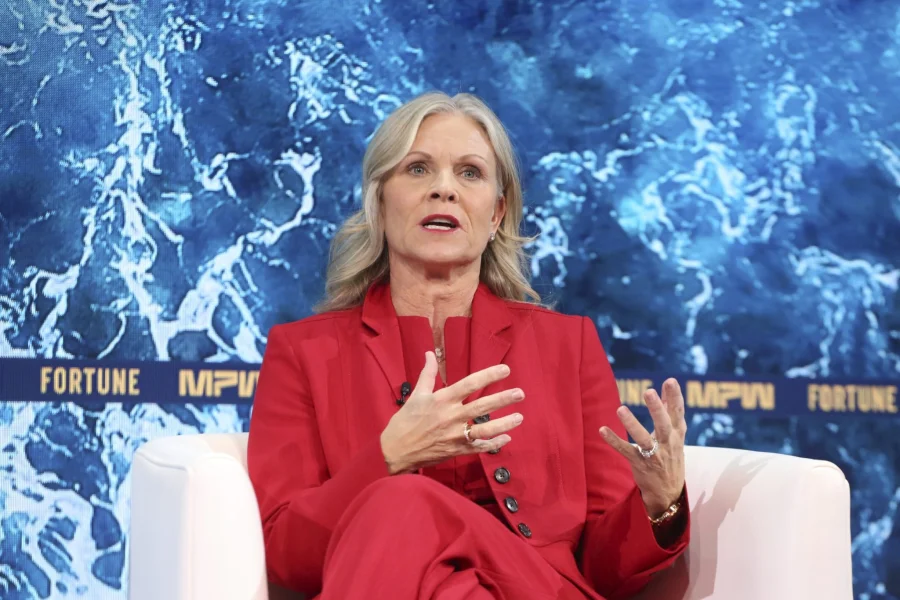
For years, the narrative around workplace productivity has often pointed fingers at the workforce—claims of quiet quitting, lack of ambition, or a desire for remote comfort. But according to ADP CEO Maria Black, the mirror might need to be turned back on the corner office. Speaking at Fortune’s Most Powerful Women Summit in California, Black offered a stark, data-backed reality check: the engagement crisis isn't a worker problem; it's a trust problem.
The 41% Equation: Trust as a Business Metric
Black’s message to the room was unambiguous. "Trust is a direct corollary to engagement," she stated. The data she shared suggests that when employees believe in their CEO and senior leaders, they are 41% more likely to be engaged in their work.
This isn't just about morale; it is about the bottom line. Engagement is the engine of productivity. When that engine stalls, companies lose money, innovation slows, and talent walks out the door. Black argued that if leaders want a vibrant workforce—one she wants her own children to inherit—they must stop looking at engagement as a perk and start treating trust as a prerequisite.
Why the "Lazy Worker" Narrative Is Failing
The ADP findings challenge the prevailing wind in corporate America, which often frames disengagement as a lack of employee effort. Black’s perspective flips this script. It suggests that employees are not inherently disengaged; they are reacting to a lack of credibility from the top.
If a workforce feels that leadership is opaque, inconsistent, or out of touch, the natural defense mechanism is disengagement. It is a rational response to an unsafe environment. By quantifying the link—41%—Black provides leaders with a metric to measure their own performance. It is no longer just about "soft skills"; it is about hard results.
The Ripple Effect on Middle Management
While the focus is on CEOs, the impact of this trust deficit cascades down through middle management. Employees rarely interact with the CEO daily; they interact with their immediate supervisors. However, the tone is set at the top.
When senior leaders demonstrate transparency and follow through on promises, it gives middle managers the license to do the same. Conversely, a culture of fear or spin at the executive level trickles down, creating a workforce that is physically present but mentally checked out. Black’s comments suggest that fixing the C-suite is the first step to healing the entire organizational chart.
Rebuilding the Broken Bridge
The path forward, according to Black, requires introspection. Leaders must ask themselves a difficult question: Do my people actually trust me? This requires moving beyond annual surveys and engaging in genuine listening.
Trust is built in small moments—how a crisis is handled, how layoffs are communicated, and whether leaders are visible during tough times. The 41% engagement boost is the prize, but it cannot be bought with perks or pizza parties. It must be earned through consistency and honesty.
Confirmed Facts vs. What Remains Unclear
Confirmed: Maria Black made these statements at the Fortune Most Powerful Women Summit. The 41% statistic is derived from ADP's internal research and insights.
Unclear: The specific methodology of the 41% study (sample size, industry breakdown) was not detailed in the original report. It is also unclear how quickly trust can be rebuilt once lost, or if the correlation implies causation—meaning, does trust cause engagement, or do engaged employees simply perceive their leaders as more trustworthy?
Risks and Balanced View
While the "trust first" approach is compelling, it places a heavy burden on leadership. Critics might argue that this perspective absolves employees of personal responsibility for their own work ethic. Furthermore, in a volatile economy where layoffs are common, building trust is incredibly difficult. Employees may feel that trusting a CEO is risky when job security is fragile.
However, ignoring the trust factor is riskier. A disengaged workforce is a costly one. The balanced view is that while trust is the foundation, it must be paired with clear expectations and fair compensation to create a truly sustainable work environment.
Our Take
Maria Black’s assertion is a necessary corrective to the current discourse on quiet quitting. It shifts the accountability from the individual contributor back to the system they operate within. The 41% figure is a powerful anchor for this argument. It suggests that before companies invest in new engagement software or team-building retreats, they should audit the integrity of their leadership. Trust is the currency of modern management, and right now, many companies are running a deficit.
Frequently Asked Questions
What did ADP CEO Maria Black say about employee engagement?
She stated that trust in leadership is the primary driver of engagement, noting that employees who trust their CEO are 41% more likely to be engaged.
Where did Maria Black make these comments?
She spoke at Fortune’s Most Powerful Women Summit in California during a conversation with Diane Brady.
Does this mean disengaged employees are not working hard?
According to Black's perspective, disengagement is often a symptom of a lack of trust in leadership rather than a lack of effort from the employee.
How can companies improve employee trust?
Black suggests leaders must start by asking if they are trustworthy, implying that transparency, consistency, and self-reflection are key steps.