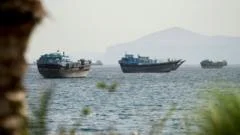
The United States military confirmed it carried out fresh airstrikes on Iranian radar and drone control sites near the strategic Strait of Hormuz on Sunday, as Kuwait reported that its air defenses had intercepted a barrage of hostile missiles and drones. The developments mark a significant escalation in the ongoing conflict, raising fears of a wider regional war that could disrupt global oil supplies.
US Central Command Confirms Strikes on Iranian Military Targets
In a statement posted on social media, US Central Command (Centcom) said its fighter jets struck Iranian military air defenses, a ground control station, and two drones that it said "posed a threat" to US and coalition forces in the region. The strikes were carried out in the vicinity of the Strait of Hormuz, a narrow waterway through which about a fifth of the world's oil passes.
Why This Matters Right Now
This is not just another military skirmish. The Strait of Hormuz is the world's most important oil chokepoint. Any sustained disruption here could send global energy prices soaring, impacting everything from the price of petrol at the pump to the cost of goods in stores. For millions of people already grappling with inflation, the economic consequences of this escalation could be severe and immediate. Furthermore, the involvement of Kuwait, a key US ally, signals that the conflict is no longer contained to Iran and Israel, but is drawing in other Gulf nations.
How the Incident Unfolded
The latest round of strikes appears to be a direct response to ongoing threats in the region. According to Centcom, the targets were selected because they were actively being used to coordinate attacks. The strikes come just days after the US and Israel launched a broader military campaign against Iran, which has included strikes on Iranian nuclear and military facilities. The situation escalated rapidly when Iran retaliated, leading to a cycle of attack and counter-attack.
Who Is Affected and What Officials Are Saying
The immediate impact is being felt most acutely in Kuwait. The Kuwaiti military confirmed that its air defense systems had successfully intercepted "hostile missile and drone attacks," and air raid sirens were heard across the country, sending civilians scrambling for shelter. While Kuwait has not directly blamed Iran, the timing and nature of the attacks strongly suggest they are linked to the US strikes. The US has not commented on the attacks on Kuwait, but the incident underscores how the conflict is destabilizing the entire Gulf region.
What We Know So Far — and What Remains Unclear
What we know: The US has confirmed it struck Iranian radar and drone control sites near the Strait of Hormuz. Kuwait has confirmed it intercepted hostile missiles and drones. Iran's Revolutionary Guards have claimed they targeted a US base in retaliation.
What remains unclear: The full extent of damage from the US strikes is unknown. It is also unclear whether the attacks on Kuwait were launched by Iran directly or by proxy forces. The exact location of the US base that Iran claims to have targeted has not been confirmed. Furthermore, the long-term strategic goal of these strikes remains ambiguous.
Risks, Concerns, and the Balanced View
The primary risk is a full-blown regional war. Each strike and counter-strike makes de-escalation more difficult. The US and its allies argue that they are acting in self-defense against an aggressive Iran that threatens regional stability. Critics, however, warn that the US-Israeli campaign is disproportionate and risks dragging the entire Middle East into a devastating conflict. The attacks on Kuwait are a stark reminder that no country in the region is safe from the fallout.
Why Similar Trends or Concerns Are Growing
The current crisis is the culmination of years of escalating tensions between Iran, the US, and Israel. The collapse of the nuclear deal, Iran's increasing uranium enrichment, and Israel's stated determination to prevent Iran from obtaining a nuclear weapon have created a powder keg. The use of drones and missiles, as seen in this incident, has become a hallmark of modern warfare in the region, making it easier for state and non-state actors to strike at long distances.
- The Strait of Hormuz is a critical chokepoint for global oil supplies.
- Kuwait is a key US ally in the Gulf, making attacks on its soil a major escalation.
- Iran has a history of using proxy forces to attack US and allied interests.
"US Central Command (Centcom) said its fighter jets struck Iranian military air defenses, a ground control station and two drones that it said 'posed a threat' to US and coalition forces." — Centcom Statement
What Readers, Users, or Investors Should Know Now
For the average person, the most immediate concern is the potential for oil price volatility. Investors should brace for market fluctuations, particularly in energy stocks. For those in the region, staying informed through official channels and following safety protocols is paramount. The situation is fluid, and further escalation is a distinct possibility.
What Could Happen Next
The most likely scenario is a continuation of the cycle of retaliation. Iran may attempt further strikes on US or allied targets, possibly through its proxies in Iraq, Syria, or Yemen. The US and Israel may conduct additional strikes on Iranian military infrastructure. Diplomatic efforts to de-escalate the situation appear to have stalled, and the risk of a miscalculation that leads to a wider war remains high.
Our Take: Why This Story Matters Beyond One Incident
This is not just a story about a military strike. It is a story about the fragility of global stability. The Strait of Hormuz is the artery of the global economy, and any disruption there affects everyone. The attacks on Kuwait show that this conflict is no longer a proxy war; it is a direct confrontation that threatens to engulf the entire region. The world is watching, and the stakes could not be higher.
FAQs
Why did the US strike Iranian radar sites?
The US military stated the strikes were necessary to neutralize threats posed by Iranian air defenses and drone control stations to US and coalition forces operating in the region near the Strait of Hormuz.
What happened in Kuwait during the attacks?
Kuwait's military confirmed that its air defense systems intercepted "hostile missile and drone attacks." Air raid sirens were activated across the country as a precautionary measure.
How does this affect oil prices and the global economy?
The Strait of Hormuz is a critical chokepoint for global oil shipments. Any military action that threatens the free flow of oil through this waterway can lead to significant price spikes and increased market volatility, impacting economies worldwide.
Is this the start of a wider regional war?
The risk of a wider regional war is now significantly higher. The direct involvement of Kuwait and the cycle of attacks and counter-attacks between the US and Iran suggest that the conflict is expanding beyond its initial scope, making de-escalation increasingly difficult.