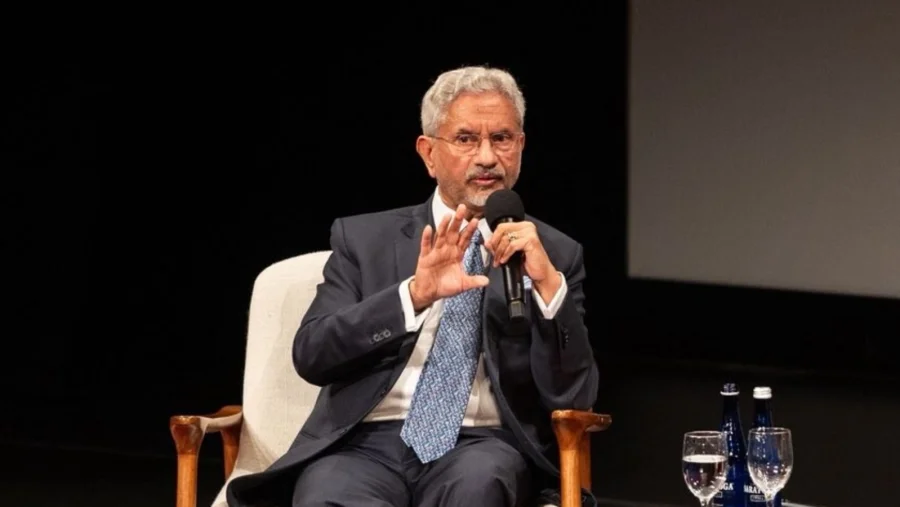
India's External Affairs Minister S. Jaishankar has said something that rarely gets said out loud in diplomacy: that the United States once wanted India to limit its trade options, and that the pretence around that position has now dropped.
The remark, made during an event hosted by the Asia Society, lands at a moment when trade has become one of the most closely watched fault lines in India-US relations. It is a short sentence, but it carries a long backstory.
What Jaishankar Actually Said — And Why the Wording Matters
According to the source material, Jaishankar's point was not about a single tariff or a single deal. It was about intent. He suggested that Washington previously preferred India to keep its trade choices narrow, and that this preference was once wrapped in diplomatic language.
Now, he indicated, that wrapping has come off. The phrasing is significant because it frames the shift as a change in style as much as substance — a move from quiet expectation to open pressure.
Why This Lands Harder Than a Routine Diplomatic Comment
Trade is no longer a side file in India's foreign policy. It sits at the centre of how New Delhi defines strategic autonomy — the idea that India chooses its own partners, its own energy sources, and its own terms.
When a senior minister says the pretence has dropped, he is telling Indian audiences that the space for ambiguity is shrinking. That has consequences for farmers, exporters, manufacturers, and anyone whose livelihood touches global supply chains.
The Asia Society Setting — And the Audience It Was Meant For
The Asia Society is a platform where Indian leaders often speak to a mixed audience of diplomats, analysts, and business figures. Remarks made there are calibrated for two rooms at once: the one in front of the speaker, and the one back home.
That dual audience matters. A line like this is read in Washington as a signal, and in India as a reassurance that the government is not pretending the pressure away.
Who Feels This First — Exporters, Farmers, and Small Manufacturers
The people most exposed to any hardening of trade posture are not in conference halls. They are in export clusters in Tiruppur and Surat, in agricultural belts that depend on stable access to overseas buyers, and in small firms that cannot absorb sudden cost shocks.
For them, the question is not whether the pretence has dropped. It is whether India's alternative trade routes — new agreements, new markets, new logistics — are ready to absorb the shift.
How New Delhi Has Been Reading Washington's Trade Mood
India has spent the past several years widening its trade footprint, signing and negotiating agreements with partners across the Gulf, Europe, and Asia. That diversification is not accidental. It is a hedge.
Jaishankar's comment fits that logic. If the US is now more open about wanting to shape India's choices, India's answer has been to make sure it has more than one door to walk through.
What Is Confirmed, and What Is Still Open to Interpretation
Confirmed: Jaishankar made the remark at an Asia Society event, and the source material attributes the statement directly to him.
Unclear: The source material does not specify which US policies or negotiations he was referring to, nor does it include a US response. Any reading of which sectors are most affected remains interpretation, not fact.
Risks and the Other Side of the Argument
There is a counter-view worth stating plainly. Some analysts argue that India-US trade friction is normal between large economies, and that public remarks can harden positions that quiet talks might soften.
Others note that India's own tariff and market-access decisions have drawn criticism from US businesses. The pressure, in other words, is not one-directional — and framing it as such would be incomplete.
The Bigger Pattern: Trade as the New Diplomatic Test
Jaishankar's remark is part of a wider shift. Across the world, trade policy is being used as a tool of strategic influence — by the US, by China, by the EU. India is not a bystander in that trend; it is a target and a player at the same time.
What has changed is the vocabulary. Where once there were euphemisms, there are now plain statements. That is the shift Jaishankar was pointing to.
What This Means for Readers Following India-US Ties
For students of foreign policy, the takeaway is to watch actions, not just statements. Trade agreements, tariff decisions, and market-access negotiations will reveal more than any single speech.
For businesses, the practical advice is diversification — of markets, of suppliers, of risk. For ordinary readers, the point is simpler: the era of polite ambiguity in trade diplomacy is fading, and India is being asked to state its choices more clearly.
What Could Happen Next
No policy change has been announced. But remarks like these often precede a more explicit articulation of India's trade position — in bilateral meetings, in multilateral forums, and in the fine print of future agreements.
The next signal to watch is whether New Delhi responds with new trade deals, new tariff positions, or a more public defence of its right to choose its partners.
Our Take
Jaishankar's line is not a complaint. It is a description of a changed environment — one where the US is more willing to say what it wants, and India is more willing to say what it will not give up.
That is a healthier conversation than one conducted in hints. It is also a harder one, because it leaves less room for both sides to pretend the disagreement is not there.
Frequently Asked Questions
What did Jaishankar say about US trade pressure on India?
He said the US once wanted India to limit its trade options, but that the pretence around this position has now dropped. He made the remark at an Asia Society event.
Where did Jaishankar make these remarks?
According to the source material, he was speaking during an event hosted by the Asia Society.
Does this mean India-US trade relations have broken down?
No. No policy change has been announced. The remark describes a shift in tone and openness, not a rupture. Trade ties between the two countries continue across multiple sectors.
What should India do in response to a harder US trade stance?
Analysts generally point to diversification — expanding trade agreements with other partners, strengthening domestic manufacturing, and reducing dependence on any single market. India has already been moving in this direction.