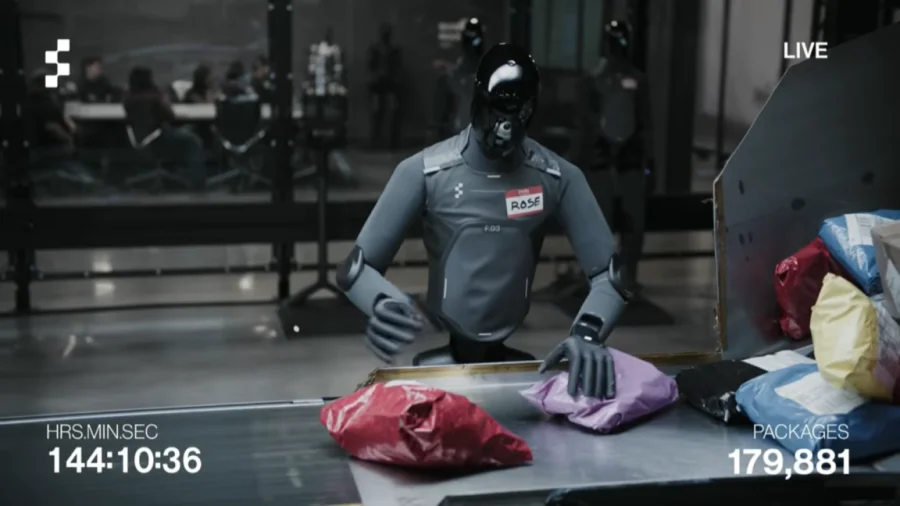
For nearly a week, a warehouse somewhere has become an unlikely internet sensation. A humanoid robot, built by the robotics startup Figure AI, has been tirelessly placing thousands of packages onto a conveyor belt — and the world can't look away.
What began as a planned eight-hour demonstration on May 13 has turned into a 24/7 livestream spectacle. Tech enthusiasts, casual viewers, and even skeptics are glued to their screens, watching a machine perform what is, at its core, a repetitive warehouse task. But the reaction has been anything but ordinary.
How a Simple Robot Demo Became a Viral Phenomenon
The livestream, hosted by Figure AI, shows their humanoid robot — likely the Figure 02 model — picking up packages and placing them onto a conveyor belt. The task seems simple, but the execution is mesmerizing. The robot moves with a fluidity that feels almost human, adjusting its grip, rotating its wrist, and placing each box with precision.
At one point, the company even pitted the robot against a human intern in a friendly competition. The moment, captured on the livestream, sent viewers into a frenzy. Comments flooded in, with many on YouTube giving the robots names and personalities. On X (formerly Twitter), users described the demo in glowing terms, with one calling it "the greatest product demo since Steve Jobs' 'one more thing.'"
The company quickly capitalized on the viral moment, rolling out official robot merchandise — a move that only fueled the online obsession.
Why This Matters Right Now
This isn't just a fun internet distraction. Figure AI's livestream represents a significant moment in the public perception of humanoid robotics. For years, robots have been confined to factory floors, performing tasks out of sight. Now, millions are watching one work in real-time, and the reaction is overwhelmingly positive.
This matters because it signals a shift. The public is no longer just curious about AI — they are emotionally invested. They are naming robots, cheering for them, and buying merchandise. This emotional connection could accelerate public acceptance of humanoid robots in everyday life, from warehouses to homes.
For investors and industry watchers, the viral success also validates Figure AI's approach. The company, which has raised significant funding, is proving that humanoid robots can capture the public imagination — and that could translate into real-world adoption.
What the Livestream Actually Shows
The livestream is deceptively simple. A single humanoid robot stands in front of a conveyor belt. Packages arrive, and the robot picks them up, one by one, and places them onto the belt. The task is repetitive, but the robot's movements are smooth and adaptive.
According to reports, the robot is capable of handling thousands of packages in a single shift. The livestream has been running continuously, with only brief interruptions for maintenance or recalibration. The company has not disclosed the exact location, but the warehouse setting suggests a controlled environment designed for the demo.
What makes the livestream compelling is the robot's apparent autonomy. It doesn't seem to follow a pre-programmed path — it adjusts to each package's size, weight, and orientation. This level of adaptability is what separates Figure AI's robot from traditional industrial automation.
Who Is Watching and Why They Can't Stop
The audience for the livestream is surprisingly diverse. Tech enthusiasts and AI researchers are analyzing every movement. But casual viewers — people who might never have cared about robotics before — are also tuning in. Comments on YouTube and X reveal a mix of awe, curiosity, and even affection.
Some viewers have named the robot "Figgy" or "Figure One." Others have created fan art and memes. The merchandise, which includes t-shirts and hoodies with the robot's silhouette, sold out within hours of launch.
This level of engagement is rare for a corporate demo. It suggests that Figure AI has tapped into something deeper — a human fascination with machines that mirror our own movements.
What We Know So Far — and What Remains Unclear
What we know:
- The livestream began on May 13 as a planned eight-hour demo.
- It has since expanded into a continuous 24/7 broadcast.
- The robot is capable of handling thousands of packages with minimal errors.
- The company has launched official merchandise in response to demand.
- Viewers have named the robots and created a community around the livestream.
What remains unclear:
- How much human supervision is required behind the scenes.
- Whether the robot can handle unexpected scenarios or errors autonomously.
- The exact commercial timeline for Figure AI's robots in real warehouses.
- How the robot's performance compares to human workers in terms of speed and cost.
Risks, Concerns, and the Balanced View
While the livestream is undeniably impressive, experts caution against overhyping the demo. As one Reddit user noted, the robot's task was relatively simple — "all it was doing was making sure the labels of the packages were facing down, and it made mistakes often too."
This is a crucial point. Even the most impressive robot demos represent narrow windows into real-world capabilities. The controlled environment of a livestream is very different from a chaotic, real-world warehouse with unpredictable packages, varying lighting, and human workers moving around.
There are also broader concerns about job displacement. While Figure AI's robot is currently a novelty, its success could accelerate automation in logistics and warehousing — sectors that employ millions of people worldwide.
On the other hand, proponents argue that robots like Figure AI's could fill labor shortages and perform dangerous or repetitive tasks, freeing humans for more skilled work. The debate is far from settled.
Why Similar Trends Are Growing
Figure AI's viral moment is part of a larger trend. In recent years, humanoid robots from companies like Boston Dynamics, Tesla, and Agility Robotics have also captured public attention. Each demo — whether it's a robot doing backflips, folding laundry, or walking through a factory — generates millions of views.
What's changing is the public's reaction. Early robot demos often sparked fear or skepticism. Now, viewers are more likely to express wonder and excitement. This shift could be driven by familiarity — as AI and robotics become more integrated into daily life, the "uncanny valley" effect diminishes.
For Figure AI, the timing is perfect. The company is positioning itself as a leader in general-purpose humanoid robotics, and the livestream is a powerful marketing tool. It's one thing to release a polished video — it's another to let the world watch your robot work, live, for days on end.
"The greatest product demo since Steve Jobs' 'one more thing.'" — User on X
What Viewers and Investors Should Know Now
For those watching the livestream, the key is to enjoy the spectacle while keeping expectations realistic. The robot is impressive, but it's still a demo. Real-world deployment will require solving complex challenges around reliability, safety, and cost.
For investors, Figure AI's viral success is a positive signal, but it's not a guarantee of commercial viability. The company still needs to prove that its robots can work reliably in uncontrolled environments and at a cost that makes economic sense.
For the general public, the livestream offers a rare glimpse into the future of work. Whether that future is exciting or concerning depends on how the technology is deployed — and who benefits from it.
What Could Happen Next
Figure AI is likely to keep the livestream running as long as the public interest holds. The company may introduce new tasks or challenges to keep viewers engaged. There's also speculation that the livestream could lead to a formal product launch or partnership announcement.
In the longer term, Figure AI's success could accelerate investment in humanoid robotics. Competitors like Tesla (with Optimus) and Agility Robotics (with Digit) are also racing to bring humanoid robots to market. The next few years could see a dramatic increase in real-world deployments.
But the biggest unknown is public acceptance. If the livestream is any indication, the public is ready to embrace humanoid robots — at least as entertainment. Whether that acceptance extends to having them in workplaces and homes remains to be seen.
Our Take: Why This Story Matters Beyond One Livestream
Figure AI's livestream is more than a viral moment — it's a cultural milestone. For the first time, millions of people are watching a humanoid robot work in real-time, and they're not just impressed — they're emotionally engaged.
This emotional connection could be the key to widespread adoption. Technology is often adopted not because it's the most efficient, but because it feels right. If people feel a connection to these robots — if they name them, cheer for them, and buy merchandise featuring them — the path to acceptance becomes much smoother.
At the same time, we must remain clear-eyed about the limitations. The livestream is a controlled demo, not a real-world deployment. The robot's mistakes, the human supervision, and the narrow task all remind us that we are still in the early days of humanoid robotics.
But the early days can be exciting. And right now, the internet can't stop watching.
FAQs
What is Figure AI's humanoid robot doing in the livestream?
The robot is picking up packages and placing them onto a conveyor belt in a warehouse setting. The task is repetitive but requires adaptability to handle packages of different sizes and orientations.
Why has the Figure AI livestream gone viral?
The livestream has captivated viewers because of the robot's smooth, human-like movements and the novelty of watching a machine work continuously. Viewers have named the robots, created fan art, and bought merchandise, turning the demo into a cultural phenomenon.
Is Figure AI's robot ready for real-world warehouses?
Not yet. The livestream is a controlled demo, and the robot still makes mistakes. Real-world deployment would require solving challenges around reliability, safety, and cost. However, the demo shows significant progress toward that goal.
How does Figure AI's robot compare to other humanoid robots like Tesla Optimus?
Figure AI's robot is focused on general-purpose manipulation tasks, similar to Tesla's Optimus and Agility's Digit. Each company has a different approach, but Figure AI's livestream has given it a unique advantage in public visibility and emotional engagement.