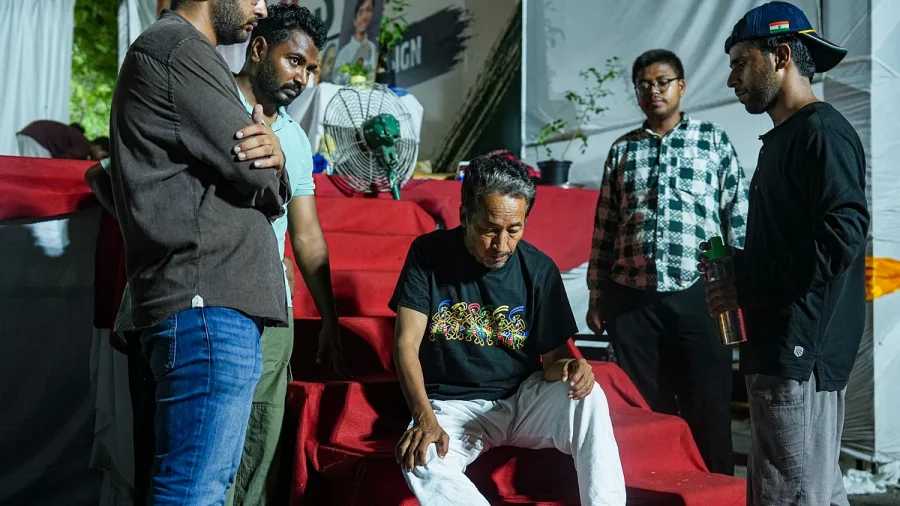
Sonam Wangchuk, the Ladakhi education activist and engineer, has drawn a firm line: his indefinite hunger strike will not end until Parliament takes up the crisis in India's education system. In a handwritten note shared on social media Monday, Wangchuk made clear that his protest is not about personal endurance but about forcing institutional accountability.
What Wangchuk’s handwritten note actually says
"Many of you have asked when I will end my fast. As mentioned earlier to supporters, I will end my fast on 20 July... if the government takes accountability for the recent failures in the education system, paper leaks, et cetera," Wangchuk wrote. He added that if no such assurance is forthcoming, his fast would continue beyond the proposed Sansad Chalo march — a planned march to Parliament.
Why this protest matters for millions of students and parents
Wangchuk’s demand goes beyond his own health. He is asking the government to publicly accept responsibility for a string of education system failures, including widespread paper leaks that have disrupted exams and shattered trust. For students who have faced delayed results, cancelled exams, and uncertain futures, this is not an abstract political issue — it is a daily reality. Parents, too, are watching closely, worried about the integrity of the system their children depend on.
The timeline: from hunger strike to Sansad Chalo march
Wangchuk began his indefinite hunger strike earlier this month, initially setting July 20 as a potential end date if the government took accountability. When that did not happen, he extended the protest. The Sansad Chalo march, planned as a mass mobilization to Parliament, is now the next phase. Wangchuk has said the march will go ahead, and his fast will continue alongside it — until Parliament acts.
Who is affected by this standoff
The immediate impact is on Wangchuk himself, whose health is at risk with each passing day of the hunger strike. But the broader consequences are for students across India, particularly those in competitive exam systems where paper leaks have become a recurring crisis. Education activists, opposition politicians, and civil society groups are watching closely. If Parliament does take up the issue, it could lead to policy changes or a formal inquiry into the education system’s failures.
Official response so far
As of now, there has been no formal government response to Wangchuk’s latest statement. Earlier, officials had not directly addressed his demand for accountability. The silence from the government has only strengthened Wangchuk’s resolve, according to his supporters. Political leaders from opposition parties have expressed solidarity, but no parliamentary assurance has been given.
What accountability actually means in this context
Wangchuk is not asking for a vague apology. He wants the government to formally acknowledge that the education system has failed — specifically in preventing paper leaks and ensuring fair exams. This is a demand for institutional responsibility, not individual blame. For many observers, this raises a deeper question: can a system that has repeatedly failed students be fixed without first admitting the problem exists?
Confirmed facts vs what remains unclear
Confirmed: Wangchuk has shared a handwritten note on social media stating his hunger strike will continue beyond the Sansad Chalo march unless the government takes accountability for education system failures and paper leaks. He has not set a new end date. Unclear: Whether any political leader or government official will offer the assurance he seeks. The exact date of the Sansad Chalo march has not been specified. Wangchuk’s current health status has not been independently verified.
Risks and balanced view of the protest
Supporters see Wangchuk’s fast as a moral stand against a broken system — a non-violent, Gandhian form of protest that forces attention on a neglected crisis. Critics, however, argue that hunger strikes can be politically manipulated and that the demand for "accountability" is too vague to produce concrete results. There are also concerns about Wangchuk’s health: prolonged fasting carries serious medical risks, including organ damage. Some question whether the protest will achieve its goal or simply become a symbolic gesture.
Wider pattern: education system failures and public anger
Wangchuk’s protest is part of a broader wave of public anger over education system failures in India. In recent years, paper leaks have affected exams like NEET, UGC NET, and state-level tests, leading to cancellations, delays, and legal battles. Students have held protests in multiple states. The issue has become a political flashpoint, with opposition parties accusing the government of negligence. Wangchuk’s hunger strike amplifies this demand at a national level.
What students and supporters can do now
For those who want to support Wangchuk’s cause, the immediate action is to amplify the demand for parliamentary accountability. Students can reach out to their local MPs, sign petitions, or participate in the Sansad Chalo march if it is organized. For those concerned about Wangchuk’s health, following verified updates from his official social media accounts is the best way to stay informed. Avoid sharing unverified claims about his condition.
What could happen next
The next few days will be critical. If a political leader or government official offers the assurance Wangchuk seeks, the fast could end. If not, the Sansad Chalo march will proceed, and the hunger strike will continue. The longer the standoff lasts, the greater the pressure on both sides. Parliament’s response — or silence — will determine whether this becomes a turning point for education reform or a prolonged crisis of conscience.
Our Take
Sonam Wangchuk’s protest is not just about one man’s fast. It is a test of whether India’s political system can respond to a genuine crisis with accountability rather than deflection. The education system’s failures — paper leaks, exam cancellations, lost student years — are not abstract problems. They affect millions of young lives. Whether or not one agrees with the method of a hunger strike, the underlying demand is hard to dismiss: that those responsible for the system should own its failures. The coming days will show whether Parliament is willing to do so.
Frequently Asked Questions
Why is Sonam Wangchuk on a hunger strike?
Sonam Wangchuk is on an indefinite hunger strike to demand that the government take accountability for recent failures in India’s education system, including widespread paper leaks that have disrupted exams and eroded trust.
When will Sonam Wangchuk end his hunger strike?
Wangchuk has said he will end his fast only if the government takes accountability for education system failures, or if political leaders assure him the issue will be raised in Parliament. He has not set a new specific date beyond the Sansad Chalo march.
What is the Sansad Chalo march?
The Sansad Chalo march is a planned protest march to Parliament, organized by Wangchuk and his supporters, to demand parliamentary action on education system failures. Wangchuk has said his hunger strike will continue alongside the march.
What does Wangchuk mean by "accountability"?
Wangchuk wants the government to formally acknowledge that the education system has failed — specifically in preventing paper leaks and ensuring fair exams. He is seeking institutional responsibility, not individual blame.