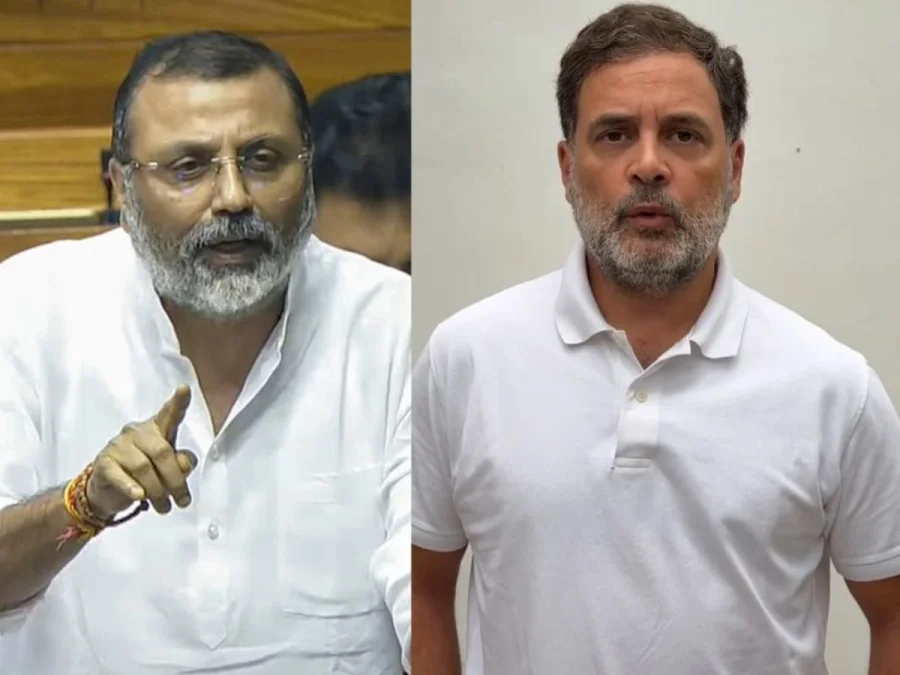
The Lok Sabha witnessed a sharp personal attack on Wednesday when BJP MP Nishikant Dubey told Congress leader Rahul Gandhi: “आप अपने आपको भी Idiot नहीं कह सकते” (You cannot even call yourself an idiot). The remark, made during a heated debate, has reignited political tensions between the ruling party and the opposition.
What Did Nishikant Dubey Say in Lok Sabha?
Speaking in the House, the Godda MP directly targeted Rahul Gandhi, questioning his credibility. “Rahul Gandhi, you cannot even call yourself an idiot,” Dubey said, implying that the Congress leader lacks the self-awareness to admit his own mistakes. The comment was met with protests from opposition benches, who accused Dubey of violating parliamentary decorum.
Why Did This Remark Spark a Political Storm?
The jibe is not an isolated outburst but part of a pattern of escalating personal attacks in Parliament. For months, BJP MPs have targeted Rahul Gandhi over his “Bharat Jodo Yatra” and his criticism of the government. Dubey’s remark is seen as an attempt to undermine Gandhi’s credibility ahead of the 2024 general elections. For Congress supporters, it is a sign of the ruling party’s desperation to silence dissent.
The Context: Rahul Gandhi’s Previous ‘Idiot’ Remark
The exchange appears to reference Rahul Gandhi’s own past comments. In 2018, Gandhi had called Prime Minister Narendra Modi an “idiot” during a speech, a remark that was widely criticized by the BJP. Dubey’s retort seems to be a deliberate echo of that controversy, turning Gandhi’s own words against him. This is a common tactic in Indian politics — using an opponent’s past statements to score points.
How Did the Opposition React?
Congress MPs immediately protested, demanding that Dubey’s remarks be expunged from the records. “This is an insult to the office of the Leader of the Opposition,” said a senior Congress leader, speaking on condition of anonymity. The party is expected to raise the issue formally in the House, potentially seeking an apology from Dubey. However, no official complaint or privilege motion has been filed yet.
What Does This Mean for Parliamentary Discourse?
The incident highlights the deteriorating quality of debate in Parliament. Personal attacks, rather than policy discussions, have become the norm. Political analysts warn that such exchanges erode public trust in democratic institutions. “When MPs resort to name-calling, it sends a message that Parliament is a circus, not a serious forum for governance,” said Dr. Neerja Chowdhury, a political commentator.
Confirmed Facts vs What Remains Unclear
What is confirmed: Nishikant Dubey made the remark in Lok Sabha; Congress MPs protested; the remark references Rahul Gandhi’s past comment. What remains unclear: whether the Speaker will take action; whether Congress will file a formal complaint; the exact context of the debate that led to the exchange. All of these are still developing.
The Political Calculation Behind the Attack
For the BJP, targeting Rahul Gandhi serves multiple purposes. It distracts from policy failures, energizes the party’s base, and forces the Congress to defend its leader rather than attack the government. For Rahul Gandhi, the attack could be a double-edged sword — it may rally opposition supporters but also reinforces the perception that he is an easy target. The remark is unlikely to change voter sentiment significantly, but it keeps the political narrative focused on personality rather than issues.
Risks and Balanced View
Critics argue that Dubey’s remark was unnecessary and undignified, lowering the standard of parliamentary debate. Supporters of the BJP say it was a justified response to Rahul Gandhi’s own past insults. The truth is that both sides have contributed to the toxic atmosphere. The real loser is the institution of Parliament itself, which is meant to be a place for reasoned debate, not personal vendettas.
Wider Trend: The Rise of Personal Attacks in Indian Politics
This incident is part of a broader trend where political discourse has become increasingly personal. From “chaiwala” jibes to “pappu” taunts, Indian politicians have long used insults as a weapon. However, the frequency and intensity have increased in recent years, fueled by social media and 24/7 news cycles. This trend risks normalizing disrespect in public life, with long-term consequences for democratic culture.
Practical Reader Guidance
For readers following this story, it is important to distinguish between political theatre and substantive issues. Focus on policy debates — such as inflation, unemployment, and national security — rather than personal attacks. If you are a voter, demand that your representatives discuss real problems, not trade insults. For students of political science, this incident is a case study in how rhetoric shapes public perception.
Future Outlook
The immediate fallout will depend on the Speaker’s response. If Dubey’s remarks are expunged, the matter may die down. If Congress escalates, it could lead to a privilege motion or a walkout. In the longer term, this incident is unlikely to change the political landscape, but it reinforces the perception that Parliament is broken. The real test will be whether both sides can return to meaningful debate in the remaining days of the session.
Our Take
This exchange is a symptom of a deeper malaise in Indian politics. When MPs spend more time insulting each other than debating policy, the public loses faith in democracy. Both the BJP and Congress are guilty of this. The real question is: will voters punish this behaviour, or reward it? For now, the only certainty is that the noise will continue, and the real issues will remain unaddressed.
Frequently Asked Questions
What did Nishikant Dubey say about Rahul Gandhi in Lok Sabha?
BJP MP Nishikant Dubey said, “Rahul Gandhi, you cannot even call yourself an idiot,” during a parliamentary debate, referencing Gandhi’s past remark against PM Modi.
Why did Nishikant Dubey call Rahul Gandhi an ‘idiot’?
Dubey’s remark was a retort to Rahul Gandhi’s 2018 comment calling PM Modi an “idiot.” It was meant to turn Gandhi’s own words against him.
How did Congress react to Dubey’s remark?
Congress MPs protested in the House, demanding the remark be expunged. The party is expected to raise the issue formally, but no official complaint has been filed yet.
What does this incident mean for Indian politics?
It reflects the growing trend of personal attacks in Parliament, which undermines democratic discourse and distracts from substantive policy debates.