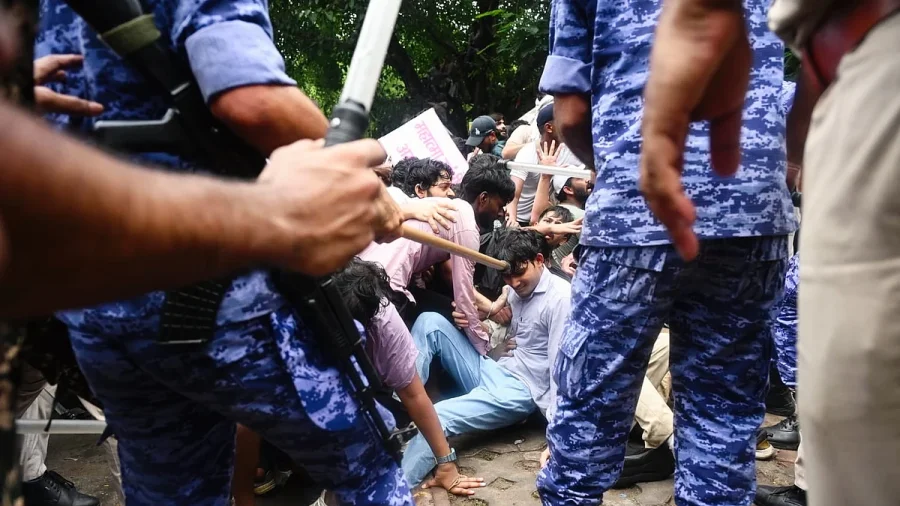
On a humid Monday morning in Delhi, thousands of students and young people turned Jantar Mantar into a living statement of defiance. They came despite knowing the police had said no. They came because, for them, questioning those in power is not a crime—it is resistance.
Why thousands defied a police ban to march on Parliament
The protest, called by scientist-activist Sonam Wangchuk and the Cockroach Janta Party (CJP), was meant to be a Parliament march on 20 July. Delhi Police had made it clear on 19 July that permission had not been granted. Yet by Monday morning, Parliament Street, Jantar Mantar Road, Tolstoy Road, Jai Singh Road, and Janpath were packed with demonstrators.
Their demand was direct and personal: Prime Minister Narendra Modi must accept responsibility for alleged examination irregularities and seek the resignation of Union education minister Dharmendra Pradhan.
What is driving this youth-led resistance
For many in the crowd, this was not just about exams. It was about a growing sense that institutional mechanisms—from examination boards to police permissions—are failing young Indians. The protest reflects a deeper frustration: that those in power are not being held accountable for systemic failures.
“We are not here to break rules. We are here to question why rules are broken for the powerful,” one student told reporters at the site.
How the protest unfolded over two days
Crowds had begun assembling at Jantar Mantar from Saturday itself, building momentum over the weekend. By Monday, the area was a sea of young faces, many carrying placards demanding justice. The march itself was not permitted, but the gathering became a symbolic act of resistance.
Police presence was heavy but restrained. No major clashes were reported as of Monday afternoon, though tensions remained high.
Who is affected and why it matters to ordinary Indians
This protest resonates far beyond Delhi. For students across India, examination irregularities—whether in competitive exams or board results—are a recurring source of anxiety and anger. The demand for ministerial accountability taps into a wider public sentiment that the education system is broken and those responsible are not being held to account.
For parents, the protest raises questions about the future of their children in a system where fairness is increasingly doubted.
What authorities have said so far
Delhi Police maintained that the march was not permitted and urged protesters to disperse. However, no official statement from the Prime Minister’s Office or the Ministry of Education has been issued in response to the specific demands raised at Jantar Mantar.
Sonam Wangchuk, known for his climate activism and educational reform work, has not commented publicly on the police denial or the scale of the turnout.
What this protest really means for Indian democracy
The gathering at Jantar Mantar is not an isolated event. It is part of a broader pattern of youth-led movements in India that question authority, demand transparency, and refuse to accept silence as an answer. From climate strikes to exam reform protests, young Indians are increasingly using public space to challenge institutional power.
This protest, though focused on exam irregularities, carries a larger message: that questioning those in power is not an act of rebellion—it is an act of citizenship.
Confirmed facts vs what remains unclear
Confirmed: Delhi Police denied permission for the Parliament march on 19 July. Thousands gathered at Jantar Mantar and surrounding roads on 20 July. The protest demanded PM Modi’s responsibility and the education minister’s resignation. The march was called by Sonam Wangchuk and the Cockroach Janta Party.
Unclear: The exact number of protesters. Whether any arrests were made. Whether the protest will continue beyond Monday. The specific examination irregularities being cited have not been officially detailed by the protesters or authorities.
Risks and balanced view
While the protest reflects genuine public frustration, critics argue that mass gatherings without permission risk public order and can be exploited by political actors. Some question whether the Cockroach Janta Party, a lesser-known political group, has the organizational credibility to lead such a movement.
Supporters counter that peaceful protest is a constitutional right, and that denying permission does not invalidate the legitimacy of the demands.
Wider trend: Youth questioning institutional power in India
This protest fits into a larger pattern of young Indians using public demonstrations to hold institutions accountable. From the 2019 climate strikes to the 2020-21 farmers’ protests, youth have increasingly turned to direct action when they feel institutional channels are blocked.
The exam irregularities issue, in particular, has sparked protests in multiple states over the past year, with students demanding transparency in competitive exams and board results.
What students and citizens should do now
For those affected by examination irregularities, official grievance channels—such as the National Testing Agency (NTA) or state education boards—remain the primary route for redress. Students are advised to document their concerns and submit formal complaints.
Citizens who support the protest’s demands can engage through legal means, including writing to elected representatives or participating in peaceful, permitted demonstrations.
What could happen next
The protest may continue if demands are not met, potentially escalating into larger demonstrations. The government may respond with a statement or a committee to examine the exam irregularities. Alternatively, the protest could fizzle out if momentum is lost or if police take stricter action.
Much depends on whether the movement gains broader political support or remains confined to student and activist circles.
Our Take
The Jantar Mantar protest is a reminder that democracy is not just about elections—it is about the daily act of questioning power. Whether or not one agrees with the specific demands, the sight of thousands of young people peacefully asserting their right to be heard is a powerful signal. In a democracy, resistance is not a threat. It is a check. And for a generation that feels unheard, that check is more important than ever.
Frequently Asked Questions
Why did the protest happen despite police denial?
Protesters argued that the right to peaceful assembly is constitutionally protected, and that denying permission does not invalidate their demands. They chose to gather symbolically at Jantar Mantar rather than march to Parliament.
Who is Sonam Wangchuk?
Sonam Wangchuk is a Ladakh-based engineer, education reformer, and climate activist. He is known for his work on alternative education and for leading the Ice Stupa project. He has been involved in several public protests on environmental and educational issues.
What are the examination irregularities being protested?
The specific irregularities have not been officially detailed by the protesters. However, recent months have seen multiple reports of alleged paper leaks, marking errors, and administrative lapses in competitive exams like NEET, UGC NET, and state board exams.
Is the Cockroach Janta Party a recognized political party?
The Cockroach Janta Party (CJP) is a registered but lesser-known political group. It has been involved in various activist campaigns but does not have significant electoral presence.