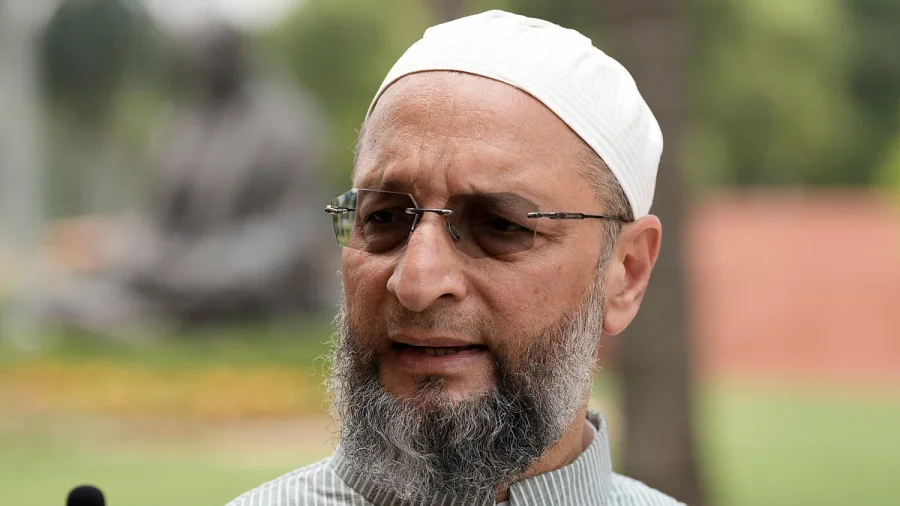
A political firestorm has erupted in Assam after AIMIM chief Asaduddin Owaisi launched a blistering attack on the state government’s newly introduced Uniform Civil Code (UCC) Bill. Calling it a “backdoor imposition of Hindu law,” the Hyderabad MP has accused the BJP-led administration of targeting Muslim personal laws while selectively shielding other communities. The charge, made on social media, has reignited a fierce national debate over the UCC, religious freedom, and the limits of legislative uniformity.
Owaisi’s Sharp Critique of the Assam UCC Bill
In a post on X (formerly Twitter), Asaduddin Owaisi did not mince words. He argued that the Assam UCC Bill, officially titled ‘The Uniform Civil Code, Assam, 2026 Bill,’ is not a uniform code at all. Instead, he claimed it is a calculated move to impose Hindu legal principles on the Muslim community through the “backdoor.” The AIMIM president specifically pointed to provisions that he says interfere with Muslim personal laws related to succession, inheritance, and divorce.
Why This Matters Right Now
This controversy matters because the Assam UCC Bill is one of the most significant legislative attempts to implement a uniform civil code in a major Indian state. The debate goes beyond Assam. It touches on the core constitutional promise of secularism versus the political push for a common legal framework. For millions of Muslims in India, this bill raises deep anxieties about the preservation of their religious identity and personal laws. For the ruling BJP, it is a key ideological promise. Owaisi’s attack has crystallized the opposition’s central argument: that the UCC is not about uniformity but about majoritarianism.
How the Controversy Unfolded
The Assam government introduced the UCC Bill in the state assembly on Monday. The proposed law seeks to prohibit polygamy and make the registration of live-in relationships mandatory. Almost immediately, Owaisi responded on X, stating that “only Hindu culture is being protected,” while Muslims were being compelled to follow what he described as “so-called uniform rules.” He highlighted that the bill exempts tribal communities from its purview, a point he used to argue that the bill’s claim to uniformity is hollow and discriminatory.
Who Is Affected and What Officials Are Saying
The primary group affected by this bill is the Muslim community in Assam, whose personal laws on marriage, divorce, and inheritance would be directly altered. However, the political impact is national. The Assam government has defended the bill, arguing it is a step towards gender justice and social reform, particularly by banning polygamy. Officials have not yet issued a detailed rebuttal to Owaisi’s specific allegations, but the political battle lines are clearly drawn. The opposition, including the Congress and other secular parties, is expected to rally behind Owaisi’s criticism.
What We Know So Far — and What Remains Unclear
What we know: The Assam UCC Bill has been tabled. It bans polygamy and mandates registration of live-in relationships. Asaduddin Owaisi has publicly condemned it as a “backdoor imposition of Hindu law.” The bill exempts tribal communities. What remains unclear: The exact legal language of the bill regarding succession and divorce is still being analyzed. The timeline for its passage and the extent of political opposition within the assembly are not yet known. It is also unclear if the bill will face legal challenges in court on grounds of religious freedom.
Risks, Concerns, and the Balanced View
Risks: The primary risk is the deepening of communal polarization in Assam and beyond. Critics argue that forcing a uniform code without consensus could alienate minority communities. There is also a legal risk: the bill could be challenged for violating the fundamental right to religious freedom under Article 25 of the Constitution. Balanced View: Supporters of the UCC argue that it promotes gender equality and national integration by replacing personal laws with a common set of rules. They point to the ban on polygamy as a progressive step for women’s rights. However, Owaisi and other critics counter that true uniformity would not exempt tribal communities, and that the bill’s selective application reveals its true intent.
Why Similar Trends Are Growing
The push for a UCC is not new, but it has gained momentum under the current central government. Several BJP-ruled states, including Uttarakhand, have already moved towards implementing a UCC. This trend reflects a broader ideological shift towards legal uniformity, which supporters see as a fulfillment of a constitutional directive principle, and opponents see as an assault on India’s pluralistic fabric. Owaisi’s reaction is part of a larger pattern of resistance from Muslim political leaders and organizations who view the UCC as a direct threat to their community’s identity.
- The Assam UCC Bill is the second major state-level attempt after Uttarakhand.
- Owaisi’s criticism is likely to be echoed by other opposition leaders in the coming days.
- The bill’s exemption for tribal communities is a key point of contention, undermining its claim to uniformity.
"Only Hindu culture is being protected, while Muslims are being compelled to follow so-called uniform rules." — Asaduddin Owaisi, AIMIM President, on X
What Readers, Users, or Investors Should Know Now
For residents of Assam, this bill could directly impact personal legal matters related to marriage and inheritance. It is advisable to stay informed about the bill’s provisions and the ongoing legislative process. For the wider public, this debate is a crucial moment in India’s ongoing conversation about secularism, religious freedom, and legal reform. Observers should watch for the bill’s passage, potential amendments, and any legal challenges that may follow.
What Could Happen Next
The Assam Assembly is expected to debate the bill in the coming weeks. The opposition is likely to mount a strong challenge, possibly leading to a walkout or a legal battle. If passed, the law will likely face scrutiny in the Supreme Court. Nationally, this could embolden other states to pursue similar legislation, further intensifying the political and social debate over the UCC.
Our Take: Why This Story Matters Beyond One Incident
Owaisi’s attack on the Assam UCC Bill is more than just political rhetoric. It highlights a fundamental tension in Indian democracy: the balance between a uniform legal system and the protection of minority religious practices. The bill’s exemption for tribal communities exposes a critical flaw in its logic, lending weight to Owaisi’s argument that it is not about uniformity but about targeting specific communities. This story matters because it forces a national conversation about what kind of society India wants to be—one that respects diversity or one that enforces conformity.
FAQs
What is the Assam UCC Bill 2026?
The Assam Uniform Civil Code Bill, 2026, is a proposed law introduced by the Assam government to create a common set of personal laws for all citizens, replacing community-specific religious laws. It specifically seeks to ban polygamy and mandate the registration of live-in relationships.
Why did Asaduddin Owaisi call the Assam UCC Bill a ‘backdoor imposition of Hindu law’?
Owaisi argued that the bill selectively targets Muslim personal laws on succession, inheritance, and divorce, while exempting tribal communities. He claims this makes the bill discriminatory and an attempt to impose Hindu legal principles on Muslims under the guise of uniformity.
Does the Assam UCC Bill apply to all communities?
No. The bill reportedly exempts tribal communities in Assam from its provisions. This exemption has become a major point of criticism, with opponents arguing that it undermines the bill’s claim to be a “uniform” civil code.
What are the main criticisms of the Assam UCC Bill?
The main criticisms are that it infringes on the religious freedom of Muslims, is selectively applied by exempting tribal groups, and could lead to increased communal polarization. Critics also argue it is a political move rather than a genuine reform for gender justice.