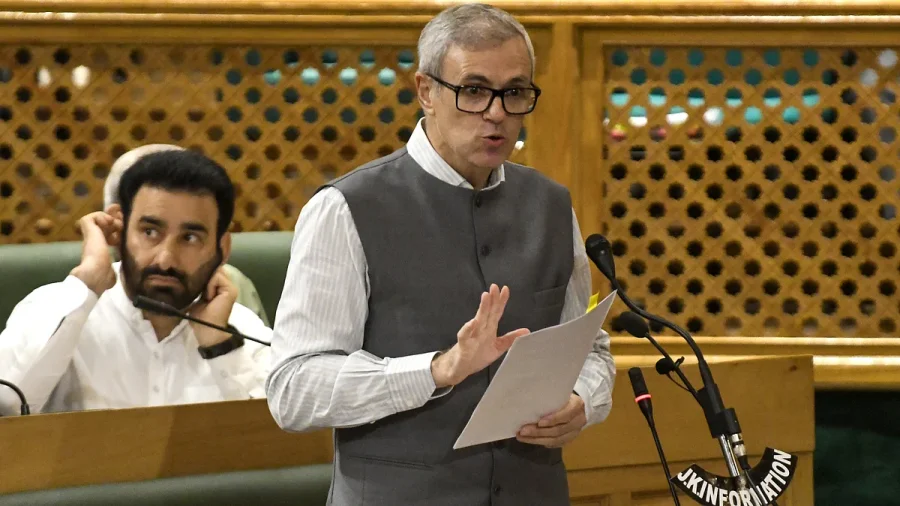
The Jammu and Kashmir Legislative Assembly turned into a battleground on Friday as Chief Minister Omar Abdullah moved a resolution demanding the immediate restoration of full statehood to the Union Territory — a demand that has hung over the region's politics since 2019.
BJP legislators staged noisy protests as Abdullah rose to table the resolution after Question Hour, with the House witnessing heated scenes. The resolution formally forwards the statehood demand to the Union government.
What the Resolution Actually Asks For
The resolution calls on the Centre to restore full statehood to Jammu and Kashmir without further delay. Abdullah's core argument: delimitation has been completed and assembly elections have been held, yet statehood remains pending.
In his framing, the two conditions that were cited as prerequisites for restoring statehood have now been fulfilled — leaving no stated reason for the delay.
Why This Demand Has Refused to Fade
Jammu and Kashmir was downgraded from a full state to a Union Territory in October 2019, alongside the revocation of Article 370. Since then, the restoration of statehood has remained the central political demand across party lines in the region.
For the J&K government, it is not a peripheral issue but a stated key priority — one that shapes its relationship with the Centre and its own political credibility.
How the Assembly Session Unfolded
According to the original report, Abdullah moved the resolution after Question Hour, at a point when BJP members were already protesting. The House descended into chaos as the resolution was tabled.
The BJP's opposition in the House signals that the statehood demand remains a live political fault line rather than a settled matter.
Who This Affects — and How
For residents of Jammu and Kashmir, statehood is not an abstract constitutional question. It determines the extent of the region's legislative powers, its representation, and its political standing within the Union.
The resolution's passage — and the Centre's response to it — will be read by voters as a measure of whether their elected government can deliver on its core promise.
What the Centre Has Said — and What Remains Unclear
Confirmed: the resolution has been moved and formally forwarded to the Union government. The BJP protested in the Assembly.
Unclear: whether the Centre will respond, in what timeframe, and whether the resolution will translate into any concrete movement on statehood. No official commitment has been reported.
Risks and the Balanced View
The resolution carries political weight but no legal obligation on the Centre. Critics may argue it is largely symbolic — a position statement rather than an enforceable demand.
Supporters counter that formal Assembly resolutions create political pressure and a public record that is difficult to ignore indefinitely. Both readings are plausible; the outcome depends entirely on the Centre's willingness to engage.
The Wider Pattern
This is not an isolated move. It fits a broader pattern of elected governments in Union Territories testing the limits of their authority and pressing the Centre on unresolved constitutional questions.
Similar tensions have played out elsewhere, making J&K's statehood resolution part of a larger debate about federalism and UT governance in India.
What Readers Should Watch For
Watch the Centre's response — or its silence. Watch whether the resolution passes the Assembly and in what form. And watch whether this becomes a recurring political flashpoint in upcoming sessions.
For now, the resolution is a formal, on-the-record demand. Its real significance will be measured by what follows.
Future Outlook
If the Centre engages, this could mark the beginning of a negotiation. If it does not, the resolution becomes another entry in a long list of unresolved statehood appeals — and a likely campaign issue in future elections.
Our Take
Omar Abdullah's resolution is significant less for what it changes today and more for what it forces into the open: a formal, public demand from an elected government that the Centre can no longer treat as background noise. Whether it moves the needle depends on Delhi. But it has now been placed squarely on the record.
Frequently Asked Questions
What did Omar Abdullah move in the J&K Assembly?
He moved a resolution seeking the immediate restoration of full statehood to Jammu and Kashmir, formally forwarding the demand to the Union government.
Why did BJP members protest?
BJP legislators staged noisy protests in the House as the resolution was moved after Question Hour, leading to heated scenes in the Assembly.
What is Abdullah's main argument for statehood?
He argues that delimitation and assembly elections have been completed — the stated prerequisites — yet statehood remains pending.
Will this resolution restore statehood immediately?
No. The resolution is a formal demand to the Centre. Restoration depends entirely on the Union government's response, which has not been reported.