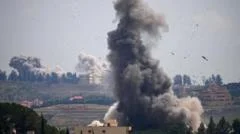
For a few tense hours, it looked like the fragile calm might shatter completely. Israeli warplanes were once again roaring over southern Lebanon, striking targets linked to Hezbollah. But in a significant shift, the bombs did not fall on Beirut. And on the ground, a partial truce — brokered by the United States — appeared to be holding, offering a sliver of hope in a region bracing for a wider war.
The situation remains deeply volatile. While Israel continues its military campaign in the south, the decision to spare the capital signals a calculated de-escalation. For the thousands of civilians on both sides of the border, the question is no longer just about who struck first, but whether this fragile pause can last.
What the Partial Truce Actually Means
The deal, announced by US officials, is not a full ceasefire. It is a limited de-escalation agreement between Israel and Hezbollah. Under its terms, Israel has agreed to halt strikes on Beirut and major population centers, while Hezbollah has reportedly accepted a US-backed proposal to stop its own attacks from southern Lebanon. However, Israeli operations in the south — targeting Hezbollah infrastructure and rocket launchers — have continued.
This is a carefully calibrated arrangement. Both sides are signaling restraint without admitting defeat. For Israel, the goal is to degrade Hezbollah’s military capabilities without triggering a full-scale war. For Hezbollah, the truce offers breathing room after weeks of intense bombardment, but without appearing to surrender.
Why This Matters Right Now
The stakes could not be higher. A full-blown conflict between Israel and Hezbollah would be catastrophic — far deadlier than the ongoing war in Gaza. Hezbollah is a far more formidable military force than Hamas, with an arsenal of over 100,000 rockets capable of reaching deep into Israeli territory. A wider war would devastate Lebanon’s already crumbling economy and displace hundreds of thousands of civilians on both sides.
The partial truce, however fragile, is a rare moment of de-escalation in a region that has seen almost none since October 7. It offers a potential off-ramp — a chance for diplomacy to replace airstrikes. But it also carries risks. If either side misreads the other’s intentions, the truce could collapse within hours.
How the Truce Unfolded
The deal emerged after weeks of intense backchannel negotiations, with US mediators shuttling between Tel Aviv and Beirut. Hezbollah, under pressure from its Lebanese allies and facing devastating Israeli strikes, reportedly signaled willingness to accept a limited truce. Israel, wary of a multi-front war, agreed to halt strikes on Beirut but insisted on continuing operations in the south to prevent Hezbollah from regrouping near the border.
The announcement came suddenly. On Monday, Lebanese officials confirmed a partial ceasefire, describing it as a “limited de-escalation” rather than a permanent peace. Almost immediately, Israeli airstrikes in southern Lebanon continued, but the capital remained quiet. The message was clear: the deal was real, but it was not a surrender.
Who Is Affected and What Officials Are Saying
For civilians in southern Lebanon, the truce offers little immediate relief. Israeli strikes continue in villages and border areas, forcing many to remain in shelters. In Beirut, however, the relative calm has allowed some residents to return to normal life — at least for now.
Israeli officials have been careful not to declare victory. “We are continuing to strike Hezbollah targets in the south to ensure our security,” a military spokesperson said. “The decision not to strike Beirut is tactical, not strategic.” Hezbollah, meanwhile, has not officially commented on the truce, but its media outlets have framed the deal as a “tactical pause” rather than a defeat.
US officials have urged both sides to extend the truce. “This is a first step,” a State Department spokesperson said. “We hope it can lead to a more comprehensive ceasefire and a reduction in tensions across the region.”
What We Know So Far — and What Remains Unclear
What we know:
- Israel has halted airstrikes on Beirut.
- Israeli strikes continue in southern Lebanon.
- Hezbollah has reportedly accepted a US-backed proposal for a partial truce.
- The deal was announced by US and Lebanese officials.
What remains unclear:
- The exact terms of the truce have not been publicly released.
- Whether Hezbollah has fully stopped its own attacks is unconfirmed.
- The duration of the truce is unknown — it could be days or weeks.
- Whether Israel will eventually halt strikes in the south remains uncertain.
Risks, Concerns, and the Balanced View
The partial truce is a high-risk gamble. Critics on the Israeli side argue that continuing strikes in the south without hitting Hezbollah’s leadership in Beirut is a half-measure that leaves the group’s command structure intact. In Lebanon, some see the deal as a capitulation, with Hezbollah accepting a truce while Israel continues to bomb the south.
There is also the risk of miscalculation. If Hezbollah perceives Israeli strikes in the south as a violation of the truce, it could resume attacks on Israeli cities. Similarly, if Israel believes Hezbollah is using the pause to rearm, it could escalate again. The truce is not a peace agreement — it is a fragile pause in a conflict that could reignite at any moment.
Supporters of the deal argue that any de-escalation is better than none. “This buys time for diplomacy,” one analyst said. “It’s not perfect, but it’s better than a full-scale war.”
Why Similar Patterns of Limited Truces Are Emerging
This is not the first time a partial ceasefire has been attempted in the region. Similar limited truces have been tried in Gaza, often collapsing within days or weeks. The pattern is familiar: one side halts attacks on population centers, but continues military operations in contested areas, leading to accusations of bad faith and eventual escalation.
The difference this time may be the role of the US. Washington has invested significant diplomatic capital in preventing a wider war between Israel and Hezbollah, fearing it could draw in Iran and destabilize the entire Middle East. Whether that investment pays off remains to be seen.
What Civilians and Investors Should Know Now
For civilians in Lebanon and Israel, the advice remains the same: stay informed, follow official safety guidelines, and be prepared for sudden changes. The truce could collapse without warning.
For investors and markets, the partial truce is a positive signal, reducing the immediate risk of a regional war. However, the situation remains highly volatile. Any escalation could trigger sharp market reactions, particularly in energy and defense sectors.
What Could Happen Next
The most likely scenario is a continuation of the current status quo: limited Israeli strikes in southern Lebanon, no attacks on Beirut, and a fragile truce that neither side fully respects. Diplomatic efforts will focus on extending the truce and eventually negotiating a more comprehensive ceasefire.
The worst-case scenario is a collapse of the deal, leading to renewed strikes on Beirut and a full-scale war. The best-case scenario is a gradual de-escalation that leads to a lasting ceasefire and a reduction in tensions along the Israel-Lebanon border.
Our Take: Why This Story Matters Beyond One Incident
This partial truce is a reminder that even in the most entrenched conflicts, moments of de-escalation are possible. It is also a warning that such moments are fragile and can be shattered by a single miscalculation. For the people of Lebanon and Israel, the stakes are existential. For the rest of the world, this is a test of whether diplomacy can still work in a region defined by war.
FAQs
What is the partial truce between Israel and Hezbollah?
The partial truce is a limited de-escalation agreement brokered by the US. Under its terms, Israel has halted airstrikes on Beirut, while Hezbollah has reportedly agreed to stop attacks from southern Lebanon. However, Israeli strikes in southern Lebanon continue.
Why is Israel still striking southern Lebanon if there is a truce?
The truce is partial, not a full ceasefire. Israel continues to target Hezbollah infrastructure and rocket launchers in southern Lebanon to prevent the group from regrouping near the border. The deal only covers strikes on Beirut and major population centers.
How long will the Israel-Hezbollah truce last?
The duration of the truce is unclear. It could last days or weeks, depending on whether both sides adhere to the terms. Diplomatic efforts are underway to extend the truce and negotiate a more comprehensive ceasefire.
What happens if the truce collapses?
If the truce collapses, Israel could resume strikes on Beirut, and Hezbollah could launch rockets into Israeli cities. This would likely escalate into a full-scale war, with devastating consequences for both sides and the wider region.