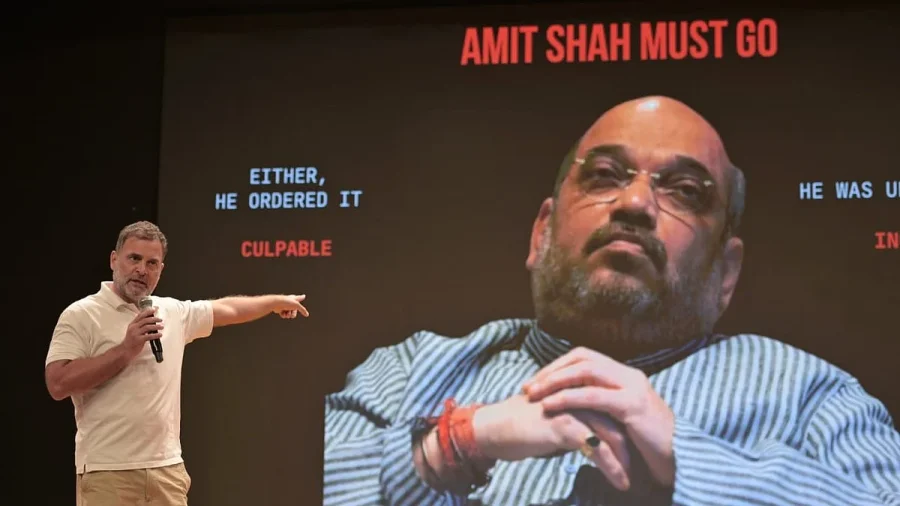
The Congress party on Wednesday launched its most aggressive attack yet on the Narendra Modi government, demanding the resignation of Union Home Minister Amit Shah over the use of pellet guns, nail-fitted lathis, and electric batons against student protesters during the 20 July demonstrations in Delhi. The demand, led by Lok Sabha Leader of Opposition Rahul Gandhi, marks a significant escalation in the political fallout from the protests, which were initially sparked by paper leaks but have now widened into a broader confrontation over the government’s handling of student unrest.
“Culpable or incompetent”: Rahul Gandhi’s ultimatum to Amit Shah
Rahul Gandhi did not mince words. Calling Shah either “culpable or incompetent,” he argued that the home minister must step down in either case. “If Amit Shah does not resign, Prime Minister Narendra Modi should sack him,” the Congress leader declared, framing the issue as a test of accountability at the highest level of government. The party’s statement directly links the home minister to the alleged excessive force, suggesting that the violence on 20 July was not an isolated incident but a reflection of a systemic failure in leadership.
Why the 20 July firing matters: The human cost of student protests
The 20 July demonstrations in Delhi were part of a wave of student protests that began over allegations of paper leaks in competitive exams. But the use of pellet guns, nail-fitted lathis, and electric batons—weapons typically associated with crowd control in conflict zones—has shocked many. For students and their families, the violence represents a dangerous escalation. For the Congress, it is a political opportunity to paint the Modi government as authoritarian and out of touch with the youth. The emotional weight of the incident is amplified by the fact that the protests were initially peaceful, with students demanding transparency and fairness in the examination system.
Timeline of events: From paper leaks to political firestorm
The crisis began weeks ago when reports of paper leaks in several competitive exams triggered widespread student anger. On 16 July, Union Education Minister Dharmendra Pradhan resigned, taking responsibility for the administrative failures. But the protests did not subside. On 20 July, students gathered in Delhi to demand a thorough investigation and systemic reforms. The police response, which included the use of pellet guns and electric batons, led to injuries and arrests. Four days later, on 24 July, the Congress escalated its attack, targeting Amit Shah directly. The party’s demand for a Supreme Court-monitored probe signals its intent to keep the issue alive in the highest judicial forum.
Who is affected: Students, families, and the broader public
The immediate victims are the students who faced the brunt of the police action—many of whom were protesting for what they saw as a basic right to a fair examination system. Their families are now grappling with injuries, trauma, and the fear of legal repercussions. But the impact extends beyond Delhi. Across India, students and young professionals are watching closely, as the incident raises questions about the right to peaceful protest and the limits of state power. For the Congress, the issue is also about mobilizing youth support ahead of upcoming elections, framing the Modi government as hostile to the aspirations of India’s young population.
Government and police response: What has been said so far
As of now, the Union Home Ministry has not issued a formal response to the Congress’s demand for Shah’s resignation. The Delhi Police, which operates under the central government, has defended its actions, stating that the force was necessary to control a volatile situation and prevent damage to public property. However, the use of pellet guns—which can cause blindness and severe injuries—has drawn criticism from human rights groups. The Congress has rejected the police’s justification, calling for an independent investigation. The party’s demand for a Supreme Court-monitored probe is a direct challenge to the government’s narrative, seeking to bypass any internal inquiry that might be seen as biased.
Analysis: Why the Congress is targeting Amit Shah now
The decision to target Amit Shah, rather than just the Delhi Police or the education ministry, is a calculated political move. Shah is not only the home minister but also the BJP’s chief strategist and a key figure in the Modi government. By demanding his resignation, the Congress is aiming for the highest possible political scalp. The framing of Shah as “culpable or incompetent” is designed to force a binary choice: either he authorized the excessive force, or he failed to prevent it. Either way, the Congress argues, he is unfit to hold office. This strategy also seeks to shift the narrative from the original issue of paper leaks to a broader critique of the government’s authoritarian tendencies.
Confirmed facts vs what remains unclear
What is confirmed: Student protests occurred on 20 July in Delhi. The police used pellet guns, nail-fitted lathis, and electric batons. The Congress has formally demanded Amit Shah’s resignation and a Supreme Court-monitored probe. Rahul Gandhi has publicly called Shah “culpable or incompetent.” What remains unclear: The exact number of injuries and arrests from the 20 July firing. Whether Shah personally authorized or was briefed on the use of such force. The Delhi Police’s internal assessment of the necessity of the force used. The timeline of any potential judicial or internal inquiry. All speculation about Shah’s direct involvement or the government’s internal deliberations should be treated as unconfirmed.
Risks and balanced view: The political and legal stakes
The Congress’s demand carries significant risks. If the government refuses to act, the party could be seen as making a hollow political gesture. If a Supreme Court probe is ordered, it could expose the police’s actions to intense scrutiny, potentially leading to disciplinary action or legal consequences for officers. However, the government may also argue that the Congress is politicizing a law-and-order situation and that the police acted within their mandate. Critics of the Congress point out that the party has not always been consistent on the use of force during protests when it was in power. The balanced view is that while the use of pellet guns and electric batons is deeply concerning, the full context of the 20 July protests—including any provocation or violence from protesters—needs to be established through a credible investigation.
Wider pattern: Student protests and state response in India
The 20 July incident is not an isolated event. Over the past decade, student protests in India—from JNU to Jamia Millia Islamia to the anti-CAA demonstrations—have often been met with a heavy-handed police response. The use of pellet guns, in particular, has been a recurring controversy, with the Supreme Court previously questioning their use in Kashmir. This pattern raises broader questions about the government’s approach to dissent, especially from young people. The Congress is tapping into this wider concern, positioning itself as the defender of democratic rights against a government it accuses of suppressing opposition.
What students and citizens should know now
For students who participated in the 20 July protests or are planning future demonstrations, the key takeaway is the importance of documenting evidence—videos, photographs, medical reports—of any police action. Legal aid organizations are likely to offer support for those injured or arrested. For the general public, the demand for a Supreme Court-monitored probe is a significant development that could set a precedent for how such incidents are investigated in the future. Citizens should follow the case closely, as the outcome will have implications for the right to protest and police accountability in India.
Future outlook: What could happen next
The Congress is likely to continue its pressure campaign, possibly raising the issue in Parliament and organizing public protests. The government may respond by ordering an internal police inquiry or by dismissing the Congress’s demand as politically motivated. If the Supreme Court takes cognizance of the matter—either through a petition or a public interest litigation—a formal investigation could be launched. The political fallout could also affect the BJP’s standing among young voters, especially if the issue gains traction on social media. However, without a credible investigation, the truth of what happened on 20 July may remain contested.
Our Take
The Congress’s demand for Amit Shah’s resignation over the 20 July firing is a high-stakes political gamble. It shifts the focus from the original issue of paper leaks to a broader critique of the government’s use of force against protesters. While the party’s motives are clearly political, the underlying concerns about the use of pellet guns and electric batons on students are legitimate and deserve a thorough, independent investigation. The demand for a Supreme Court-monitored probe is a reasonable way to ensure credibility. However, the Congress must also be prepared to accept the findings of such a probe, even if they do not fully align with its political narrative. For now, the ball is in the government’s court—and the eyes of India’s youth are watching closely.
Frequently Asked Questions
Why is the Congress demanding Amit Shah’s resignation?
The Congress alleges that Union Home Minister Amit Shah is either “culpable or incompetent” for the use of pellet guns, nail-fitted lathis, and electric batons against student protesters on 20 July in Delhi. The party argues that as the home minister, he is ultimately responsible for the police action.
What happened on 20 July in Delhi?
On 20 July, student protesters gathered in Delhi to demonstrate against paper leaks in competitive exams. The Delhi Police used pellet guns, nail-fitted lathis, and electric batons to control the crowd, leading to injuries and arrests. The Congress has described this as excessive force.
What is the Congress demanding from the Supreme Court?
The Congress is demanding a Supreme Court-monitored probe into the 20 July firing and the alleged use of excessive force. The party wants an independent investigation that is not controlled by the central government.
Has the government responded to the Congress’s demand?
As of now, the Union Home Ministry and the Delhi Police have not issued a formal response to the demand for Amit Shah’s resignation. The police have defended their actions as necessary to control a volatile situation.