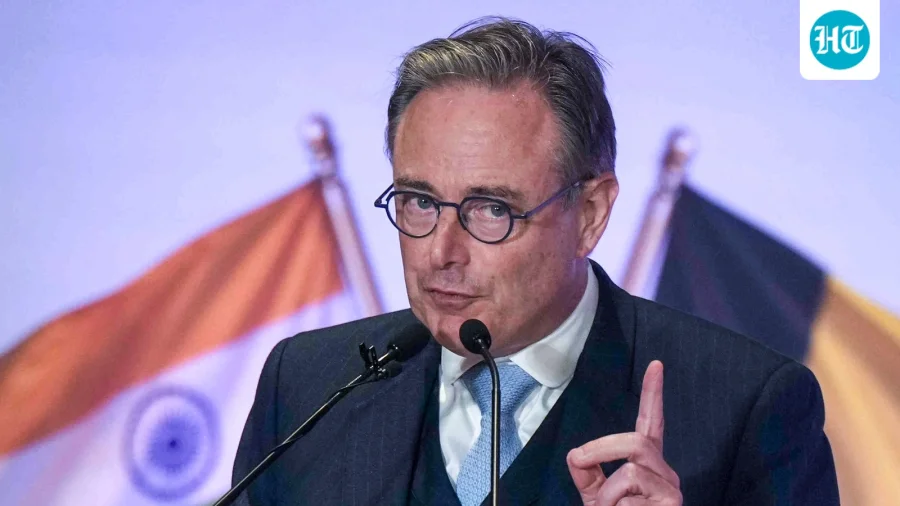
The Belgian Prime Minister chose a diplomatic stage in India to deliver a pointed message about global trade — without naming the United States. Speaking at a high-level dialogue on the India-EU Free Trade Agreement, Bart De Wever criticised the rising tide of protectionism and what he described as erratic tariff decisions that undermine business confidence.
Unpredictable tariffs under fire at India-EU trade forum
"Decide something on Monday, revoke it on Wednesday," De Wever said, in remarks widely interpreted as a veiled criticism of the Trump administration's tariff policies. The comment struck a chord with European and Indian business leaders who have struggled to plan amid shifting US trade rules.
The Belgian PM did not explicitly name the United States, but the timing and phrasing left little room for ambiguity. His audience — policymakers, diplomats, and industry representatives — understood the reference instantly.
Why De Wever's words carry weight beyond Belgium
Belgium holds strategic importance as the EU's political heart, hosting key European institutions in Brussels. When its Prime Minister speaks about trade predictability, he speaks for a broader European consensus that has grown weary of Washington's stop-start approach to tariffs.
For Indian businesses eyeing European markets, De Wever's message reinforces a crucial point: the EU wants a reliable trading partner, and it expects the same in return. The India-EU FTA talks, long in negotiation, now carry renewed urgency on both sides.
How the India visit fits into a larger trade puzzle
De Wever's visit comes at a delicate moment for global commerce. The United States has imposed and then suspended tariffs on multiple trading partners, creating uncertainty that ripples through supply chains worldwide. European leaders have repeatedly called for stability, but this is one of the clearest public critiques delivered on foreign soil.
India, meanwhile, has been navigating its own trade relationships carefully — balancing its strategic partnership with Washington against its deepening economic ties with Europe. De Wever's remarks offer New Delhi a glimpse of European frustration that could shape future negotiations.
What this means for Indian exporters and EU businesses
For Indian exporters, the message is reassuring: Europe remains committed to a rules-based trading system. The FTA, once finalised, could open significant opportunities for Indian textiles, pharmaceuticals, and technology services in European markets.
For European companies operating in India, De Wever's push for predictability signals that the EU is serious about creating a stable framework — one that protects investments from sudden policy shifts, whether from Washington or anywhere else.
European Union's official stance on trade stability
The EU has consistently advocated for multilateral trade rules through the World Trade Organization. De Wever's comments align with this institutional position, though his directness suggests growing impatience within European capitals.
Officials familiar with the dialogue said the Belgian PM's remarks were carefully calibrated — critical enough to make a point, diplomatic enough to avoid a diplomatic incident. The strategy appears to have worked, generating headlines without triggering an official response from Washington.
Reading between the lines of diplomatic language
In diplomatic circles, what is unsaid often matters as much as what is spoken. De Wever's refusal to name the United States was itself a statement — a way of criticising policy without attacking a nation or its leadership. This approach preserves room for dialogue while making the European position unmistakably clear.
The choice of India as the venue adds another layer. By voicing these concerns in New Delhi, De Wever signals that Europe sees India as a like-minded partner in defending predictable trade — a subtle alignment that could strengthen India-EU ties.
Confirmed remarks versus diplomatic interpretation
What is confirmed: De Wever made the "Monday-Wednesday" comment during the India-EU FTA dialogue. What remains interpretation: whether he intended it specifically as a dig at Trump tariffs. The phrasing strongly suggests it, but no official clarification has been issued.
What is also unclear is whether this signals any concrete policy shift from Belgium or the EU. For now, the remarks appear to be diplomatic signalling rather than a precursor to formal action against US trade policies.
Why Belgium matters in the India-EU trade equation
Belgium is not just another EU member state — it is home to the European Commission and Council, making it central to EU decision-making. Belgian support for the India-EU FTA carries outsized influence in Brussels corridors where trade deals are ultimately approved.
Beyond politics, Belgium is a significant trading partner for India in its own right, with strong bilateral flows in chemicals, diamonds, and machinery. De Wever's visit reinforces both tracks — the bilateral relationship and the broader EU framework.
Risks and reactions to criticising US trade policy
Public criticism of US tariffs carries risks. Washington has shown willingness to retaliate against trading partners it perceives as hostile, and European leaders are aware of this vulnerability. De Wever's remarks may have been calculated to test the waters — to see how much pushback Europe can offer without provoking retaliation.
Supporters of the Belgian PM's stance argue that silence has not worked and that Europe must speak frankly about the costs of unpredictable trade policy. Critics, however, warn that public criticism could complicate EU-US relations at a time when unity matters on other fronts.
A broader European shift toward trade assertiveness
De Wever is not alone in voicing frustration. Several European leaders have privately and publicly questioned the reliability of US trade commitments. This visit marks a pattern: Europe is increasingly willing to articulate its own trade interests rather than defer to Washington.
For India, this shift presents an opportunity. A Europe that is more assertive about trade stability is a Europe more likely to finalise the FTA with India — a deal that has been in negotiation for years without conclusion.
What Indian businesses and policymakers should watch next
Indian businesses should monitor whether De Wever's remarks translate into accelerated FTA negotiations. The Belgian PM's public commitment to the deal suggests political will exists at high levels, but technical negotiations remain complex.
Policymakers in New Delhi should also note the European appetite for predictability. When the FTA is eventually negotiated, India's ability to offer stable, transparent trade rules will be a key bargaining chip.
The road ahead for India-EU trade relations
The coming months will reveal whether De Wever's words mark a turning point or remain a footnote in trade diplomacy. The FTA negotiations are expected to continue through 2025, with both sides expressing optimism about reaching a framework agreement.
What is certain is that the era of unquestioned US trade leadership has passed. Europe is speaking its own mind, and it chose India as the venue to say so.
Our Take
De Wever's comment was brief, but it captured a moment of genuine global realignment. The United States, under Trump, has treated tariffs as a negotiating tool to be deployed and withdrawn at will. Europe, which built its prosperity on predictable trade rules, finds this approach fundamentally destabilising.
By choosing India as the platform for this message, De Wever did two things at once: he reassured India of Europe's commitment to a rules-based order, and he signalled to Washington that European patience has limits. Whether this translates into concrete policy shifts remains to be seen, but the diplomatic signal is unmistakable.
Frequently Asked Questions
What did the Belgian PM say about Trump tariffs during his India visit?
Bart De Wever criticised unpredictable tariff measures, saying some countries "decide something on Monday, revoke it on Wednesday." He did not name the United States directly, but the remarks were widely interpreted as a veiled criticism of Trump-era tariff policies.
Why did Bart De Wever make these remarks in India?
He was speaking at a high-level dialogue on the India-EU Free Trade Agreement. The venue allowed him to criticise protectionism while reinforcing Europe's commitment to stable, rules-based trade with India.
How might this affect India-EU trade negotiations?
The remarks signal strong European political will to finalise the India-EU FTA. De Wever's public support could help accelerate negotiations, though technical complexities remain.
Did the US respond to the Belgian PM's comments?
No official response from US officials or the Trump administration has been reported. The remarks were diplomatic in tone and did not name the US explicitly, leaving room for quiet diplomacy.