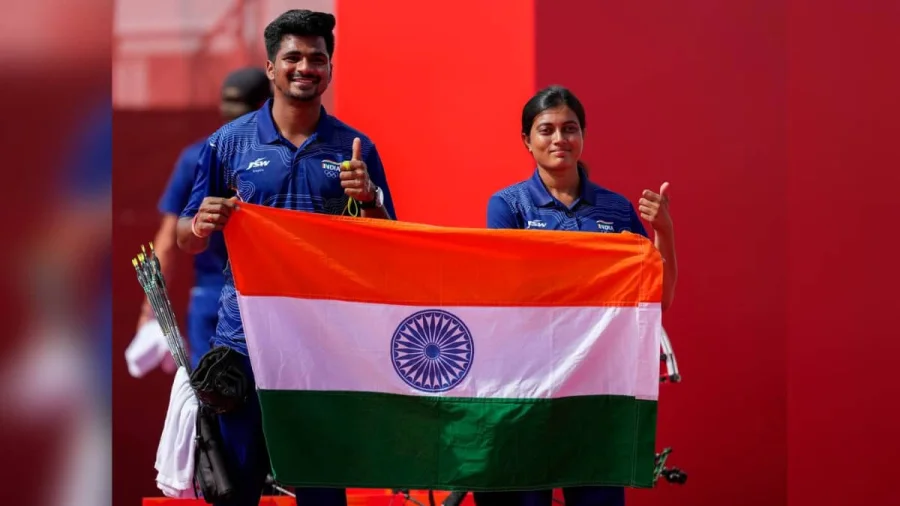
Fifteen arrows each. Nothing separating them. Then one shot to decide everything — and India took it.
Chikitha Taniparthi and Sahil Jadhav beat South Korea in the compound mixed team final at the Asian Games 2026 on Wednesday, winning gold in a shoot-off after the match ended locked at 157-157. India scored 20 in the tiebreaker. South Korea managed 19.
By a single point, a gold medal and an Olympic berth were settled.
A Final That Refused to Break Open
Compound mixed team finals are usually decided by small margins. This one gave nothing away at all.
Neither pair could build a decisive lead across regulation. Every end stayed tight, every arrow mattered, and the scoreboard kept returning the same answer: level. When 15 arrows apiece produced 157-157, the contest moved into the shoot-off — the archery equivalent of a penalty shootout, where one loose release ends it.
India's duo scored 20. South Korea's scored 19. That was the entire difference between gold and silver.
Why This Gold Carries More Than a Medal
The headline number is the medal. The bigger number is the quota.
Winning the compound mixed team title at the Asian Games 2026 confirmed an Olympic berth for India in the LA 2028 cycle. For a discipline that has spent years fighting for visibility inside Indian archery, that is the part that changes careers, funding and selection pathways.
An Olympic quota is not just a slot. It is a signal to federations, sponsors and state governments about where resources should go next.
From a Level Scoreline to a National Headline
The original report describes a final that stayed tightly contested throughout, with neither side able to establish a decisive advantage. That is the honest picture of elite compound archery — the margins are measured in millimetres on the target face, not in dominant spells.
What separated the two teams in the end was composure, not superiority. India's pair held their nerve under intense pressure in the shoot-off. South Korea, one of the sport's established powers, did not.
The Two Names at the Centre of It
Chikitha Taniparthi and Sahil Jadhav are now Asian Games gold medallists and Olympic-quota holders. That combination does not come around often in Indian archery.
For young archers across India — many training on modest grounds in Andhra Pradesh, Jharkhand, Maharashtra and the northeast — this is the kind of result that makes an Olympic pathway feel real rather than theoretical. It also raises expectations sharply. Once you win at this level, the next question arrives immediately: can you repeat it on the world stage?
What the Record Shows — and What It Doesn't Yet
Confirmed: India won compound mixed team gold at the Asian Games 2026. The final finished 157-157 after 15 arrows each. India won the shoot-off 20-19. An Olympic berth for the LA 2028 cycle has been secured. India completed a golden double in compound archery at these Games.
Not yet confirmed: The exact formalities and timeline for the Olympic quota confirmation, official statements from the athletes or the national federation, and the full details of India's remaining archery schedule at the Games. No verified quotes from the archers or coaching staff were available at the time of writing.
Anything beyond the above should be treated as unconfirmed until officially stated.
Why India's Compound Programme Keeps Delivering
India's strength in compound archery is not accidental. Compound is a discipline where equipment precision, repeatable technique and structured training produce measurable returns — and India has built depth here faster than in recurve, where the Olympic programme has historically been tougher to crack.
The mixed team format rewards exactly that: two archers who can each absorb pressure without the other collapsing. India's pipeline has been producing those pairings consistently. This gold is the latest evidence, not an outlier.
The Other Side of the Story
A 20-19 shoot-off is a one-arrow result. It is worth saying plainly: this final could have gone the other way, and South Korea will know that as well as India does.
Compound archery also remains outside the Olympic programme in its traditional form, which means quota structures and event inclusion can shift between cycles. India's berth is significant, but the pathway to LA 2028 is not fully locked in terms of event formats and selection criteria.
There is also the familiar risk of over-celebration. One Asian Games gold does not guarantee world championship medals, and India's compound teams have historically been strong in Asia while finding the World Cup and World Championships circuit harder to dominate.
Where This Fits in India's Archery Story
India has been steadily converting archery potential into podium finishes across compound events, and the mixed team format has become one of its most reliable medal routes.
A golden double in compound at a single Asian Games is not a small thing. It suggests the depth is now structural — multiple archers capable of winning, not one standout carrying a category.
What This Means for Readers Following Indian Archery
If you follow the sport, watch three things from here: the official confirmation of the Olympic quota, how the federation structures the LA 2028 preparation cycle, and whether these two archers are retained as a pairing or rotated.
For aspiring archers and parents evaluating the sport, the practical takeaway is simpler. Compound archery in India now has a visible, repeatable route to the Olympic stage. That route did not exist in the same form a decade ago.
What Comes Next
Expect official statements from the athletes and the national federation in the coming days, along with clarity on the quota confirmation process.
India's remaining archery events at the Asian Games 2026 will now be watched with higher expectations. And the longer arc — qualification cycles, selection trials and preparation for LA 2028 — begins almost immediately.
Our Take
This is a genuinely significant result, and it deserves to be reported as one. But the story is not the shoot-off drama alone. It is that India has now produced a compound mixed team good enough to beat South Korea in a final where nothing separated them for 15 arrows.
That is a depth story, not a luck story. The Olympic berth makes it a structural one. The next test is whether Indian archery can convert this into sustained results on the world circuit — because that is where the real measure of a programme lies.
Frequently Asked Questions
Who won gold in the compound mixed team archery at the Asian Games 2026?
India's Chikitha Taniparthi and Sahil Jadhav won gold, defeating South Korea in a shoot-off after the final ended level at 157-157.
What was the final score of the India vs South Korea compound mixed team final?
The regulation score was 157-157 after 15 arrows each. In the shoot-off, India scored 20 and South Korea scored 19.
Did India qualify for the LA 2028 Olympics with this win?
Yes. According to the original report, the victory sealed an Olympic berth for India in the compound mixed team event for the LA 2028 cycle. Formal confirmation details are awaited.
What is a shoot-off in archery?
A shoot-off is a tiebreaker used when teams are level after regulation. Each archer shoots a single arrow, and the team with the higher combined score wins. In this final, India scored 20 to South Korea's 19.
[NEWS_SCHEMA] {"@context":"https://schema.org","@type":"NewsArticle","headline":"Asian Games 2026: India Win Compound Mixed Team Gold, Seal LA 2028 Berth","description":"Chikitha Taniparthi and Sahil Jadhav beat South Korea in a shoot-off to win Asian Games 2026 compound mixed team gold and confirm India's LA 2028 Olympic quota.","image":"","datePublished":"","dateModified":"","author":{"@type":"Person","name":"Sports Desk","url":"","sameAs":[]},"publisher":{"@type":"Organization","name":"","logo":{"@type":"ImageObject","url":""}},"mainEntityOfPage":{"@type":"WebPage","@id":""},"articleSection":"Sports","keywords":"Asian Games 2026 compound mixed team gold India, Chikitha Taniparthi, Sahil Jadhav, India compound archery gold, LA 2028 Olympic berth, India vs South Korea archery final"} [/NEWS_SCHEMA] [SOURCES] No verified external sources were available at the time of writing. This report is based solely on the original story provided. Readers should await official confirmation from the Indian archery federation and the Olympic qualification authorities before treating quota details as final. [/SOURCES]