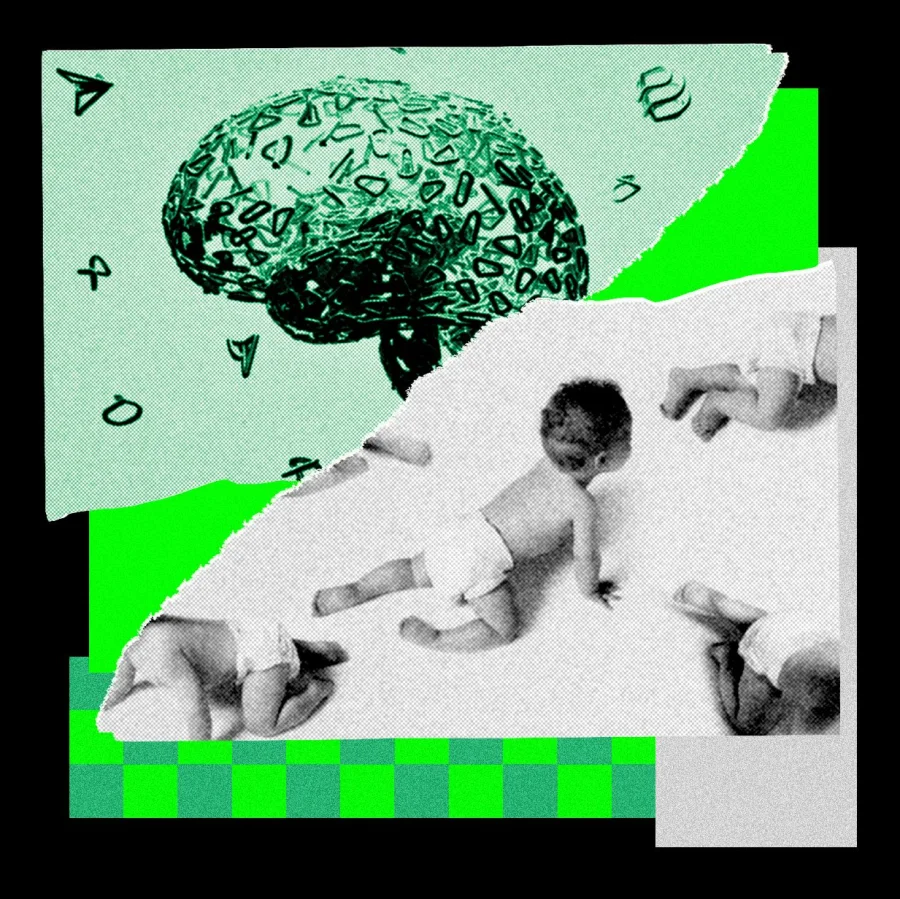
For all the hype around large language models and generative AI, there is one intelligence benchmark they consistently fail: a human baby. Infants—with no training data, no GPUs, and no fine-tuning—learn language, object permanence, social cues, and cause-and-effect relationships faster and more efficiently than any machine ever built. And that is precisely why scientists are now looking at the architecture of their little brains for the next breakthrough in artificial intelligence.
Why Babies Outperform AI—With Almost No Data
A baby learns the word “dog” after hearing it a handful of times, often in noisy, imperfect conditions. An AI model needs millions of labeled examples to achieve similar recognition—and still fails when context shifts. This efficiency gap is not trivial. It points to a fundamental difference in how biological brains and artificial neural networks process information.
Babies are born with built-in inductive biases—hardwired expectations about how the world works. They expect objects to be solid, gravity to pull things down, and faces to be important. AI systems start from a blank slate and must learn everything from scratch, which is both data-hungry and brittle.
The Infant Brain Architecture That Could Change AI
Researchers are studying how infant brains use sparse, noisy, and limited sensory input to build robust models of the world. Key features include: predictive coding (the brain constantly predicts what will happen next and updates only when wrong), sparse representations (using few neurons for each concept), and sleep-based consolidation (where the brain reorganizes learning during rest).
These mechanisms allow babies to generalize from a handful of examples—something AI still struggles with. If engineers can replicate even a fraction of this architecture, AI systems could become far more efficient, adaptable, and human-like.
Where AI Falls Short: The Baby Test
Consider a simple experiment: show a baby a ball that disappears behind a screen, then reveal a different ball. The baby shows surprise—because it expected the same object. This understanding of object permanence and identity is automatic for humans. For AI, it is a hard problem that requires explicit programming or massive training.
Similarly, babies learn language through social interaction, joint attention, and physical context. AI learns from text corpora—stripped of emotion, embodiment, and real-world feedback. The result is fluency without understanding.
What This Means for the Future of AI
The implication is not that AI is useless—it is already transformative in narrow domains. But the path to general intelligence may not lie in scaling up models or adding more data. It may lie in understanding how a one-year-old brain, weighing just one kilogram and running on 20 watts, outperforms a data center.
For parents, educators, and technologists, this is a humbling reminder: human cognition remains the gold standard. And for AI researchers, the most exciting frontier may not be in code—but in the crib.
Confirmed Facts vs What Remains Unclear
Confirmed: Babies learn language and causal reasoning with far fewer examples than current AI systems. Infant brains use predictive coding and sparse representations. AI models require massive data sets and still lack robust generalization.
Unclear: Whether specific infant brain mechanisms can be directly translated into AI architecture. The timeline for any such breakthrough is unknown. No major AI company has publicly adopted this approach as a core strategy.
Risks and Balanced View
Critics argue that biological inspiration has been tried before—neural networks themselves were inspired by the brain—and progress has been incremental. There is also a risk of oversimplifying infant cognition. Babies are not just small learning machines; they are embedded in social, emotional, and physical environments that are hard to replicate.
Others caution that even if we understand how babies learn, building a system that mimics that process may require breakthroughs in hardware, energy efficiency, and embodiment that are decades away.
Wider Trend: The Return to Cognitive Science in AI
This research is part of a broader shift. After years of focusing on scale—bigger models, more data, more compute—some AI labs are returning to cognitive science and developmental psychology. The idea is that intelligence is not just a pattern-matching problem; it is an embodied, interactive, and developmental process.
Companies like DeepMind have already hired developmental psychologists. The field of “developmental AI” is growing, and the baby brain is its most powerful inspiration.
Practical Reader Guidance
For parents: the way your baby learns—through play, interaction, and exploration—is a model of efficient intelligence. Screen time does not replicate this. For students and researchers: consider interdisciplinary work combining neuroscience, psychology, and computer science. For investors: watch for startups focusing on brain-inspired architectures rather than just scaling existing models.
Future Outlook
If researchers succeed in translating infant learning principles into AI, the impact could be profound: systems that learn from a handful of examples, adapt to new contexts without retraining, and operate on a fraction of the energy. But this is a long-term vision. In the near term, AI will continue to excel at narrow tasks while remaining far from the flexible, efficient intelligence of a baby.
Our Take
The comparison between AI and babies is not just a cute analogy—it is a serious scientific challenge. For all our technological progress, we have not yet built a machine that can learn as efficiently as a one-year-old. That should humble us and inspire us. The next leap in AI may not come from more data or bigger models, but from understanding the architecture of the most powerful learning machine we know: the human brain, starting from infancy.
Frequently Asked Questions
Is AI smarter than a baby?
No. AI can outperform humans in narrow tasks like chess or image recognition, but it cannot match a baby’s ability to learn language, understand cause and effect, or generalize from minimal examples.
How do babies learn faster than AI?
Babies use built-in biases (expectations about the world), predictive coding (constantly predicting and updating), and social interaction. AI systems start from scratch and need massive data sets to learn similar concepts.
Can AI ever learn like a baby?
Possibly, but it would require fundamental changes in AI architecture—moving from data-driven pattern matching to embodied, interactive, and developmentally inspired learning. This is an active area of research.
Why does this matter for the future of AI?
Because scaling up current models is hitting limits of cost, energy, and data. Learning from infant brains could lead to more efficient, adaptable, and general AI systems—closer to human-like intelligence.