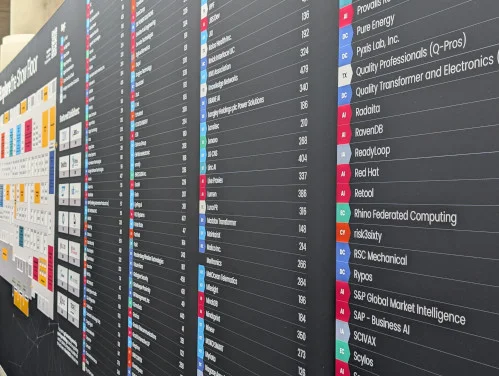
For all the talk of revolutionary algorithms and sentient machines, the real future of artificial intelligence may depend on something far less glamorous: a stable power grid, a secure data center, and a network that doesn't buckle under pressure. That was the sobering, essential message from the first day of TechEx North America, where the conversation shifted from what AI can do to what it needs to survive in the real world.
While visitors to the show in San Jose were eager to see the cutting edge front and centre, the nuance and detail brought by speakers and exhibitors revealed a deeper truth. The biggest hurdles for enterprise AI aren't in the code—they're in the concrete, the cables, and the cooling systems.
The Unseen Foundation: Why Power and Infrastructure Are AI's Biggest Bottlenecks
Across the different tracks of Edge Computing, IoT, Data Centre Congress, and Cyber Security, a single question echoed through the halls: What needs to be built around AI before it can take its place in the physical, business-oriented world? The answer, according to experts, is a massive, often overlooked layer of infrastructure.
The Edge Computing track, with its roots in traditional industries like manufacturing and logistics, focused on the practical realities of deployment. Latency, the tiny delay that can cripple a real-time AI application, was a central theme. Speakers emphasized that for industrial IoT (IIoT) and IT amalgams, the discipline of deployment is just as critical as the algorithm itself. You can't run a factory-floor AI on a cloud server hundreds of miles away; the data needs to be processed at the edge, close to the action.
Why This Matters Right Now
This isn't an abstract academic debate. For any enterprise considering AI adoption—whether for predictive maintenance, autonomous logistics, or customer-facing chatbots—the infrastructure question is a financial and operational time bomb. A company that invests millions in AI software without securing the power and network capacity to run it is building a house on sand. The cost of failure isn't just a slow algorithm; it's a factory shutdown, a security breach, or a lost customer. The stakes are that high.
How the Conversation Unfolded at TechEx North America
The first day of the event positioned edge computing not just as a technology, but as a strategic reassessment. Companies are being forced to re-evaluate their entire data architecture. The old model of sending everything to a central cloud is collapsing under the weight of AI's data demands. The new model is distributed, localized, and intensely focused on security.
This shift is driving a surge in demand for specialized data centers, micro data centers at the edge, and new cooling technologies to handle the immense heat generated by AI processors. The conversation at TechEx made it clear: the data center is no longer just a utility; it's a strategic asset.
Who Is Affected and What Officials Are Saying
The impact is being felt across every sector. For IT managers, it means a complete rethinking of network architecture. For CFOs, it means massive capital expenditure on power and cooling. For CEOs, it means a new risk profile where a power outage can halt AI operations. The cybersecurity track at TechEx was particularly stark, warning that the convergence of IT and OT (operational technology) creates a vast new attack surface. A compromised edge device isn't just a data leak; it can be a physical safety hazard.
What We Know So Far — and What Remains Unclear
What we know: AI deployment is fundamentally constrained by power availability, network latency, and cybersecurity vulnerabilities. The edge computing model is the most viable path forward for many industrial applications. The cost of building this infrastructure is significant and will be a major barrier to entry.
What remains unclear: The long-term sustainability of the energy demands of large-scale AI. The full scope of security threats in a hyper-connected, AI-driven environment. And the economic model for sharing infrastructure costs across multiple enterprise tenants.
Risks, Concerns, and the Balanced View
The optimism at TechEx was tempered by a clear-eyed view of the risks. The biggest concern is the "infrastructure gap"—the lag between AI software development and the physical capacity to run it. This gap creates a two-tier system where only the largest, most well-funded companies can truly deploy AI at scale.
There is also a growing unease about the concentration of AI infrastructure in the hands of a few cloud providers, creating a single point of failure for the entire ecosystem. The cybersecurity risks are not hypothetical; the more devices connected to an AI network, the more potential entry points for an attacker. The balanced view is that while the potential of AI is immense, the path to realizing it is paved with hard, unglamorous work.
Why Similar Trends and Concerns Are Growing
This focus on infrastructure is not unique to TechEx. Across the tech industry, from hyperscale data center builders to chip manufacturers, the conversation is shifting from performance to power. The rise of generative AI has created an insatiable demand for compute, and the industry is scrambling to build the physical plant to support it. The trend is clear: AI is becoming an industrial-scale operation, with all the challenges that entails.
- Data center power consumption is projected to double by 2030, driven primarily by AI workloads.
- The average latency requirement for industrial AI applications is under 10 milliseconds, forcing a move to edge computing.
- Cybersecurity incidents targeting industrial IoT devices have increased by over 200% in the last two years.
"AI is a matter of power, infrastructure and security." — Keynote speaker at TechEx North America
What Readers, Users, and Investors Should Know Now
For enterprise decision-makers, the takeaway is clear: start planning your AI infrastructure today. Don't wait for the perfect algorithm. Audit your power capacity, assess your network latency, and harden your cybersecurity posture. The companies that will win in the AI era are not necessarily the ones with the best models, but the ones with the most resilient foundations. For investors, the opportunity is shifting from AI software to AI infrastructure—data centers, cooling technology, edge computing hardware, and cybersecurity solutions.
What Could Happen Next
Expect to see a wave of investment in modular, scalable data centers designed for edge deployment. The competition for power will intensify, with tech companies striking direct deals with energy providers. The cybersecurity industry will develop new, AI-specific threat detection and response tools. The gap between AI haves and have-nots will widen, potentially leading to new regulatory discussions about access to AI infrastructure.
Our Take: Why This Story Matters Beyond One Event
TechEx North America served as a reality check for an industry often lost in hype. The message from San Jose was that AI is not a magic wand; it's a heavy machine that needs a solid floor, a steady power supply, and a locked door. The companies that understand this will build the future. The ones that don't will be left with a lot of expensive, useless code. This story matters because it reframes the AI conversation from one of pure possibility to one of practical, urgent responsibility.
FAQs
What are the biggest infrastructure challenges for deploying AI in enterprises?
The biggest challenges are power availability, network latency, and cybersecurity. AI workloads require immense amounts of electricity and generate significant heat, demanding robust cooling. Real-time AI applications need data processing close to the source (edge computing) to avoid delays, and the convergence of IT and operational technology creates new security vulnerabilities.
Why is edge computing so important for AI?
Edge computing is critical because it reduces latency. For applications like autonomous vehicles, factory automation, or real-time fraud detection, sending data to a central cloud and back is too slow. Processing data at the "edge"—closer to where it's generated—enables the speed and reliability that many AI applications require.
How is the cybersecurity landscape changing with AI deployment?
AI deployment dramatically expands the attack surface. Every connected sensor, camera, and edge device becomes a potential entry point for hackers. The convergence of IT (information technology) and OT (operational technology) means a cyberattack can now have physical consequences, such as shutting down a power grid or a factory line. AI-specific security tools are becoming essential.
What should a company do first if it wants to adopt AI?
Before buying any AI software, a company should conduct a thorough audit of its existing infrastructure. This includes assessing power capacity, network bandwidth and latency, and cybersecurity readiness. The most successful AI deployments start with a solid foundation, not a flashy algorithm. Planning for infrastructure should be the first step, not an afterthought.