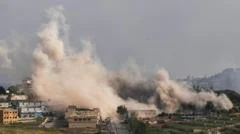
Dozens of people have been killed across Lebanon as Israel launched one of its most intense waves of airstrikes in recent memory. The strikes, which Israel says targeted 100 Hezbollah infrastructure sites and fighters, come just hours after Prime Minister Benjamin Netanyahu vowed to "crush" the Iran-backed group. For families in southern Lebanon and beyond, the skies have turned into a source of terror — and the ground, a place of mourning.
Israel Strikes 100 Hezbollah Targets in Major Escalation
Israel's military confirmed it carried out widespread airstrikes across Lebanon, hitting what it described as Hezbollah command centers, weapons storage sites, and rocket launchers. The operation marks a significant escalation in the long-running conflict between Israel and the Iran-backed militant group. According to Israeli officials, the strikes were preemptive and aimed at degrading Hezbollah's ability to launch attacks against Israeli territory.
Lebanon's health ministry, however, reported a devastating human toll. The strikes killed at least 356 people, including 24 children and 42 women, and wounded more than 1,246 others, according to preliminary figures. The numbers are staggering for a single day of violence, and they have sparked international concern over the rising civilian death toll.
Why This Matters Right Now
This is not just another skirmish. This is the deadliest single day of Israeli strikes in Lebanon in years, and it threatens to pull the region into a wider war. For ordinary Lebanese families, the airstrikes mean shattered homes, lost loved ones, and a future filled with uncertainty. For the international community, the escalation raises fears of a full-blown conflict between Israel and Hezbollah — one that could draw in Iran, Syria, and other regional powers.
The timing is also critical. Netanyahu's vow to "crush" Hezbollah signals a shift in Israeli strategy — from containment to destruction. That change in posture could have consequences far beyond Lebanon's borders.
How the Escalation Unfolded
The latest wave of violence did not happen in isolation. Tensions between Israel and Hezbollah have been simmering for months, with cross-border exchanges of fire becoming increasingly frequent. In recent weeks, Hezbollah launched several rocket attacks on northern Israel, prompting Israeli warnings of a severe response.
On the morning of the strikes, Israeli warplanes began hitting targets across southern Lebanon, the Bekaa Valley, and areas near Beirut. The strikes continued throughout the day, with the Israeli military issuing evacuation warnings for some areas. Hezbollah responded by firing rockets into northern Israel, though the scale of the retaliation was limited compared to the Israeli bombardment.
By evening, Lebanon's health ministry was counting the dead — and the world was watching a crisis unfold in real time.
Who Is Affected and What Officials Are Saying
The human impact of the strikes is devastating. Entire families have been wiped out in villages across southern Lebanon. Hospitals are overwhelmed with wounded civilians, many of them women and children. The Lebanese government has called for an emergency meeting of the United Nations Security Council, accusing Israel of committing "war crimes."
Israeli officials, meanwhile, defend the strikes as necessary self-defense. "We will not allow Hezbollah to threaten our citizens," a military spokesperson said. "Every target we hit was a legitimate military objective." But the high civilian death toll has drawn sharp criticism from human rights groups, who say Israel must do more to avoid civilian casualties.
Netanyahu himself struck a defiant tone. "We will crush Hezbollah," he said in a televised address. "We will restore security to the north, and we will not stop until the mission is complete."
What We Know So Far — and What Remains Unclear
What we know: Israel struck 100 Hezbollah targets across Lebanon. Lebanon's health ministry reports 356 dead, including 24 children and 42 women. Netanyahu has vowed to continue operations until Hezbollah is "crushed." Hezbollah has retaliated with rocket fire into northern Israel.
What remains unclear: The full extent of Hezbollah's military losses. Whether Israel will launch ground operations. How Hezbollah will respond in the coming days. The exact number of fighters versus civilians among the dead. The international community's next steps — including potential diplomatic intervention.
Risks, Concerns, and the Balanced View
The risks of this escalation are enormous. For Israel, the danger is getting drawn into a prolonged conflict that could drain military resources and lead to higher casualties. For Lebanon, the risk is complete devastation — the country is already reeling from an economic collapse, and a full-scale war could push it over the edge.
For Hezbollah, the challenge is maintaining credibility. The group has long positioned itself as Lebanon's defender against Israel. If it fails to respond forcefully, it could lose support among its base. But a massive retaliation could trigger an even more devastating Israeli response.
There is also the risk of regional spillover. Iran, Hezbollah's main backer, has warned that it will not stand idly by if the group is threatened. That could draw in other proxies across the Middle East, including in Syria, Iraq, and Yemen.
Critics of Israel's strategy argue that the heavy civilian toll will only fuel resentment and recruitment for Hezbollah. "Every dead child is a new recruit for the next generation," one analyst noted. Supporters of Israel's actions say the strikes are necessary to prevent a larger war later.
Why Similar Conflicts Are Growing More Dangerous
The Israel-Hezbollah conflict is part of a broader pattern of escalating violence across the Middle East. From Gaza to Yemen to Syria, proxy wars and direct confrontations are becoming more frequent and more deadly. The rise of precision-guided munitions and drone warfare has made it easier for states to strike deep into enemy territory — but it has also made it harder to avoid civilian casualties.
In Lebanon, the situation is particularly volatile because Hezbollah is deeply embedded in civilian areas. The group's infrastructure — command centers, weapons depots, rocket launchers — is often located in or near residential neighborhoods. That makes it nearly impossible for Israel to strike military targets without causing civilian harm.
- Hezbollah's military wing is considered more powerful than the Lebanese army
- The group has an estimated 150,000 rockets and missiles aimed at Israel
- Previous conflicts in 2006 and 2021 caused massive destruction in Lebanon
- Iran provides Hezbollah with funding, weapons, and training
"Every strike that kills civilians is a strategic victory for Hezbollah, because it turns the world against Israel." — Middle East security analyst
What Readers, Users, or Investors Should Know Now
For those following the conflict, the key things to watch are: Hezbollah's next move, Israel's decision on ground operations, and international diplomatic efforts. The situation remains highly fluid, and any single event — a major Hezbollah rocket attack, an Israeli ground incursion, or a diplomatic breakthrough — could change the trajectory overnight.
For travelers, the region is extremely dangerous. Multiple airlines have suspended flights to Beirut and Tel Aviv. Foreign governments are urging their citizens to leave Lebanon immediately. For investors, the conflict adds another layer of uncertainty to an already volatile region, with oil prices and defense stocks likely to see movement.
What Could Happen Next
The most likely scenario in the short term is continued escalation. Israel has signaled it will not stop until Hezbollah's military capabilities are significantly degraded. Hezbollah, for its part, will likely try to launch more rockets into Israel to demonstrate that it can still strike back.
In the medium term, the conflict could take several paths. A diplomatic intervention — possibly led by the United States, France, or the United Nations — could broker a ceasefire. Alternatively, the violence could spiral into a full-scale war, with Israel launching ground operations in southern Lebanon.
The wildcard is Iran. If Tehran decides to directly intervene, the conflict could expand dramatically. For now, Iran appears to be watching from the sidelines, but that could change quickly.
Our Take: Why This Story Matters Beyond One Incident
This is not just another chapter in the Israel-Hezbollah conflict. It is a potential turning point. Netanyahu's vow to "crush" Hezbollah represents a fundamental shift in Israeli strategy — from deterrence to destruction. If Israel follows through, the consequences for Lebanon, for the region, and for global stability could be profound.
The civilian death toll is a tragedy that should not be overlooked. Behind every number is a family destroyed, a child lost, a future stolen. As the world watches, the question is whether diplomacy can catch up before the violence spirals further out of control.
FAQs
Why is Israel striking Lebanon now?
Israel says the strikes are a response to ongoing Hezbollah rocket attacks on northern Israel. Prime Minister Netanyahu has vowed to "crush" Hezbollah and restore security to Israeli border communities.
How many people have been killed in the Lebanon strikes?
Lebanon's health ministry reports at least 356 people killed, including 24 children and 42 women. More than 1,246 people have been wounded. The death toll is expected to rise as rescue operations continue.
What is Hezbollah's role in this conflict?
Hezbollah is an Iran-backed militant group based in Lebanon. It has been fighting Israel for decades and is considered one of the most powerful non-state military forces in the world. Israel views Hezbollah as an existential threat due to its large rocket arsenal.
Could this conflict spread to other countries?
Yes. Iran, Hezbollah's main backer, has warned it could intervene. Other Iranian proxies in Syria, Iraq, and Yemen could also get involved. The United States has sent additional naval assets to the region as a deterrent.