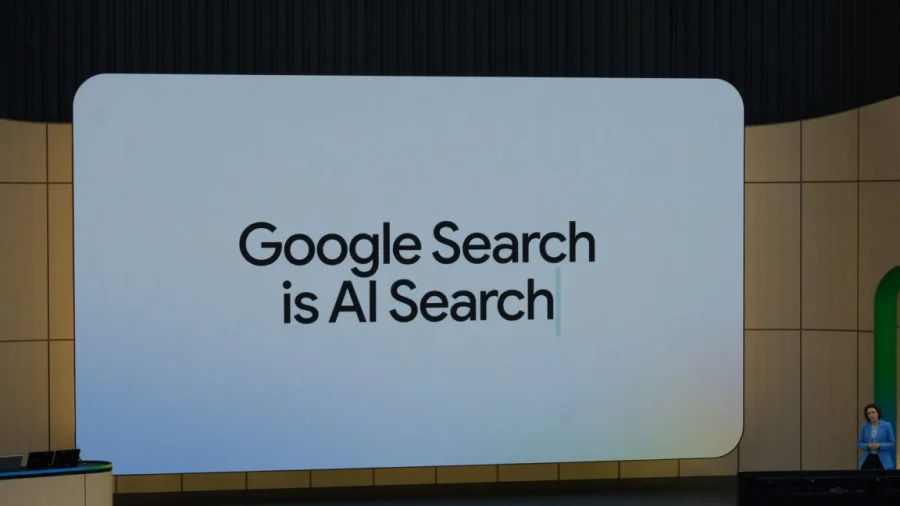
For over two decades, Google Search has worked the same way: you type a query, and it returns a list of blue links. That era is ending. At Google I/O 2026, the company made it official. Search is no longer just about finding information. It's about getting things done — autonomously, intelligently, and without you needing to click a single link.
Google's VP of Search, Liz Reid, stood on stage and delivered a line that should make every publisher, competitor, and user sit up: "Google search is AI search." It wasn't a suggestion. It was a declaration. And the data backs it up. AI Mode usage has doubled since its introduction just over a year ago. The company is all in.
What Google's Agentic AI Search Actually Means
This isn't just a smarter search bar. Agentic AI means Google's search engine can now perform multi-step tasks on your behalf. Instead of searching for "best Italian restaurant in Mumbai" and then separately searching for "how to book a table," the new Google can do both — and book the reservation. It can compare flights, check your calendar, and purchase a ticket. It can research a topic, compile a report, and email it to you.
The shift from "search as a tool" to "search as an agent" is the most fundamental change in the product's history. Google is no longer just a gateway to the web. It is becoming an active participant in your digital life.
Why This Matters Right Now
This matters because Google is not a small experiment. It processes over 8.5 billion searches per day. Any change to its core product ripples across the entire internet. For users, it means faster, more convenient results — but also less control. For businesses, it means your website might no longer be the destination. For publishers, it means traffic from search could drop dramatically if Google's AI answers your questions without sending anyone to your site.
The emotional weight here is real. People are worried about losing the open web. They are worried about Google becoming a walled garden. And they are worried about what happens when an AI makes decisions on their behalf — like booking the wrong flight or misunderstanding a complex request.
How the Shift to Agentic AI Unfolded
Google started testing AI Mode for search just over a year ago, in early 2025. At the time, it was seen as a cautious step into the world of generative AI search. But the reception was stronger than expected. At I/O 2026, Reid revealed that AI Mode usage had doubled, and the company decided to accelerate the transition.
The timeline is aggressive. By the end of 2026, Google plans to roll out agentic capabilities to a significant portion of its user base. The company is betting that the convenience of an AI that acts for you will outweigh any concerns about privacy, accuracy, or the death of the traditional search result page.
Who Is Affected and What Google Is Saying
Every Google user is affected, but the impact is uneven. Power users who rely on search for research will see the biggest change. Small businesses that depend on organic traffic are bracing for impact. Publishers are watching their referral traffic with anxiety.
Google's message is clear: this is the future, and it is inevitable. "All the metrics that matter to Google say this is the right move," the company has stated. The objections — from privacy advocates, competitors, and users — are noted but will not change the course. Google is simply too big and too influential to be swayed by criticism.
What We Know So Far — and What Remains Unclear
What we know: Google is committed to agentic AI search. AI Mode usage is growing. The company has the resources and infrastructure to make this happen. The shift is already underway.
What remains unclear: How will this affect ad revenue? Will users trust an AI to make purchases on their behalf? How will Google handle errors when an agentic AI makes a mistake? And most importantly, what happens to the open web when Google no longer sends traffic to external sites?
Risks, Concerns, and the Balanced View
The risks are significant. Agentic AI introduces new failure modes. An AI that books a wrong flight or sends an incorrect email could erode trust quickly. Privacy concerns are amplified when an AI has access to your calendar, email, and payment information. There is also the risk of monopolistic behavior — Google controlling not just the search results but the actions that follow.
On the other hand, the potential is enormous. For users with disabilities, agentic AI could be transformative. For busy professionals, it could save hours of manual work. For people in regions with limited internet access, a single AI that can do everything could be a lifeline.
The balanced view is this: agentic AI search is coming. It will bring real benefits. But it also demands careful regulation, transparency, and user control. Google has not yet fully addressed these concerns.
Why Similar Trends Are Growing Across the Industry
Google is not alone. Microsoft's Bing has been integrating AI agents. Perplexity AI is building its own agentic search. Startups like Adept are focused entirely on AI agents. The entire industry is moving in the same direction. The question is not whether agentic AI will happen, but who will do it best — and who will be left behind.
- Microsoft has integrated AI agents into Bing and Copilot, allowing users to automate tasks.
- Perplexity AI is testing agentic features that can book travel and make purchases.
- Startups like Adept are building standalone AI agents that can control web browsers.
"Google can get whatever outcome it wants because it's just that big and influential." — Ars Technica analysis
What Readers, Users, and Investors Should Know Now
For users: Start exploring AI Mode now. Understand what it can and cannot do. Be cautious about granting permissions to an AI agent. Always double-check critical actions like purchases or bookings.
For businesses: Diversify your traffic sources. Do not rely solely on Google for visitors. Invest in direct relationships with your audience through email, social media, and other channels.
For investors: Watch Google's ad revenue closely. If agentic AI reduces clicks, ad prices could change. But if Google successfully monetizes actions instead of clicks, the revenue potential could be even larger.
What Could Happen Next
By the end of 2026, expect agentic AI to be a standard feature in Google Search. By 2027, it could be the default. The traditional "10 blue links" will become a legacy feature, accessible only through a toggle. The web as we know it will continue to evolve, and Google will be at the center of that transformation.
The biggest unknown is regulation. Governments are already scrutinizing AI. If agentic AI leads to high-profile errors or privacy breaches, regulators could step in. But for now, Google is moving full speed ahead.
Our Take: Why This Story Matters Beyond One Announcement
This is not just a product update. It is a fundamental shift in how humans interact with information. For 25 years, search has been a passive tool. Now it is becoming an active agent. The implications for privacy, trust, and the open web are profound. Google is betting that convenience will win. History suggests it might be right. But the cost — in terms of user autonomy and web diversity — could be higher than many realize.
FAQs
What is Google agentic AI search?
Google agentic AI search is a new version of Google Search that can perform multi-step tasks on your behalf, such as booking flights, making reservations, or compiling research reports, without requiring you to visit multiple websites.
How is Google's AI search different from regular search?
Regular search returns a list of links. AI search, especially agentic AI, can understand complex requests, take actions, and complete tasks autonomously. It moves from "showing information" to "doing things."
Will Google agentic AI search replace traditional search results?
Not immediately, but the trend is clear. Google is investing heavily in agentic AI, and traditional "10 blue links" may become less prominent over time. Users will likely have the option to switch between modes.
Is Google agentic AI search safe to use?
Google has implemented safety measures, but risks remain. Users should be cautious about granting permissions for financial transactions or sensitive data. Always verify critical actions taken by an AI agent.